
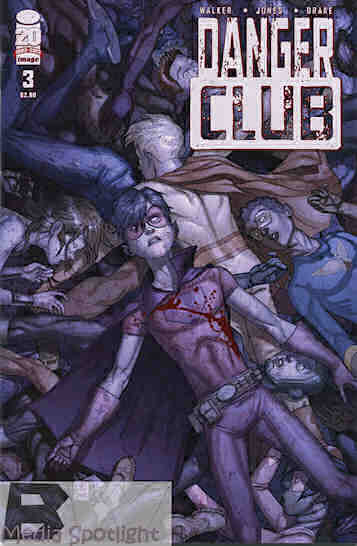
Man, that was one heck of a party last night!
Danger Club #3
Image Comics (July, 2012)
WRITER: Landry Q. Walker ARTIST: Eric Jones COLORISTS: Michael “Rusty” Drake with Garry Black & Vegasday FLATS: Pannel Vaughn LETTERER/LOGOS: Jimmy Bentacourt PRODUCER: Javier Jose Diaz EDITOR: Branwyn Bigglestone
Moonlight (who I think I misnamed as Kid Vigilante last issue) brings his data to the President, and learns the shocking truth about what happened to the heroes. Meanwhile Kid Vigilante and The Magician leave Apollo at his temple while the other Danger Club members investigate an old villain HQ only to find a leftover trap!
What they got right: The mystery takes an interesting turn that keeps me interested in where it’s going. We also get the full effect of just how this is affecting the sidekicks.
What they got wrong: However, I still want to know more about these characters. They’re still not all that memorable, so when Gravity Girl flips out at the end I find it hard to care as much as I should. Maybe a miniseries or story arc that shows these characters before the incident and gives us a chance to connect with them would be a huge benefit to connecting to later stories.
Recommendation: As a purely event-driven story it isn’t bad and is at least worth checking out. I just want to care more about the heroes.
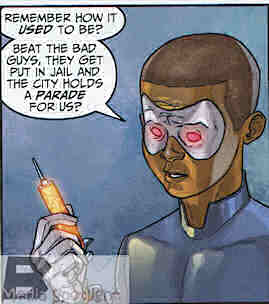
I miss those days too, Ivan.



 BW Media Spotlight
You know, I’ve seen the “why should I care” comments a few other places and it confuses me. But since we know each other and those people are strangers, I’ll ask you about it.
One: It’s only issue 3. The details of the characters are meant to unfold over the course of the story. That’s part of the story, learning who they are. In issue 1 all we knew about Kid Vigilante was that he wanted to kick Apollo’s ass. In issue 2 we learn that he has a brother that is basically brain dead and were see a more vulnerable side. We learn about who he is and where he comes from. We see him reach out from his pain to his arch-nemesis. That was issue 2. I think it stands to reason that as we progress, more and more details will unfold.
We also learn that Yoshimi’s comes from a place called Micro-Tokyo. That her relative created the giant robot defenders. That a new type of robot has since been created. That Yoshimi is forbidden by her culture to be a pilot (that she is of the lesser cast of “engineer”) and that she could care less about such rules.
People seem to want a total information dump. I’m never going to give them that in this book. While I think it can work (there are no bad methods), it’s generally a path that amounts to: Here’s the story. Now read the story. This is an unfortunate trend in comics. As it’s executed, it’s typically a cheat and a lazy form of writing. I want do things differently.
As for the rest (such as Gravity Girl and Moonlight): Why should you care about them? Well aside from the fact that this is a story about how children maintain (or don’t) in a world where there structure is gone (see inside front of issue 1), how they cope when their families are lost to them and they are obviously suffering – no particular reason. And while I think that the previous examples should be enough, it’s not really relevant. The story isn’t about them, their role is to represent two different paths that lost children might take.
But let’s look at the first page. Gravity Girl and Moonlight are shown to be happy, part of a group. Gravity Girl has obviously chosen to stay with that group while Moonlight has sought out an authority figure to “tattle” on his former friends. Gravity Girl (Cindy) is seen to be be unsure of herself and in pain over the loss of her mother. She’s a twelve year old girl who has had everything wonderful about her life ripped away and then effectively been tortured with her own inner pain. And she can’t take anymore. Moonlight finds himself seeking someone to take care of him and protect him and instead something clearly horrible happens to him
My question is: Why isn’t that enough to make you (or others) care? Do you need to know her last name is Grant? That she was raised by a single mother or that she was notorious for screwing up and making bad situations worse. It’s still only issue 3, so you would still learn some of these things. But do you need to know it going in to care?
Now, I admit, we know very little about Ivan (The Magician). That will come next issue. We will get deeper into who Jack is in #5 and so on…
I was recently flipping through a team books for one of the big two publishers. Two pages were spent on telling us who each character was. It was a dreary and boring information dump and at the end of it, there was nothing left for me to learn. I threw the book in the trash. I’m not sure why people want to read that. This is a story. We will get there. I could tell you everything about everyone in one paragraph. But why? Do you really want that?
LikeLike
Don’t get me wrong. I wasn’t totally numb to Gravity Girl’s action, extreme as it was. If anything I’d like to see her in the “old days” and I might really like her as a character. I’m not asking for an info dump (at best a character profile so I don’t have to keep going to my old reviews to remember The Magician’s name, for example), but I’m watching strangers when everything has already fallen apart with no reference as to their lives before other than it used to not suck. I didn’t need to know Cindy’s last name, but the other stuff might have helped me connect to her better, to know who she was and WHY she had a harder time keeping sane than the other sidekicks. All we know is that she was a reserve member of the Danger Club pre-incident.
I’m following along OK, but there are things of this world that I don’t understand, like where Micro-Tokyo came from. For example, look at Yoshimi’s sequence in that issue or Kid Vigilante’s. We learned something about them in that issue, while still getting the action and the slowly unfolding mystery as to what actually happened to the adult heroes. Issue #2 is my favorite thus far and why Yoshimi’s my favorite character in the comic at this point. Having GG talk about why she couldn’t handle it (I think the backstory you mentioned could have fit in one or two panels rather than the half a book uncompressed stories of the big two these days) might have elicited more emotion from me. Not having read the other reviews or knowing the other reviewers I can only speak for myself.
In Moonlight’s case, we know all we need to for the story, although as noted above I had some trouble keeping him and Kid Vigilante straight. I just really want to see what they were like in the old days, before the heroes disappeared, to see what the kids once had and (except maybe Apollo) want to get back. How Ladybug sided with the Club, stuff like that.
I’m enjoying the comic, and find it easier to follow than say Kirby: Genesis, which also features characters I don’t know in an unfolding situation. But when I can’t remember the names of the main characters it’s harder to connect. That’s why I recommended the profiles or a flashback issue.
LikeLike
Well, I would disagree. What we know about Gravity Girl is that she was a reserve member of the Danger Club, AND that she was happy. As for what they were like before, it’s pretty much what we see on the retro pages. The idea is that those pages serve as a shortcut, that anyone familiar with the long history of superhero universe can fill in the gaps with. These characters have had their silver age and their bronze age. Now it’s the modern age.
Much of what you ask for we will get to (I certainly wouldn’t leave why Micro-Tokyo is completely untouched), but I’m shooting to unroll it all in a natural manner. While the backstory we’re discussing for Gravity Girl could have been done in two panels, the natural inclusion for it would take more with this style of storytelling. I’m purposefully avoiding unnatural expository wherever possible.
Additionally, look at this the way Supergirl unfolded. The first few issues should read differently on a second pass after you’ve finished the series.
We only have 8 issues. At the end of it there should be a complete understanding of who the characters are and why the world is what it is. That’s the goal anyway. We can only promise to try our best to cross every T and dot every I.
The person we learn most about this issue is Jack. Though it is certainly more subtle than what we learned of Yoshimi or Kid Vigilante in issue 2. Jack in this issue is arrogant and careless – and someone died. The idea is that small aspects like this will play into a larger story. But they can only do that if we build them up first.
LikeLike
By issue 8 everything may well be explained and I may end up being totally on board. Remember that I wasn’t as with Supergirl: Cosmic Adv. until issue #2 and it’s now my favorite miniseries. However, I can only judge what we currently have, and it may well be that by the end I would in fact look at the early issues differently. For all I know, it could end up like the Tron comic, and it’s only that I’ve come to trust your work (and I think we discussed what happened with that comic and SLG) that I know you can do better (Supergirl, Batman TB&TB), which makes for a more positive outlook on this title even if this is purposely darker than those last two titles. Since those issues aren’t here yet from a critical perspective I can only comment on what I currently know.
Frankly, everyone is in a lighter mood in the opening splash pages. I really want to read those adventures. Perhaps a prequel revisit in the future? I understand why they’re there and it’s nice to have but, and maybe it’s just my interests, I really want to see those adventures and really meet these characters to see how far they’ve fallen. Heck, that’s one of the reasons I find the Clone Wars cartoons interesting while others complain about knowing what happens to Anakin and finding it pointless. Also, I would say everything about Cosmic Adv/ reads differently once you know about Mxyzptlk’s involvement, and it’s still a blast to read. 😀
To bring up Kirby: Genesis again, there is nobody aside from the character Kirby that I have any connection to at all, and even Kirby’s is a bit tenuous, based on my basic knowledge of Jack Kirby’s talent as well as that of Kurt Busiek, who like you is one of my favorite writers. Yet, he’s not as interesting as Kid Vigilante, even in issue #1 as he outwits Apollo to take him down and shows basic leadership skills in trying to bring the former sidekicks together. In the opener to issue 2, KV gets shot in the head by Fearless (it’s the opening page, so that doesn’t feel like a spoiler) and I felt confusion, yet interest because I kind of liked both characters. I saw them in action and had a feel for them. All I saw of Gravity Girl was her standing with her friends and then freaking out with no more context than anyone else. I felt sorry for her, but not as much as I wanted to. Perhaps this changes later on, or we see how the rest of the Club responds to what happened. Again, I can only judge what I’ve already seen versus your work in general.
Besides, you don’t exactly make it easy for me to post a “got wrong” with your stories. So when something like this stands out I’m drawn to comment.
LikeLike
Funny thing: When we created the idea of the retro page, I knew those would be the comics that you (and a few others) would want to read. I’d like to write them and Eric would like to draw them. But if we did, I’m not sure we could sell them. People seem to mainly respond to gratuitous violence – hence some scenes in this book.
Really, it’s meant as a bit of a commentary on such things. And not in a way that reflects kindly on modern comics violence.
You also point to something that is a bit of a problem with the current system of reviews. There are people out there that would love Cosmic Adventures, but saw a review of issue 1 that failed to understand the full story and was therefore negative, and so they never checked it out. It’s akin to reviewing films in fifteen minutes intervals.
There is something for the single issue format. One which the work Eric and I did on Brave and the bold should show our love for. I’m looking forward to an inevitable future project that fits that model. That’s something that can be reviewed as it comes out. Books like Danger Club… not so much.
LikeLike
I don’t know if it’s a problem exactly, or at least it’s a necessarily inherent one. Look at my Chapter by Chapter series, going over one chapter at a time (or at least that was the plan and hopefully will be next book), or reviews that go over a show episode by episode. Sometimes you have to judge by what you see now and decide if you’re going to keep reading or watching, even if it’s a continuing miniseries with a set ending. (Or something like Lost that took it’s name too seriously and got pretty much everyone lost, including the fans.) Anime is kind of like that, too, usually. It’s a gamble but the good stories end up worth the payoff, although this may be why trade waiting has become so popular.
LikeLike