
Chapter By Chapter (usually) features me reading one chapter of the selected book at a time and reviewing it as if I were reviewing an episode of a TV show or an issue of a comic. There will be spoilers if you haven’t read to the point I have, and if you’ve read further I ask that you don’t spoil anything further into the book. Think of it as a read-along book club.
By Charles Dickens
In the previous chapter we were introduced to Ebenezer Scrooge, Bob Cratchit, Fred the nephew, and Jacob Marley, after being reminded a lot that Marley was dead even before we saw his ghost. It’s as if Dickens was expecting a Scooby-Doo plot twist: “It really was Marley. He’s been alive this whole time and plotting for seven years to scare Scrooge out of his estate.” “I would have gotten away with it, too, if it hadn’t been for you meddling spirits!”
I looked up “stave” to see if it was a stand-in for the word chapter, but it actually means something closer to a line of verse. It’s not written like a poem, and certainly not intended to be sung, so it’s an odd choice to me. Still, that’s what we’re going by.
Tonight, Ebenezer will be visited by the Ghost Of Christmas Past, as in his past. He won’t be going back to the birth of Jesus, though I’m sure every time traveller has been there more times than the grassy knoll. How they kept from being spotted when the Bible only points to Joseph, Mary, and Jesus (the Three Kings actually went to their house because Herod was after the babe, one of many to misunderstand what He is King Of) is a question for another time. Grab your coats, we’re going on a field trip!
Stave 2: The First Of The Three Spirits
The titles are interesting in hindsight. By now we know all three Spirits and what their deal are: Past, Present, and Yet To Come (aka future), but as the book is written there is no hint of that. The staves are “The (X) Of Three Spirits” and even Marley didn’t mention what the Spirits represented, just that there will be three of them over three nights…except we all know they did it in one night. Space is warped and time is bendable, I guess.
To confirm that bit of MST3K dialog, the clock strikes twelve, which is odd because that’s when Ebenezer went to sleep, and he can find nothing wrong with the clock beyond the fact that it stopped. He tries to look out the window and we get this paragraph.
The idea being an alarming one, he scrambled out of bed, and groped his way to the window. He was obliged to rub the frost off with the sleeve of his dressing-gown before he could see anything; and could see very little then. All he could make out was, that it was still very foggy and extremely cold, and that there was no noise of people running to and fro, and making a great stir, as there unquestionably would have been if night had beaten off bright day, and taken possession of the world. This was a great relief, because “three days after sight of this First of Exchange pay to Mr. Ebenezer Scrooge or his order,” and so forth, would have become a mere United States’ security if there were no days to count by.
I’m not sure how to read that paragraph. Product of its time, maybe, but its the structure I’m confused by more than referencing United States’ security and how it connects to days. So he listens to the clock because he can’t get to sleep until it reaches one, with a “deep, dull, hollow, melancholy One”, and then the curtains are drawn open by our first Spirit, standing as close to Ebenezer as the narrator is to the reader, spiritually (no pun intended) the elbow. I’m not sure why Dickens writes it that way. Just say the Victorian version of “the Spirit was all up in Scrooge’s face”.
It was a strange figure—like a child: yet not so like a child as like an old man, viewed through some supernatural medium, which gave him the appearance of having receded from the view, and being diminished to a child’s proportions. Its hair, which hung about its neck and down its back, was white as if with age; and yet the face had not a wrinkle in it, and the tenderest bloom was on the skin. The arms were very long and muscular; the hands the same, as if its hold were of uncommon strength. Its legs and feet, most delicately formed, were, like those upper members, bare. It wore a tunic of the purest white; and round its waist was bound a lustrous belt, the sheen of which was beautiful. It held a branch of fresh green holly in its hand; and, in singular contradiction of that wintry emblem, had its dress trimmed with summer flowers. But the strangest thing about it was, that from the crown of its head there sprung a bright clear jet of light, by which all this was visible; and which was doubtless the occasion of its using, in its duller moments, a great extinguisher for a cap, which it now held under its arm.
Even this, though, when Scrooge looked at it with increasing steadiness, was not its strangest quality. For as its belt sparkled and glittered now in one part and now in another, and what was light one instant, at another time was dark, so the figure itself fluctuated in its distinctness: being now a thing with one arm, now with one leg, now with twenty legs, now a pair of legs without a head, now a head without a body: of which dissolving parts, no outline would be visible in the dense gloom wherein they melted away. And in the very wonder of this, it would be itself again; distinct and clear as ever.
In every depiction I’ve never seen the closest I’ve noted to this is I think the Chuck Jones version. Otherwise, the more common depiction is an androgynous being (not classic David Bowie, just not really visually recognizable as male or female, but with a voice that has parts of both, as a man trying to voice Bea Arthur or a woman trying to voice Wil Wheaton) in a nightgown with for some reason a candle on its head, or alternately more feminine than male performers vocally. The animated version I’m thinking of was closer to the Biblical depiction of an angel but without wings, multifaced but done like a series of ghostly images, but otherwise androgynous candle head in its undergarments is the Multiversal Continuity design for the Ghost Of Christmas Past. Apparently it should have been played by Warwick Davis. Strange how an alternate take has become the definitive look of the Ghost versus what we see here. At least they get “The voice was soft and gentle. Singularly low, as if instead of being so close beside him, it were at a distance” correct, and the Spirit is referred to with male pronouns, thus so will I. David Bowie it is. Despite not being a candlehead apparently the head is bright enough that Ebenezer asks it to wear a cap.
“What!” exclaimed the Ghost, “would you so soon put out, with worldly hands, the light I give? Is it not enough that you are one of those whose passions made this cap, and force me through whole trains of years to wear it low upon my brow!”
An interesting line in light of the theory mentioned yesterday, that Ebenezer is a good man lost to his greed and the events we see here. Of all the Spirits this is the one where we most get to see what shaped the man called Ebenezer Scrooge into what we see at the start of the story. Ebenezer has come off as a man who has lost his passion, even in the very coin he chases. Yet here the Spirit claims it is his passions that in part formed his cap. If this were Ebenezer from the start that wouldn’t be likely.
It would have been in vain for Scrooge to plead that the weather and the hour were not adapted to pedestrian purposes; that bed was warm, and the thermometer a long way below freezing; that he was clad but lightly in his slippers, dressing-gown, and nightcap; and that he had a cold upon him at that time. The grasp, though gentle as a woman’s hand, was not to be resisted. He rose: but finding that the Spirit made towards the window, clasped his robe in supplication.
“I am a mortal,” Scrooge remonstrated, “and liable to fall.”
“Bear but a touch of my hand there,” said the Spirit, laying it upon his heart, “and you shall be upheld in more than this!”
A slightly alternate take on that bit of dialog, which is why I post it. In some versions he does mention the weather along with the concern of falling but not often. Granted I’ve only seen a handful of adaptations because you can only see the same story so often. As much as I enjoy it I’m not up to seeing every version ever. From there the Spirit goes to the first location, a country road Ebenezer recognizes immediately and has to brush a “pimple” upon seeing it. Already the memories are flooding back, and they must have been happy ones, the first time he’s had once since last he can remember. He feels joy as seeing people and places he recognizes, and sadness when he remembers being alone at the boarding school. If Ebenezer were so heartless and cold, would he jump so quickly to these emotions?
Interesting, while the sights and sounds outside the school are bright and amazing the school itself is a dreary place. These are shades of the past, which may mean they haven’t actually traveled back in time but in Ebenezer’s memories. While folding laundry today I was watching an episode of Haley’s On It in which she had a different memory of the events at a trampoline center that led to misunderstanding. I wonder…is this how the school really looked or just how Ebenezer remembers it? As he watches his younger self reading his mind tells him of all the people who were there with him–Ali Baba, Robin Crusoe and Friday, fictional characters to sustain him through his solitude, something I can relate to and it frankly made me tear up a bit reading it. Ebenezer breaks from that spell, sobs again, and starts thinking that the caroling boy from outside his keyhole may have deserved better than the childhood trauma Ebenezer gave him. Already the cracks are forming just from the combined memories of joy and sadness. These isolated days may have been the first steps in darkening Ebenezer’s heart.
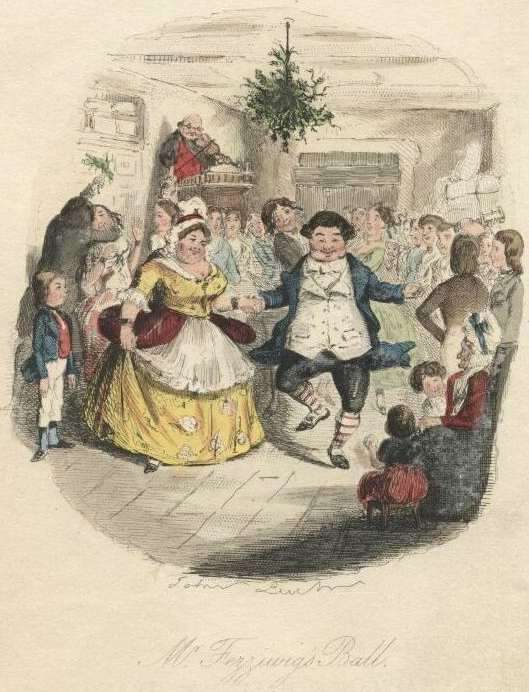
John Leech’s depiction of the Fezziwigs and the party. In some adaptations this is where Ebenezer met Belle, but not here.
I always assumed Fen, Ebenezer’s sister, coming to get him was part of the same event witnessed. That’s how it’s often depicted, but I guess they were starved for time or something. It’s another Christmas when she finally comes to collect him, insisting Father was now a more caring man and bringing his son home forever. The whole sequence is beautiful. It takes some odd circumstanced to make me tear up. I’m not a stone cold anything, but I don’t cry easy, either. This portion of the trip is so well written that between the two eras of Ebenezer Scrooge the emotion comes across so beautifully I can’t help it.
It might have been nice to see Ebenezer at home, to see if his Father was the man Fen declared him to be, but all we get is word that Fen died but not before giving birth to Fred, who has yet to be named. Instead the Spirit takes him to old Fezziwig’s. We’re told that Fezziwig has gone the way of Jacob Marley. Two important people in Ebenezer’s life gone from it. Could this have affected him, given the warmth and love both show him in these memories? Same for his fellow apprentice, Dick Wilkins. In adaptations I’ve seen, Dick is…there. Here we see that Ebenezer is happy to see him, before getting sad for a moment about “Poor Dick! Dear, dear!”, suggesting he, too, was lost from his life.
What follows is a description of the party and how festive it all is. It does sound like a rather merry time…and then we see after the party is broken that the current old Ebenezer had gotten into the spirit the whole time., with an interesting look from the Spirit. I do love this exchange.
A small matter,” said the Ghost, “to make these silly folks so full of gratitude.”
“Small!” echoed Scrooge.
The Spirit signed to him to listen to the two apprentices, who were pouring out their hearts in praise of Fezziwig: and when he had done so, said,
“Why! Is it not? He has spent but a few pounds of your mortal money: three or four perhaps. Is that so much that he deserves this praise?”
“It isn’t that,” said Scrooge, heated by the remark, and speaking unconsciously like his former, not his latter, self. “It isn’t that, Spirit. He has the power to render us happy or unhappy; to make our service light or burdensome; a pleasure or a toil. Say that his power lies in words and looks; in things so slight and insignificant that it is impossible to add and count ’em up: what then? The happiness he gives, is quite as great as if it cost a fortune.”
It leads him to consider the treatment of his own clerk. No time to think on it because the Spirit jumps to a woman ending their relationship. We later learn her name is Belle, believing that love of money, a fear of the world and of being poor, had taken him over and that she didn’t have a place in his life, despite his protests. Ebenezer is openly hurt both then and now but then the Spirit shows us the only shade that he couldn’t possibly have lived, Belle with her family and husband. The husband remarks seeing Ebenezer, whom she immediately mentioned as the man he teased seeing, alone in his counting house after the passing of Marley. This shows Ebenezer what he could have had, but we aren’t really shown what changed his heart. Look back at what we’ve seen. Scrooge brought home by his sister, who we know died. The celebration at Fiziwigs’, also mentioned that he died with a possible inference that Dick had as well. Could this be what drove him to seek solace in something he could control, namely wealth? We don’t really know. One scene he’s happy and enjoying Christmas and the next he loses his lady love, some adaptations even suggesting Ebenezer was going to or had proposed, which we don’t see here.
It’s not surprising that after returning, he grabs an extinguisher cap and uses it on the Spirit, who noted that these were the memories he made. It would have been nice to actually see what drove him to lose the man he was at Fezziwig’s. Belle in mourning clothes isn’t enough and it’s guesswork on my part that it was the passing of the most important people in his earlier joy and Bell’s dumping him that formed the man we know, when the path to becoming the man we know is what drove her off. However, we saw the breaks in who he is now, questioning his actions to the caroling boy and his treatment of Bob Cratchit…and that one’s only going to get harder next time, as Ebenezer Scrooge faces the Ghost Of Christmas Present. Thus the Ghost Of Christmas Past represents not only the man he was, but the man he should have been, through those he lost:
- Fen, the sister who tried to bring him back to a loving family. When she died he lost his connection to family, aka his nephew.
- Fizziwig, the man who should have showed him how to be a good businessman while not giving up his humanity and zest for life. When he died Ebenezer became bitter and distant, probably aided by Dick’s passing and later his only other friend, Jacob Marley.
- Belle, his last connection to his humanity. She didn’t die but she felt she couldn’t fight against the man he was becoming. If she or he had fought harder he would be the one to be her husband and father to her children. (Lady seems rather fertile according to the description.)
- And quite possibly the young man who read out of a lust for adventure as much as to escape what his life was before Fen “rescued” him from the boarding school. He died when the rest of that which connected him to life was gone from his life.
Somehow this is still my favorite part of the story, seeing who Ebenezer was as well of glimpses of what he could have been, should have been. Which is why I wish more was shown to us about how he fell from that joy. Tomorrow we see the next stave as the clock strikes again, and as Ebenezer has seen the man he should have been, we see more of the results of what he is today…before seeing the consequences in the final Spirit.



 BW Media Spotlight
[…] Last night we met with the Ghost Of Christmas Past. Tonight he will be visited by Ghost Of Christmas Present. I wonder if he still looks like Santa Claus in green? […]
LikeLike
[…] Stave 2: The First Of The Three Spirits […]
LikeLike