
Chapter By Chapter (usually) features me reading one chapter of the selected book at a time and reviewing it as if I were reviewing an episode of a TV show or an issue of a comic. There will be spoilers if you haven’t read to the point I have, and if you’ve read further I ask that you don’t spoil anything further into the book. Think of it as a read-along book club.
By Charles Dickens
Last night we met with the Ghost Of Christmas Past. Tonight he will be visited by Ghost Of Christmas Present. I wonder if he still looks like Santa Claus in green?
The first Spirit showed Ebenezer the man he was, but also the man he should have become. The people we’re shown believed in family, festivity, and love. When those people died or left, Ebenezer lost the ability in all three. Now we have the Presents, the results of Ebenezer’s actions in the present when he disconnected from those things. We’ll have to wait on the consequences, but each Spirit comes with a theme that connects through Ebenezer Scrooge himself. What will he learn from this expedition?
Grab your coats because we’re taking a trip through London, and meeting three children who play an important part in these events. What three, you ask? You only know the one? Don’t forget who the Spirit hangs out with. They’re on this journey, too.
Stave 2: The Second Of The Three Spirits
Awaking in the middle of a prodigiously tough snore, and sitting up in bed to get his thoughts together, Scrooge had no occasion to be told that the bell was again upon the stroke of One. He felt that he was restored to consciousness in the right nick of time, for the especial purpose of holding a conference with the second messenger despatched to him through Jacob Marley’s intervention. But finding that he turned uncomfortably cold when he began to wonder which of his curtains this new spectre would draw back, he put them every one aside with his own hands; and lying down again, established a sharp look-out all round the bed. For he wished to challenge the Spirit on the moment of its appearance, and did not wish to be taken by surprise, and made nervous.
The Spirits do enjoy messing with him, don’t they? Then again, when you look like the Grim Reaper I guess the Ghost Of Christmas Future has no choice. Again, we are only going to figure out who the third Spirit is once we meet the second. If you never saw the story before, like when this book was published, you aren’t expecting to see all three phases of time. These are the things you lose when a moment or story are so well known you lose that connection. Learning Vader’s identity, why Citizen Kane said “Rosebud” as his final words, or what planet the Apes lived on were such great twists but now that they’ve been referenced deader than Jacob Marley seeing it for the first time loses some strength. It’s both the blessing of a good story that we know it so well and a curse that we know it so well even before seeing the original. I wonder what voices my head would come up with for these characters if I had never seen the story before this?
So Ebenezer isn’t prepared for nothing to happen, but goes to have a look around and sure enough comes upon the Spirit Of Christmas Present, once the narrator starts going on about people being so sure of what they would do in a given situation with the value of hindsight and time to think. It’s the second time, along with the doornail in Stave 1, that it breaks into an unnecessary ramble. Usually all the rambling serves setting the scene or the mood, so ones like this kind of stand out. Since pronouns are a huge deal nowadays, it’s interesting that the narrator first refers to the Spirit as “it” when of all of them he’s the most clearly male upon first observation, but does settle into the “he”. John Leech’s images in the version I have does give us a thinner Santa Claus in green, which I believe is the depiction of Father Christmas; either way it’s the best Christmas character to base a Spirit on. Santa/Father Christmas represents the giving of gifts and making others happy, and that describes this Spirit’s personality. Of the three he’s probably the most lively and often depicted in adaptations as the most jolly while his fellow Spirits are either matter of fact (for the days gone by have happened and are now just events to learn from) or a fearful visage of quietness (representing fear of the future).
Based on his design (I’m sure someone who understands symbols and history better than myself can explain the empty, rusty scabbard) it’s interesting that Ebenezer, as the Spirit puts it, has “never seen the like of me before” given that he is designed on Father Christmas or I really don’t know my timeline. Of all of them he’s probably the most recognizable of the Spirits, as the Ghost Of Christmas Yet To Come is just one interpretation of Death and Father Christmas is tied to…duh…Christmas. It would be more likely that he forgot the form of Father Christmas as he lost ties to the season. He should be at least more recognizable than a multifaced candlestick.
“Spirit,” said Scrooge submissively, “conduct me where you will. I went forth last night on compulsion, and I learnt a lesson which is working now. To-night, if you have aught to teach me, let me profit by it.”
So already he’s changing. By seeing who he was and should have become, his eyes are open but the pain of those events linger. Right now the life he lived is pulling him in two directions, showing his negative response to those events and what he should have learned between his youth and the old man he is today. His eyes are open and now he’s about to see the world for the first time, when before he barely looked up on the rare occasion he was out. Nowadays he’d probably just have the counting house as part of those offices and use Doordash to get his meals, never having to see another living soul. We joke about that, but that’s not a good thing, and blinds you from the real world, something both sides of many of our modern discussions should think about.
Again our narrator becomes long-winded, or the written equivalent, but this time he’s setting up the atmosphere, comparing the dirty buildings of London, thanks to all the fireplace soot, with the white snow, but while the place looks rather dreary all of the merriment and festivity in the people and in the air seem more influenced by the snow than the soot. The stores are all showing their best stuff for customers to buy, but as a side effect helps bring the color and light into the world. If the Spirit sees anyone arguing, a few splashes from his torch doesn’t burn them but fills them with the holiday spirit and they stop. The Ghost Of Christmas Past is a light, caused by passion, while the Christmas Present’s torch brings the light, and the Ghost Of Christmas Future has no light. This is symbolism I can follow.
“Is there a peculiar flavour in what you sprinkle from your torch?” asked Scrooge.
“There is. My own.”
“Would it apply to any kind of dinner on this day?” asked Scrooge.
“To any kindly given. To a poor one most.”
“Why to a poor one most?” asked Scrooge.
“Because it needs it most.”
The same reason Jesus preached to the sinners, because they needed his message more than the ones already saved. “Preaching to the choir” doesn’t really work.
“Spirit,” said Scrooge, after a moment’s thought, “I wonder you, of all the beings in the many worlds about us, should desire to cramp these people’s opportunities of innocent enjoyment.”
“I!” cried the Spirit.
“You would deprive them of their means of dining every seventh day, often the only day on which they can be said to dine at all,” said Scrooge. “Wouldn’t you?”
“I!” cried the Spirit.
“You seek to close these places on the Seventh Day?” said Scrooge. “And it comes to the same thing.”
“I seek!” exclaimed the Spirit.
“Forgive me if I am wrong. It has been done in your name, or at least in that of your family,” said Scrooge.
“There are some upon this earth of yours,” returned the Spirit, “who lay claim to know us, and who do their deeds of passion, pride, ill-will, hatred, envy, bigotry, and selfishness in our name, who are as strange to us and all our kith and kin, as if they had never lived. Remember that, and charge their doings on themselves, not us.”
Not everyone who claims to do good is in fact doing good. Something else we should remember in our modern conversations from the culture war to government and even religion. It’s why I supported Occupy Wall Street until the crazies took over, and the Tea Party until it just kind of faded away not really achieving their goal.
“And how did little Tim behave?” asked Mrs. Cratchit, when she had rallied Bob on his credulity, and Bob had hugged his daughter to his heart’s content.
“As good as gold,” said Bob, “and better. Somehow he gets thoughtful, sitting by himself so much, and thinks the strangest things you ever heard. He told me, coming home, that he hoped the people saw him in the church, because he was a cripple, and it might be pleasant to them to remember upon Christmas Day, who made lame beggars walk, and blind men see.”
Bob’s voice was tremulous when he told them this, and trembled more when he said that Tiny Tim was growing strong and hearty.
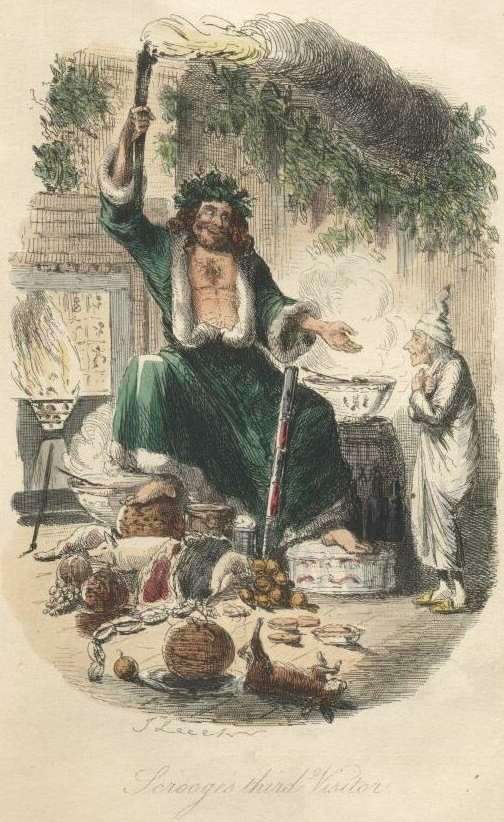
John Leech’s depiction of the Ghost Of Christmas Present, not quite the Santa in green we usually get in American depictions.
That third line, that bit of foreshadowing, is something I didn’t realize before but was missing from all the adaptations I’ve experienced. We know what’s coming but it might have been possible that he grew stronger before falling again. My mom did and that still gets me. Could be that Bob is trying to be strong for Tim’s sake or his wife’s. What follows is a fabulous description of the meal and love between the clan. Afterwards, they sit and toast…but when Bob toasts Ebenezer his wife balks, and is only willing to share in the toast for the day, not for Ebenezer himself. Even Tiny Tim, often depicted as the loving one, seems uncomfortable in doing so, and that’s after the Spirit tells Ebenezer the famous part about the empty chair.
Usually we go from here right to Fred’s, but in the original text the Spirit brings Ebenezer to visit other places who have no ties to him, miners and sailors all making merry for the holiday as if it was the only time Joy came into their lives. It really doesn’t tie to Ebenezer’s story and doesn’t do a lot different from the people on the street or the places we focus on. I don’t really miss their absence, to be honest. I supposed it could benefit Ebenezer but doesn’t really boost the narrative and its loss isn’t a big one.
We do finally reach Fred’s and finally get his name. You’d think the narrator at least, who being as much a character as anyone else despite not being a character in the book actually wants to meet him, would have given us Fred and Bob’s names when they were introduced in the story. In this case showing a narrator with a personality allows the story to be told with the emotional register our protagonist started out lacking, so while it wouldn’t work for every story not narrated by a member of the cast it totally works here outside of the occasional sidebar that’s just inane rambling.
It is a fair, even-handed, noble adjustment of things, that while there is infection in disease and sorrow, there is nothing in the world so irresistibly contagious as laughter and good-humour.
If only social media warriors would understand that. In fact, they could do to read the whole exchange as it’s not Ebenezer’s wealth that Fred blames but the lack of it, as in he has financial wealth but not emotional wealth. No love, no interest in the lighter side of life that is very much on display at this gathering. In fact he thinks visiting his crotchety uncle may the old fogey some moment of joy, if only to spread humbugs at him. Some people are actually like that. In fact one of Ebenezer’s nieces plays a song later that reminds him of one Fen liked and it brings him a sense of peace. The tale of the events of the evening benefits from the narrator, or otherwise Topper chasing one of Fred’s sisters-in-law rather obviously would have felt like more inane rambling rather than continuing to show the festive mood of the evening. Apparently Topper likes them plump, though that could mean something different back then and there.
Ebenezer even end up joining in what I’m guessing are trivia or spelling games or whatever “forfeits” are, forgetting nobody can hear him, and even getting the right answer more often than not, and unlike the emotionless Ghost Of Christmas Past watching him at Fezziwig’s, Present enjoys watching Ebenezer become part of the merriment in spite of himself. Don’t forget, this whole time the man’s in his sleeping gown. Even when reminded what others thought of him during a game of “Yes And No” he doesn’t lose his enjoyment of proceedings, and unlike the Cratchits these guests have no qualms about toasting him for the merriment he brought them, in the “so bad it’s hilarious” manner.
Ebenezer joins the Spirit on what’s essentially his rounds, seeing others in more need of holiday cheer than the Cratchits or Fred and his guests before noticing that the Spirit is looking older and older, as Christmas Day comes to a close. He also notices something odd under his robe…not that! Two children…SHUT UP! If you know the story, you know these children, the other two I was talking about.
“Spirit! are they yours?” Scrooge could say no more.
“They are Man’s,” said the Spirit, looking down upon them. “And they cling to me, appealing from their fathers. This boy is Ignorance. This girl is Want. Beware them both, and all of their degree, but most of all beware this boy, for on his brow I see that written which is Doom, unless the writing be erased. Deny it!” cried the Spirit, stretching out its hand towards the city. “Slander those who tell it ye! Admit it for your factious purposes, and make it worse. And bide the end!”
I put the emphasis on “beware this boy” because Ebenezer’s own ignorance has been part of his problem, and some of the other modern issues I’ve been commenting on this article. When Ebenezer asks if there is no way to help these children, who in keeping with later adaptations are not in the best of physical health, he throws the “are there no prisons” line Ebenezer gave to the charity workers back in his face. The book doesn’t give us Ebenezer’s reaction like some adaptations would do before the Spirit disappears, the clock striking twelve and leaving Ebenezer alone in the streets…well, not alone. The third Spirit is here, and thus the “scary” part of “scary ghost stories” is about to begin. Next chapter, anyway.
Had Ebenezer learned from Fen’s desire to bring the family together in warmth and love, he might have taken part directly in Fred’s party, perhaps even with Belle or another woman, and cousins for Fred to know. Had he learned from Fezziwig showing that money isn’t everything and treating his employees well and spreading Christmas cheer maybe Tiny Tim’s father could afford the medical care he needs and his family wouldn’t think so ill of Ebenezer. In both cases they find ways to love, live, and be merry…but what would have been has Ebenezer Scrooge been the better man others showed him how to be?
Next time it’s not what would have been but what may or may not be. There’s one last Spirit, and it’s the one Ebenezer Scrooge fears the most. Don’t fear the Reaper because it’s not you he’s coming for.



 BW Media Spotlight
[…] When we last left Ebenezer Scrooge he was all alone on the empty streets of London with one more Spirit, our final one and the scariest of them all. Even comedy versions tend to leave the Ghost Of Christmas Yet To Come scary. The only time I recall even seeing its face was in Mickey’s Christmas Carol, when they showed that Pete was playing the Ghost (like a modern superhero movie who wants to brag about their celebs so the heroes take their masks off in public)…and this is the version that sent Scrooge (McDuck, fittingly playing Ebenezer) to Hell! Uncle Walt wasn’t afraid to make Hell as scary as he could get away with in a family cartoon. […]
LikeLike
[…] Stave 3: The Second Of The Three Spirits […]
LikeLike