
Chapter By Chapter (usually) features me reading one chapter of the selected book at a time and reviewing it as if I were reviewing an episode of a TV show or an issue of a comic. There will be spoilers if you haven’t read to the point I have, and if you’ve read further I ask that you don’t spoil anything further into the book. Think of it as a read-along book club.
By Charles Dickens
When we last left Ebenezer Scrooge he was all alone on the empty streets of London with one more Spirit, our final one and the scariest of them all. Even comedy versions tend to leave the Ghost Of Christmas Yet To Come scary. The only time I recall even seeing its face was in Mickey’s Christmas Carol, when they showed that Pete was playing the Ghost (like a modern superhero movie who wants to brag about their celebs so the heroes take their masks off in public)…and this is the version that sent Scrooge (McDuck, fittingly playing Ebenezer) to Hell! Uncle Walt wasn’t afraid to make Hell as scary as he could get away with in a family cartoon.
We’ve seen the reasons for Ebenezer’s actions, the result of Ebenezer’s actions (or lack thereof), but now it’s the consequences of Ebenezer’s actions. What is the legacy he’ll be leaving behind. It’s the future that scares us the most, and maybe that’s why this Spirit has roughly the same look and personality (or lack of) in pretty much every incarnation, from the homage to the comedy to the faithful adaptation. This is the one taken the most seriously, the reason for the “scary ghost stories” line in “It’s The Most Wonderful Time Of Year”. I’ve seen the adaptations but this is my first experience with the original and I’m really hoping it doesn’t disappoint.
Sure enough it does not. One pointing hand coming out of a robe so dark he blends with the night. Batman would be jealous. He doesn’t speak, and Ebenezer just guesses he nods when he asks if he’s to show him the future. Also the change has long since started. He states that he wants to be a better person but from his reaction it seems he’s still wrestling with his own past, the man he wants to no longer be.
“Ghost of the Future!” he exclaimed, “I fear you more than any spectre I have seen. But as I know your purpose is to do me good, and as I hope to live to be another man from what I was, I am prepared to bear you company, and do it with a thankful heart. Will you not speak to me?”
It gave him no reply. The hand was pointed straight before them.
It’s not easy to change who you were. I’ve spent so long being down for the count that rewriting myself into the active man I used to be isn’t easy, my age starting to play into things as I turned 50 this year. I can understand Ebenezer being concerned of falling into habits he’s held for far longer than slightly under a decade. As they say, old habits die hard.
There isn’t a lot different from what you know here, something that’s been true for much of this book. In a time where faithful adaptations are few and far between, and in some cases outright scorned for ego and politics, it’s nice to see that this story has so many faithful adaptations. We have the scene with Ebenezer hearing people on the streets talking about a man’s passing, the curiousness of his not being in his usual spot at a gathering place, and the part where the three people rob a dead guy blind. What is is different is Ebenezer doesn’t comment on these events, or when he thinks comments it’s done through the narrator rather than Ebenezer himself. It’s something you can get away with in prose, as even in adaptations with a narrator it’s usually more interesting getting his thoughts from the man himself.
One thing I’ve never seen adapted is visiting a couple, who owe the dead guy money, being relieved for a time about his passing because they won’t have to pay it, unless someone takes over the business. So even these people are happy he’s gone for their own sake, rather than the people who don’t care or robbed the bed while he still lay on it. As usual, when the Spirit takes him to the bedside, Ebenezer can’t bring himself to look at the body.
Also as usual Ebenezer asks to see something tender tied to death and ends up at the Cratchits. The Ghost Of Christmas Present said that if events don’t change he foresaw an empty chair where Tiny Tim sat, and the chapter is subtle in showing us Tim’s chair from the last visit. Interestingly, Fred came upon Bob while walking near what I’m guessing is Tim’s gravesite and offered condolences. I’m not sure if Bob even knows of Ebenezer’s passing…come on, that’s not a spoiler anymore…since Tim seems to have done his own passing fairly recently. Then again…
The Ghost of Christmas Yet To Come conveyed him, as before—though at a different time, he thought: indeed, there seemed no order in these latter visions, save that they were in the Future—into the resorts of business men, but showed him not himself. Indeed, the Spirit did not stay for anything, but went straight on, as to the end just now desired, until besought by Scrooge to tarry for a moment.
When Tim passed versus the other guy is now unclear but it’s not the point. Ebenezer asked for a tender scene and got one. If Bob earned a decent wage he might have gotten the boy help, or being able to afford it, Ebenezer could have helped pay for it since Bob is an important employee and should have been a friend to him as Fezziwig no doubt was to Ebenezer. Mankind should have been his business, Marley had stated, and charity begins at the home. This is as close to home as Ebenezer could get.
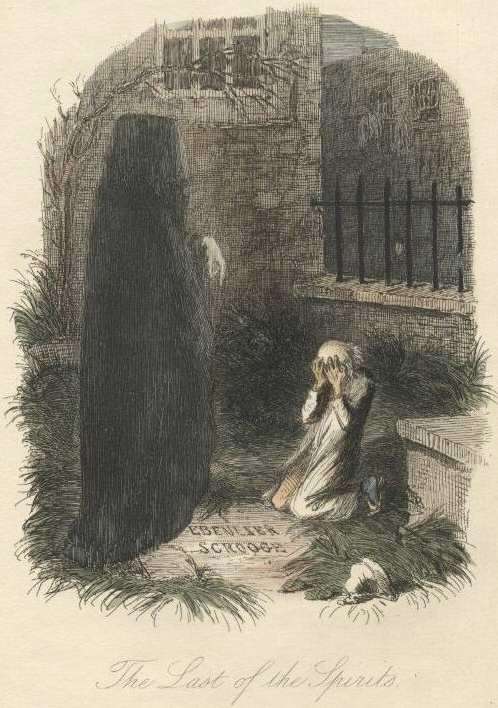
John Leech’s interpretation seems to be the guide everyone’s followed.
We all know what this builds up to: the gravestone. Ebenezer is going to die someday. All men do unless they’re hit with a space meteor or make unfortunate deals with the devil or other such fictional immortalities. We really aren’t given a good explanation as to why this bothers him, but allow me to theorize again. I don’t think its his ego that is the turning point. The people we have seen in this trip either couldn’t care less about Ebenezer’s passing or were thrilled by it due to how they personally profit. The laundress, chamberwoman, and undertaker’s assistant rob him blind. The couple who has never been in any adaptation I know (and I’m surprised we get names for) are free of their debt, at least for now. His peers joke about it. Nobody attended his funeral with compassion, and his gravestone is unattended. The only other death is of a child he just recently saw full of life, and whether or not it’s close to Ebenezer’s own passing it’s the last break in the thought that wealth was some kind of protection, something that brings him joy.
He’s seen others with less in more joyful spirits. It’s not the money that made Ebenezer miserable but the pursuit of it OVER family, compassion, and the Christmas spirit. There are two translations of 1 Timothy 6:10 but I prefer “For the love of money is a root of all kinds of evils.” The seven deadly sins speak not of the acts themselves but extremes that pull us from God. We need to eat but gluttony comes from putting food before yourself. Lust? You should lust after your spouse, but not your neighbor’s. Greed? We need things to survive, and that includes money. Currency allows us to get things we need when we otherwise have nothing to barter or trade with, but money should not come before God, and Luke 24:8 notes that “To whom much is given, much will be required”. If you have more wealth, using it to benefit your loved ones is your first priority, but after that using to benefit the less fortunate through charity is also your duty, and it’s a duty we saw Ebenezer shove aside. He wouldn’t even let Bob have enough coal to warm himself with at work, and wouldn’t do so for himself either, plus the wimpy fire in his living space. I’m betting he died of pneumonia. There was a head cold mentioned earlier in the story.
It’s seeing how little his life mattered, after re-teaching him the lessons that Fen, Fezziwig, and Belle should have left him with, but that’s on Ebenezer for not getting it and being led off the path. He could have had wealth and happiness together, but chose one extreme and thus lost the other. That’s the sin, and one he now vows to remove from his life.
Tomorrow, the final stave. We’ve seen the origins of his actions, the results of his actions, and the consequences of his actions. Now that he is no longer burdened by the boy of Ignorance, what will he become? It’s why I haven’t called him Scrooge throughout this review, and I will explain that in the next and final installment.



 BW Media Spotlight
[…] Stave 4: The Last Of The Spirits […]
LikeLike