
Chapter By Chapter (usually) features me reading one chapter of the selected book at a time and reviewing it as if I were reviewing an episode of a TV show or an issue of a comic. There will be spoilers if you haven’t read to the point I have, and if you’ve read further I ask that you don’t spoil anything further into the book. Think of it as a read-along book club.
By Charles Dickens
Last night was the Ghost Of Christmas yet to come. I’ll link to each of the staves for anyone coming in here before jumping into the final review, since I won’t be doing a Clutter Report book report on this one, and this last chapter is kind of short compared to the others. First, I want to go over the reason I’ve referred to Ebenezer Scrooge by his first name, rather than the more traditional usage of his last name like this book and pretty much every adaptation.
Britannica.com defines “scrooge” as “a selfish and unfriendly person who is not willing to spend or give away money — usually singular”. Of course the name comes from our pal Ebenezer, and if usually in the negative. We live in a world where we’ve misused the names “Chad” and “Karen”, the former positively despite actual people named Chad who are not “Chads”, and the latter negatively despite actual people named Karen who are not “Karens”. The latter is actually insulting, and I know a Karen who is not a “Karen” as the internet uses it and doesn’t deserve that. I used to know a Chad, but I don’t know what he’s like today.
Often forgotten when you call someone a scrooge is that Scrooge’s story is one of redemption, of not being a scrooge. Also remember technically Fen is a Scrooge, being Ebenezer’s sister, and thus her son Fred is at least a Scrooge by blood, probably taking his father’s name but we’re never given it. So they were NEVER scrooges, yet Fen had the name. We even hear from Fen that their unnamed dad has had his own emotional awakening, bringing Ebenezer back home to the family away from the boarding school. So calling someone a scrooge SHOULD mean “yeah, he’s a skinflint who hates celebrations, but there’s some good in him so he could realize what a fool he’s been and reform someday”, rather than focusing on the man he was. A real scrooge then should be the guy who USED to be a Christmas-hating money hoarder but is now a caring person with his wealth and loves Christmas like he used to.
However, just like the narrator isn’t going to change the English language by complaining about dead doornails versus coffin nails, there’s not much I can do and have better things to deal with. Let’s finish the book and then review the work as a whole.
Stave 5: The End Of It
What can I really say to anyone who has seen any non-parody adaptation. It’s pretty much all the same. Waking up in his bed, learning the Spirits did it all in one day, having the boy secretly deliver the large goose to the Cratchits (no showing of what they thought of it or if they even got it, though I’d like to think the boy didn’t take his money and the goose), running into the charity collector, visiting Fred’s for dinner (and recognizing everyone due to the Spirit-led visit, including Topper and the “plump sister” he’ll be pursuing…wonder if Ebenezer came up with a plan to help without the obvious pursuit during Blind Man’s Bluff?), and the fun moment of Ebenezer pretending to chastise Bob before showing his change of heart. It’s all there same as usual. You wouldn’t want it any other way.
Thankfully absent here that I’ve seen in other adaptations is the pronouncement that Ebenezer became a “second father” to Tiny Tim, one version even having Ebenezer state he would be to Bob, which just seems all kinds of rude. A grandfather, maybe, but that shouldn’t be Ebenezer’s saying but the narrator’s. It does say that Tim does not die, at least from whatever he’s sick from. I’m guessing that means the pay raise was enough to cover the doctor or Ebenezer himself paid the medical bills as a sort of apology and the idea that if God puts someone in need in your path you should help. Possibly both given the “back pay” of donations to the charity collector. We never see if he runs across the charity kid again and I was disappointed that the boy Ebenezer calls on doesn’t get himself confused realizing he’s talking to the old scrooge Scrooge. Overall, it’s the finale we expect and are glad for it.

So let’s talk about the book itself. This is the version I’ve been reading, if the link to Project Gutenberg is still working. It’s a collection of public domain books in eBook form, in different formats, and apparently some audio works as well though I haven’t explored those. It’s worth going over and if I didn’t already have a big collection of novels to go over this could be a source of Chapter By Chapter fodder in the future. The images are by John Leech and are quite good for illustrations of the time.
Of course you just saw the final chapter but here are the reviews for the previous chapters, or “staves” as the book calls them:
- Stave 1: Marley’s Ghost
- Stave 2: The First Of The Three Spirits
- Stave 3: The Second Of The Three Spirits
- Stave 4: The Last Of The Spirits
- And of course you’re on Stave 5
One cannot control whether or not a tale will become a timeless classic or a character the “breakout character” of the story. Today’s writers don’t even seem to care anymore, making a story so “modern” that it couldn’t possibly mean anything to the next generation. Even a timeless story, one that anyone can get into regardless of when its set, may not necessarily become a classic that everyone wants to adapt. The Scarlet Pimpernel has maybe one or two movies while every generation has a Zorro, and some adaptations tried to turn the Pimpernel into French Zorro while Zorro himself takes on more and more Batman elements with each adaptation. Whether something is niche or mainstream will also be decided on by your audience. Star Wars is more mainstream than some of its inspirations. It has to be more than repetition, as some claim, for It’s A Wonderful Life becoming a classic even though it didn’t do well at the box office. Star Trek only gained a fan following in syndication, after NBC canceled it due to underperforming.
So what makes this story so timeless that everyone and their uncle wants to adapt this story? It’s a solid redemption tale. Ebenezer Scrooge isn’t looked down upon as an old white dude, and it goes into why he’s such a greedy curmudgeon. We see the highs and lows of his life through the Ghost Of Christmas Past, and see how quickly the facade drops when he’s re-exposed to the lessons of Fen and Fezziwig as to how to be a good person. I speculated that it was the death of both that started him on the path that cost him his lady love, Belle, who couldn’t compete with the man he was becoming, though the book and other adaptations don’t really connect the passing with the falling. I think it should have.
Before that we see the man he was through his actions. The book does a great job setting up the characters and the scenes both dreary and festive thanks to the narration. Instead of the usual “matter of fact” telling like most other narrators, including the other adaptations, the book gives us a narrator with a personality. It feels more like he is relating a story to friends rather than just telling events for a format without images. Perhaps being a tale with images, the movies have never bothered giving the narrator much of a personality, but here there are sidebars and remarks that aren’t the narrator chastising Ebenezer for his actions “You’re A Mean One, Mr. Grinch” style. He simply states who Ebenezer was and what he became without judgement, trusting the reader can figure it out he’s a jerk who gets better by reading the story. The story has a message but it isn’t preaching it down our throats. Even some of the asides that held up the story, like the commentary about the expression “dead as a doornail” or talking about wanting to essentially party with Fred like it’s 1899 because he seems fun is more about making the narrator a character without making him part of the cast. Considering the story is about finding your soul again it’s a style that works here when it wouldn’t work in other works. I’ve seen it done badly, but this is not one of those stories.
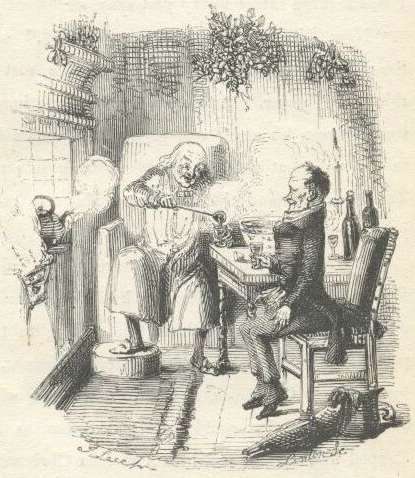
One last John Leech image before I go. Apparently with a cameo from Bob Hope.
I also really like the transitions between Spirits. The first Spirit shows Ebenezer his happy memories but by necessity ends with going over the early stages of his fall. The second Spirit shows him the happy moments of Christmas even among people who have few kind words about Ebenezer himself. That ends with the foreshadowing of Tiny Tim’s death and the scary depictions of Ignorance and Want, with the warning for Ebenezer to fear ignorance more than want, leads into the scarier part of the book, right up to leaving him in the streets to meet the Third Spirit rather than the safety of his bed like the first Spirit did. It doesn’t just drop you in the new mood but prepares you and draws you in to what the next chapter of Ebenezer’s journey is going to be like.
The characters are well defined. You get a good sense of who they are and what they’re like, often before they’re even named because Dickens does take much longer than the adaptations to tell us the name of the clerk at Ebenezer’s counting house or Ebenezer’s chipper nephew. John Leech’s artwork only clarifies what Dickens’ narration makes our mental eye see of them.
All of this is important to bring the reader along on Ebenezer’s journey of rediscovery and seeing the man he’s become. Without time to dull the lessons of Fen coming with good news about their father’s change of heart or Fezziwig putting work aside for an office Christmas party, Ebenezer has a chance to recognize what those times meant to him and what he lost out on…namely Belle. Some adaptations even suggest that Ebenezer was about to propose when Belle decided he was no longer the same man she fell in love with. We see how those poorer than Ebenezer (yet Fred still is able to hire staff to maintain the house and set up the Christmas party) finding the joy he lacks and even his peers have little regard for him for the way he lives. He’s not evil. He isn’t taking candy from babies, and we don’t see evidence of mistreating his debtors, just the one couple relieved they at least have time to catch up on their owed debt if not being freed from it that is left out of other adaptations. His biggest sin is the wages he pays and unwillingness to give to charity. He’s a hard hearted man, but not a wicked man besides that.
As I said, the book doesn’t preach a message, it teaches it. Through Ebenezer’s experience we learn what being a good man looks like, what a caring person looks like, that Christmas is a time for compassion and family. We don’t have to be smacked over the head because we’re drawn into the world of A Christmas Carol, going with Ebenezer on his journey of self discovery, and cheer him own as he becomes the man he should have been. If we’re already good people we can caught up in the adventure. If like Ebenezer we strayed from the righteous path or are at the crossroads where he went the wrong direction, we can see our own journey and change course. I don’t have to be an old rich white British man in the 19th century to relate to him and want to see him succeed. That’s another lesson lost to modern storytellers.
Would I recommend anyone else read this book? Absolutely! You may have seen all the adaptations, homages, and parodies but if you like to read this is a great book to read, if only to see what inspired so many takes over the years. Plus it’s just a great story for Christmas on its own.
Finally, the usual Chapter By Chapter teaser. Outside of Captain Yuletide this will be my last post before Christmas besides possibly one more Christmas special I’m adding to the playlist, unless it turns out not to be worthy. After Christmas I’m taking a break from the whole site until New Years, where I’ll announce the next book to be reviewed in the Chapter By Chapter review series. What will it be? Well, since this is technically the original story review it’s another licensed book, but not an adaptation. We’re going to planet Vulcan for one of my favorite Star Trek novels that’s tied to one of my other favorite Star Trek novels. Hopefully it won’t be as disappointing a re-read as Enterprise–The First Adventure was, but be warned….there will be a murder.


 BW Media Spotlight