

Our travels through the original sales pitch for Star Trek continues. Not to be confused with the pitch for fan series Star Trek Continues. In our previous installment we saw the ship was originally planned to be named the Yorktown rather than the Enterprise, as well as seeing prototypes of what became episodes of the original series and the first pilot, which we can’t call unaired on a technicality. “The Cage” was reworked into “The Menagerie”…and then many years later “The Cage” was finally aired in its original form on The Sci-Fi Channel.
In part two of our look at the pitch before moving on to the writer’s guide, we’ll meet the crew of the Enterprise Yorktown. It should be fascinating to see which specific characters and general character ideas made it to “The Cage” and into the series we finally got. Of the original crew, only Mr. Spock made it to the series, though I thought Dr. Boyce (or at least his actor in the medical officer role) was in one of the early episodes, maybe the first approved pilot “Where No Man Has Gone Before”. He did appear in novels, and of course everyone showed up in the comic Early Voyages and in the Prime Timeline’s Strange New Worlds, though he would be replaced for probably “modern” reasons.
With that, let’s meet the crew we almost had, including a captain who did finally show up on TV.
Robert M. April —
The “skipper”, about thirty-four, Academy graduate, rank of captain. Clearly the leading man and central character. This role is designated for an actor of top reputo and ability. A short hand sketch of Robert April might be “A space-age Captain Horatio Hornblower “, lean and capable both mentally and physically.
A colorfully complex personality, he is capable of action and decision which can verge on the heroic–and at the same time lives in a continual battle with self-doubt and the loneliness of command.

Robert April as he appeared in the animated series, his first on-screen appearance. Since the original show’s team worked on it, that’s April to me.
These are attributes we would see in Pike and Kirk. Pike’s solo official story in the Classic Timeline started with him doubting his ability to remain captain of the Enterprise after losing a crewman during the previous mission, although ultimately that only led to one of the scenarios the Talosians tried to use to make him stay and make space babies with Veena. Early Voyages actually did show us the mission and why it went wrong, but the comics and novels aren’t canon, and the shows and movies exist in three timelines, at least to many fans. The original shows and movies up to Enterprise is the Classic Timeline, the J.J. Abrams movie the “Kelvin Timeline”, and the aptly named Bad Robot is the “Prime Timeline”, though who knows what potential new owners will do with all of that. Kirk, despite losing quite a few crewman, especially in security, also lamented in “The Naked Time” about how being ship’s captain had kept him from actual love, and in the second movie, Generations, and in the occasional novel mention this would also come up. The ship had become his “lover” in a spiritual sense.
As with similar men in the past (Drake, Cook, Bougainville, and Scott), his primary weakness is a predilection to acton over administration, a temptation to take the greatest risks onto himself. But, unlike most early explorers, he has an almost compulsive compssion for the plight of others, alien as well as human, must continually fight the temptation to risk many to save one.
Their typo on “compassion”, just in case I’m somehow wrong about the word. We only have one official story from Roddenberry’s Pike, and while he does make himself part of what later Trek would call the “away team”, he was kind of dragged into events because he was the most likely to be tempted by the Talosians. Kirk we have a lot more of, and he is one of those captains who won’t give an order he wouldn’t do himself. He doesn’t take as many risks, but as one of the leads, he’s the action guy. You’re not going to see McCoy doing the serious fighting, though DeForest Kelley did do his share of fighting in Westerns. Of course, Edith Keeler definitely tested the idea of risking the many to save one, and that one he was in love with. That’s why Roddenberry changed the end so that Kirk stopped McCoy rather than Spock stopping Kirk from saving her. It hid harder for Kirk to let her get hit by the car for the sake of the timeline.
The rest of the cast list was done in one paragraph each. In the series we got, the team of Kirk, Spock, and McCoy were the leads, though the supporting cast of Scotty, Uhura, Sulu, and later Chekov would get stories or moments to themselves, something that can’t be said for Chekov’s replacement in the animated series or even Uhura’s back-up comm officer. Shows after that were treated more like an ensemble, which the movies had become for the original cast.
The Executive Officer
Never referred to as anything but “Number One”, this officer is female. Almost mysteriously female, in fact–slim and dark in a Niley Valley way, age uncertain, one of those women who will always look the same between years twenty to fifty. An extraordinarily efficient officer, “Number One” enjoys playing it expressionless, cool–is probably Robert April’s superior in detailed knowledge of the multiple equipment systems, departments and crew members aboard the vessel. When Captain April leaves the craft, “Number One” moves up to Acting Commander.

Number One, later Picard’s nickname for Riker, would appear in “The Cage” as well as post-Roddenberry Pike time stories in comics and Bad Robot’s stuff. That would be her lone appearance until Paramount Plus, so Gene had to find a different role for his wife to play. Later works would put her origin point as “Illyrian” and actually give her a name: Una Chin-Riley. Una, as in Uno, or “one”. Cute, guys. You got your naming system from Codename: Kids Next Door. I don’t know why Roddenberry didn’t give her a name or if he ever planned to as the show went on. He’s been accused of misogyny in the past, and there is evidence of it. She’s also basically Spock, so I can see why the network opted to leave her in the first pilot.
The Navigator
José Orgegas, born in South America, is tall, handsome, about twenty-five and brilliant, but still in the process of maturing. He is full of both humor and Latin temperament. He fights a perpetual and highly-personal battle with his instruments and calculators, suspecting that space, and probably God too, are engaged in a giant conspiracy to make his professional and personal life as difficult and uncomfortable as possible. José is painfully aware of the historical repute of Latins as lovers–and he is in danger of failing this ambition on a cosmic scale.
I think he showed up in the Early Voyages comic, but they didn’t lean into these particular traits if they did.
Ship’s Doctor
Phillip Boyce, an unlikely space traveler. At the age of fifty-one, he’s wordly, humorously cynical, makes it a point to thoroughly enjoy his own weaknesses. Captain April’s only real confidant, “Bones” Boyce considers himself the only realists aboard, measures each new landing in terms of relative annoyance, rather than excitement.

Boyce would make it to “The Cage” and there’s a fascinating issue of Early Voyages that would have made for a good episode. Some of these traits, including the nickname, of course would be used for Dr. McCoy
The First Lieutenant
The captain’s right-hand man, the working level commander of all the ship’s functions from manning the bridge to supervising the lowliest scrub detail. His name is “Mr. Spock”, and the first view of him can be almost frightening–a face so heavy-lidded and satanic you might almost expect him to have a forked tail. Probably half Martian, he has a slightly reddish complexion and semi-pointed ears, but strangely–Mr. Spock’s quiet temperament is in dramatic contrast to his satanic look. Of all the crew aboard, he is the nearest to Captain April’s equal, physically and emotionally, as a commander of Men. His primary weakness is an almost cat-like curiosity of anything the slightest “alien”.
Oh, you were not pulling that off on 1960s television. You think slapping a couple of ears, funky eyebrows, and the green rather than red complexion was going to be time in the chair? That’s if you could get make-up to do that every week. Nevermind, though, because television was so not ready for someone that devil-looking. Instead you got the Spock you got, and given ladies went crazy for Spock and Nimoy, it was all for the best. It is interesting to see what early Spock could have looked like. Fanaritsts, give it a go. My schedule won’t let me.
The Captain’s Yeoman —
Except for problems in naval parlance, “Colt” would be called a yeowoman; blonde and with a shape even a uniform could not hide. She serves as Robert April’s secretary, reporter, bookkeeper, and undoubtedly wishes she could also serve him in more personal departments. She is not dumb; she is very female, disturbingly so.
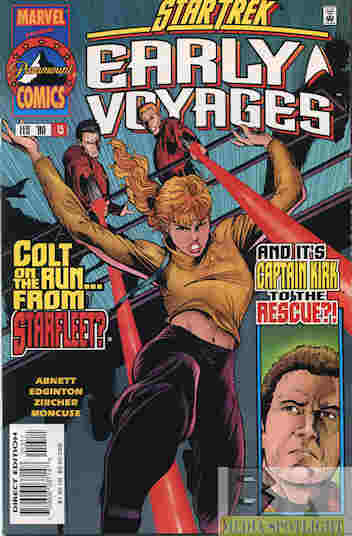
“Disturbingly”? Did I mention Gene was accused of misogyny? Colt would make it to “The Cage” but any attraction to Pike was mentioned in passing at best as the one Talosian said “okay, Veena isn’t working out and we need our planet repopulated–let’s grab the rest of the main cast women”. Personally I’d get “personal” with a yeoman that looked like Laurel Goodwin, and J.M. Colt would get a good appearance in the Early Voyages comic, where they called her Mia…but what the hell was Bad Robot thinking? Why would you drop a cute redhea…oh, right. Hollywood is trying to prove that they really do hate redheads after all.
In part three of the pitch examination we’ll move away from the story itself and get a bit into the backstage stuff with story goals and budget concerns. It’s not our usual discussion topic around here, but I might as well check out the whole thing, right?



 BW Media Spotlight
[…] through the sales pitch for the original Star Trek series we saw the concept and met the crew, nothing the changes between what was initially planned and what finally made it to television. In […]
LikeLike
[…] in the pitch part of this subseries of story bible/writer’s guide reviews, we looked at the crew of what was then the SS Yorktown, who would become the USS Enterprise crew in the original pilot. […]
LikeLike