

Previously in our “trek” through the sales pitch for the original Star Trek series we saw the concept and met the crew, nothing the changes between what was initially planned and what finally made it to television. In this installment we look at what goes into making a science fiction drama in the 1960s.
When I looked at the sales pitch for the original ThunderCats, they were focuses on the story because it was a cartoon. Everything was going to be drawn. For a live-action series you have to let the money people know how much money is going into pre-production and the actual production, the spending money before hopefully making money. I image the pitch for the animated series don’t have to worry about set pieces and what they cost. The writer’s guides didn’t have to worry about that, either. The writers had to have some idea what the recurring locations looked like, but they weren’t building the sets. We did get a layout of the Enterprise-D bridge in the writer’s guide for Star Trek: The Next Generation.
So we’re about to see in the next few pages just what was planned and considered necessary to build the sets, props, and costumes for this show. I’m not expecting price tags, just a sample of what they’re hoping to get out of it. The end results were limited by their budget and the available effects of the day (the transporter was used because it was cheaper than using the shuttlecraft everytime, which was late the first time they needed it, thus creating the transporter in the first place–don’t expect to see it in the pitch or guide), but we can look at what they wanted versus what they got.
However, there’s one more page we didn’t get to cover last time, written in the style of a report to Captain April, which would further go over the premise of the show.
III. You are therefore posted, effective immediately, to command the following: The S.S. Yorktown.
Cruiser Class — Gross 190,000 tons
Crew Complement — 203 persons
Drive — space-warp. (maximum velocity .73 of one light-year per hour)
Range–18 years at galaxy patrol speeds
Registry — Earth, United Space Ship
Of course, the “cruiser’ class would give way to the Constitution Class, at least in the series proper. What was the crew count the Enterprise end up with? 203 in “The Cage”, but by the time Kirk came on board they made more bedrooms. From Memory Alpha:
The 203 crew count originated from an initial Star Trek is… pitch (p. 9), which Gene Roddenberry wrote while devising Star Trek in March 1964, whereas he had revised the number upwards to 430, “approximately one-third of them female,” in a 17 April 1967 third draft of the The Star Trek Guide (p. 7). The latter number was adopted by Franz Joseph for his 1975 Star Trek Star Fleet Technical Manual, whose “Class I Heavy Cruiser – Constitution Class Starships” specifications, in turn, became the source for most of the information visible on the Enterprise graphic display in (the Star Trek: Discovery episode): “Brother“.
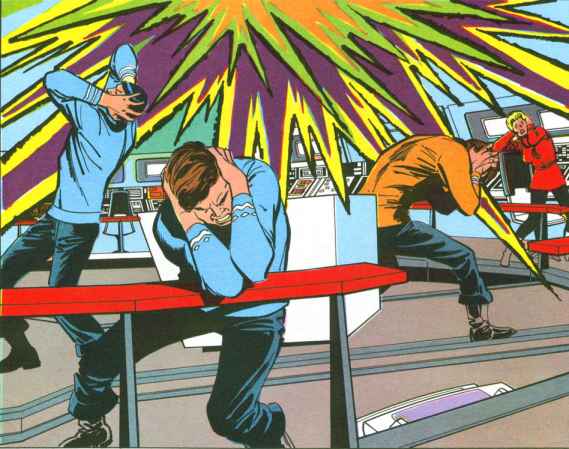
“Did we really need the bowling alley this close to the bridge, Jim?”
Of course, we’ll get to the guide when we’re done with the pitch, and it is the third edition despite being from season one. I think. We’ll find out. So the crew count from the pitch did make it into the first pilot, but was upgraded for the second, and what’s become official for NCC-1701. No idea what the weight and range were, but it was intended to be operating mostly on it’s own for five Earth years or however Starfleet calculates years, with minor stops at Starbases for repairs, upgrades, and minor refits. Major refits were handled back at the shipyards on Earth. Back to April’s assignment order.
IV. Nature and duration of command:
Galaxy exploration and Class M investigation: 5 years
Clearly transfering over to the series.
V. You will patrol the ninth quadrant, beginning with Alpha Centuri and extending to the other Pinial Galaxy limit
VI. You will conduct this patrol to accomplish primarily:
(a) Earth security, via exploration of intelligence and social systems capable of a galaxial threat, and
(b) Scientific investigation to add to the earth’s body of knowledge of life forms and social systems, and
(c) Any required assistance to the several earth colonies in this quadrant, and the enforcement of appropriate statutes affecting such as Federated commerce vessels and traders as you might contact in the course of your mission.
All of which did make up events in the franchise, or at least traveling in the Alpha Quadrant. Deep Space Nine was a station where supposedly the mysteries came to them, while Voyager was more interested in getting home.
VII. Consistent with the equipment and limitations of your cruiser class vessel, you will confine your landings and contacts to planets approximating earth-Mars conditions, life, and social orders.
I’m not sure why the pitch uses earth without the capital E so often. They also spelled Alpha Centauri wrong, unless they meant a different sector. I wonder if the intention of the Yorktown was that it could land on planets, like Voyager, or if that refers to shuttlecrafts. This could also be an early influence on the Prime Directive, as they were supposed to stay away from primitive cultures. We all know how that turned out.
From here we go into “Some format and budget considerations…”. This is where they give Desilu or NBC some idea how much dough they might have to put out to make this show happen. It’s not really story related, but it’s still fascinating…look, I could keep hunting synonyms or I can keep the Mr. Spock reference going. It’s fascinating to somebody, especially if they plan a pitch to a studio, network, or crowdfunding/investors.
SETS. Our format is tailored to practical production and cost factors. Use of stage sets, backlot and other locations are ximplfied by Captain April’s “Class M” orders. And our own “Parallel Worlds concept. The majority of story premises listed can be accomplished on such common studio backlot locales and sets such as Early 1900 Street, Oriental Village, Cowtown, Border Fort, Victorian Drawing Room, Forest and Streamside.
I think they mean “simplified”, though I half expected that to be an industry buzzword we don’t know. I never heard of “amortized” until today. Again, guides, I don’t need your typos when I make plenty of my own. Now my backstage expertise is lacking here, but I’m assuming these were names for pre-existing sets that productions would use for various stories, like reusing props and costumes. As it turns out they probably spent more time on the ship, on an obvious alien world backlot (probably Forest, but Victorian Drawing Room does sound like someplace Trelaine would hang out in), and Vasquez Rocks National Park, the American version of that quarry that the TARDIS would keep dropping into on Doctor Who or where the Power Rangers fought monsters outside of the city.
STAGES. The remarkable story latitude inherent in the concept also serves practical considerations by permitting reasonably simple adaptation of stories to fit current studio construction. For example, interiors and exteriors temporarily available after an “Egyptian” motion picture, a “horror” epic, or even an unusual teleflim, could be used to meet the needs of a number of story premises listed here.
SET AND LOCALE CARRY-OVER. Where particularly advantageous set or location conditions occur, or where a particularly exciting “world” is created, STAR TREK may do three of four stories there.
There was only one story that even came close to horror, and the closest they ever got to Egypt was meeting an Incan god in the animated series and probably one of the comics or novels. I don’t think they were meant to be anything more than examples, though. The point is reusing sets and stages for other movies and shows to help keep the budget down when visiting supposedly alien worlds. I wonder if they planned for starbases? “This mummy will help replace those leaky reactor coils.”
THE CRUSIER. The “S.S. Yorktown” is, of course, a standing set to be amortized over the life of the series. For economy, the basic set is designed that all cabins, wardrooms, and passages can be redressed and doubled.
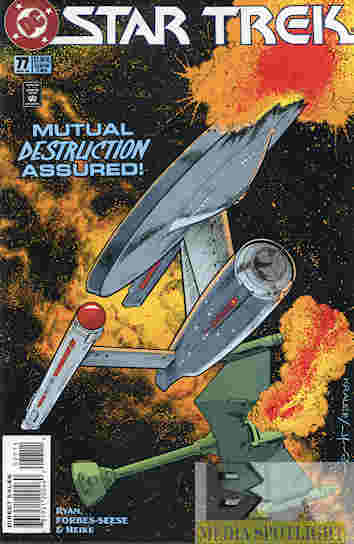
I wonder how much of the Yorktown‘s design they made, and if any of it translated to the Enterprise?
Star Trek had a lot of ship-only “bottle episodes” now that I think about it. That meant a lot of reuse for the same passageways they ran through over and over. Not as many as Doctor Who but we only got one bottle episode in the TARDIS during the classic run and that’s kind of sad. And to answer my earlier question:
LANDINGS. The Cruiser will stay in space orbit, will rarely land on a planet. Landings are made via a small (and transportable) recon rocket vehicle. Generally, audience view of sightings and landings will be that of the control crew, i.e., through instruments or on a “telescreen” (permitting use of selected stock film). Also for economy, ship miniaturization footage will be planned for maximum use, also amortized over the life of the series.
Of course that never happened. As stated earlier, the shuttlecraft model wasn’t read in time for filming the first pilot, so they ended up creating the transporter, and I guess that effect was cheaper than the launching shuttlecraft as it ended up in the successful pilot and the series. Shuttlecrafts were only used on certain occasions, like the story needed to trap the cast somewhere.
CASTING. Although it would be foolish to state we will never do a “monster” episode, most casting will be fairly routine. Where required, “alien” variations will be obtained via padding, wigs, and simpler makeup devices. But again, our general format stays “Parallel Worlds” and (as always in quality drama) the must unusual, exotic, and shockingly exciting differences always come out of action and reaction.
And the show would give us mostly minor changes like ears or eyebrows, maybe a change in skin color. It wasn’t until the movies that the Klingons would get their famous bumpy foreheads, and the show would occasionally give us an alien with serious make-up like in the episode “Journey To Babel”.
LANGUAGE. We establish a “telecommunicator” device early in the series, little more complicated than a small transistor radio carries in a pocket. A simple “two-way scrambler”, it appears to be converting all spoken language into English.
In the show they mostly ignored that little language barrier. One episode did involve a translator, but it wasn’t part of the communicators like it would with the communication badges in The Next Generation. Enterprise actually had a person on board whose job was to translate the alien languages they came across, being a prequel series and the Vulcans being jerks in that series. Otherwise you’d think they’d offer up that technology instead of just a database for Hoshi to work with. The communicators were basically just walkie-talkies while the tricorders probably had a language function on the rare occasion they were broken out.
WEAPONRY. Equally basic and simplified. The Cruiser is armed with Lasser Beams for self-protection only. Crew sidearms are rifles and pistols with an adjustment and will fire simple bullets, explosive projectiles, or hypodermic pellets which sun or tranquilize. Alien weaponry, because mineral, vegetation, and gravity are similar to earth, will follow a general earth pattern. Ranges from spears, bows, swords, and lances, to various of firearms. Now and then, of course, we may spring a surprise variation, such as a fairly advanced civilization which clings to feudal armor and swords as a way of life.
In the show the “Lasser Beams” would not be limited to the ship, as the phaser would have a stun, kill, and “heat rocks before we freeze to death” settings. I kind of like the multiple projectile type weapon myself, but it’s hard to imagine the Star Trek universe without phaser or the “phase pistol” of Enterprise.
COSTUME. Alien garments are basically recognizable, i.e., also following the “Parallel Worlds” concept. Pastoral, indian, or viking types of alien would generally clothe themselves close to that worn at similar periods in our own social evolution. Crew uniforms are ‘naval’ in general appearance, attractively simplified and utilitarian. Again, surprise variations are possible here too.
Well thank goodness they pivoted out of that. I don’t mean that the uniforms looked like casual wear with a bunch of decals on it (and we make fun of the Pumaman’s superhero outfit–at least his cape doubles as a poncho and the puma symbol is kind of cool). I mean the part about looking similar to our own outfits at different times. It did happen with the occasional pre-civilization world they stumbled upon, but none of the advanced races. Imagine if they did a story with, for example, a planet with all black people with modified African culture symbolism or something. Glad we never got anything like that.
Next time we’ll go a bit long finishing up the sales pitch as we go back to the storytelling side of things, with one of my favorite parts of this article series: the potential stories. Part one gave us a couple and we were promised more. This should be fun, and we can compare them to the writer’s guide when we get there as well as the final show. See you then!



 BW Media Spotlight
[…] In our last installment we got a bit of the backstage of the show, what it takes to create a show with sets and props and stuff. This time we finish with some more story ideas, to really wow the suits…who don’t really care about science fiction or stories. They just want to see if they’re going to make more money. A rant for another time, perhaps. […]
LikeLike
[…] a deep dive. That’s because there isn’t as much to talk about as when the sales pitch did their set listing. In that, they had to let the network and production company know how much it would cost to build […]
LikeLike