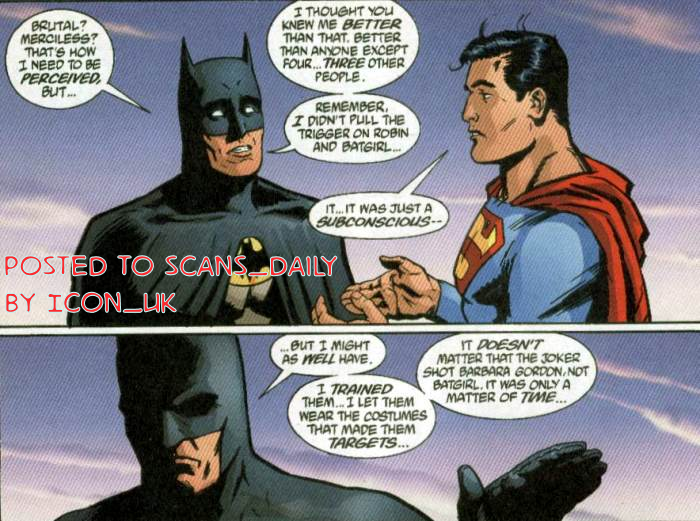
Well look who said something stupid. Again.
I’m at a point where I’m willing to call Frank Miller overrated. Apparently he did some good stories, but I’m never exposed to them. Whatever good faith he earned with The Dark Knight Returns, a story I clearly don’t share the world’s opinion on, should have been gone with All-Star Batman & Robin and what he did to Wil Eisner’s The Spirit in the movies. Learning that he disagreed with Eisner in how the character Eisner created should be depicted by Eisner, I’m convinced that movie was Miller trying to prove he was right…and only succeeded in doing the opposite and killing any chance the character had to get out of the comics. Then again, Judge Dredd and the Punisher each got a second chance as a movie, so anything’s possible.
Then there’s Zack Snyder. You know, the guy who said if someone thinks superheroes wouldn’t kill they live in a fantasy world…ignoring the fact that creating fantasy worlds is literally his job. He made Superman kill and every attempt to defend that movie makes me dislike the movie more…and I’m the guy who said Man Of Steel was a good superhero movie, just a bad Superman movie. The more he forces me to think about it, the more I change my opinion. His Batman was sentencing thugs to death. This to him is what real heroes are, psychos and whiny boys. The man is the embodiment of what I was talking about earlier in the month when discussing the fading use of bright colors in Hollywood. I’m not surprised that Snyder is a huge Frank Miller fans. Both like bleak and depressing takes on heroes I love. Just Miller is more in love with cities and sleazy women.
So, what happens when two bad tastes are brought together like the peanut butter cup of my nightmares? You get this interview from the Inverse magazine site, as Zack Snyder interviews Frank Miller…and reminds me why I don’t like either of their takes on the superheroes that most created my tastes and got me through my young life. Of course I have to dissect this one after I heard about it. Bounding Into Comics just reported on it. I’m here to deconstruct the deconstructors. Hold on to your hard hats, kids! They think BATMAN is the happier character of the two.
Zack Snyder: Look, here’s the thing, I was approached by Inverse to curate an issue of their online magazine, and they were like, “What do you want to talk about in comic books?” The first thing I said is, “I want to talk about sex.” And they were like, “Jesus, OK, well…” And then I said, “OK, but you know what I’m saying?” If I said to my father like, “Oh, I want to work in comic books,” he’d be like, “Oh, that’s cute. You’re going to work with the children.” But my perception of comic books is that — and it’s partly your fault, Frank — I perceive comic books as one of the most complete storytelling formats where the artist, with words and pictures, can describe the human condition in the most complicated and beautiful way. And so I told them, “Look, I really want to explore the perception of comic books as an adult medium with adult themes, real struggles, and psychologically complex characters that are fully formed in their morality, or lack thereof, and really hold up a mirror to us as a society.”
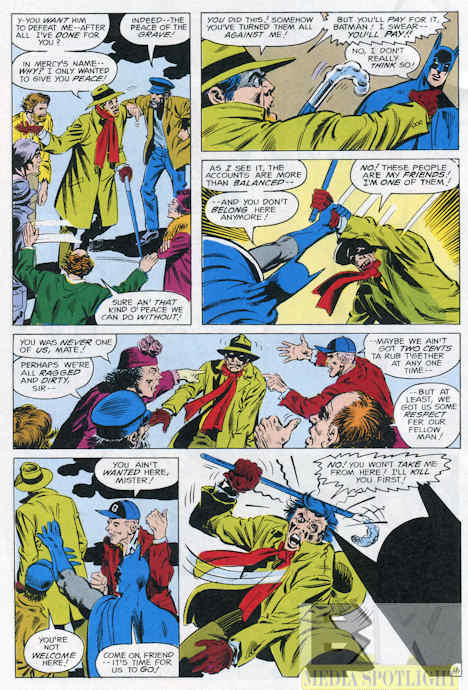
Yes, so immature before Frank Miller came along…years after this comic page.
My first Batman comic, and longtime readers may be sick of hearing about it, was about a crazy person believing that they were doing homeless people a favor by killing them with poisoned coins. No gore, no multi-issue exploration of every character’s life. Just a simple Batman investigation that didn’t involve his usual rogues and a good crime drama. I was maybe 6-9 years old when I read it, and it wasn’t kid unfriendly, but I’d still call it adult. In other words it was accessible to any age group old enough to understand it and follow along. Mainline comics now are hostile to kids, and believe you can’t tell an all-ages tale with “real struggles and psychologically complex characters blahblahblah” and yet Batman: The Animated Series exists, as well as that Super Powers Team episode that longtime readers are also sick of hearing me bring up. Snyder gushes about Frank for a bit (and given we’re told the article was edited down I’m betting longer than we see) before starting the interview.
Zack Snyder: OK, so I’m going to start. Over the course of your career, you’ve redefined what a comic book can be. What initially drew you to explore darker, more adult themes in your storytelling and in a comic book medium as a way of expressing that?
Frank Miller: I am, like any artist, someone who tests boundaries and I wanted to do comics that were growing with me or, at least, with its audience. Working on Daredevil was my opportunity as my first regular gig at Marvel. I continued having more freedom with the success of the series to explore new narrative possibilities and techniques. It wasn’t until later I had a chance to do whatever I wanted and started doing things like political parody dressed up as science fiction with Martha Washington. And then to explore my deepest love of film noir and crime fiction in Sin City.
I have no problem with that. Those were original properties. Though I might take issue with things in them personally and even critically, that was in their own space. I’m not a Daredevil reader and don’t have a lot of interest in the character, so I can’t say if his time there was any good, though it did inspire the original Teenage Mutant Ninja Turtles comics, right down to having a version of Daredevil’s “The Hand” known as “The Foot”. It was a parody at some point.
Zack Snyder: Right. In some ways, don’t you think Sin City is the noir we never saw? They would always cut away in a noir movie. You kept showing us actually what they didn’t.
Frank Miller: Well, what they couldn’t.
Zack Snyder: Yeah, exactly.
Frank Miller: Imagine… What was that Mitchum movie where he played the psycho priest? The Night of the Hunter. Kind of Night of the Hunter done in the era of Silence of the Lambs.
Did those stories need that? Were the in the noir novels? You just wanted to see tits and gore. Just say it, Frank. I’m not versed in noir, so I only know Mike Hammer, which gets mentioned next in the interview, from when Stacey Keach played him on TV. My mom was into that show and Keach was fun to watch in that role. Find it if you have time. I also having read Ronin because that’s not my genre either. We pick up the interview at…
Zack Snyder: Mythology, both ancient and modern, plays a significant role in your work. How do you see classic archetypes? Have they influenced your characters in the worlds you’ve created at all?
Frank Miller: Well, we’re definitely kindred spirits here, Zack, because I grew up on that stuff and it’s at the absolute hardcore of the superhero comics that I grew up on and was first trained to do. If you look at the slogan for Shazam, it’s basically just a list of mythic heroes and gods. It’s Solomon. It’s Hercules. That’s the S and the H. And it’s Atlas, Zeus — and I don’t remember what the last two are.
Achilles and Mercury. Each of those chosen patrons stood for one of the original Captain Marvel’s powers. Solomon for wisdom is right at the start. Hercules for strength, Atlas for stamina (kind of necessary when you hold an entire world up), Zeus for power, Achilees for courage, and Mercury for speed. I’m surprised he got wisdom, but of course he got all the power players, and not courage or speed. Look, I had to look up what each member represented and I don’t expect him to get it on the spot, but I do find it interesting what sticks in one’s mine. I knew the names but only remembered Solomon, Hercules, Atlas, and Mercury as far as what they represent, while I knew all the names that make up the acronym.
(Frank Miller:) And Superman has the origin of Moses, which kind of makes sense since he was created by a couple of Jewish kids in Ohio. And never mind Wonder Woman. She’s just got Greek mythology all over her.
Zack Snyder: Yeah, legit.
Frank Miller: So how do I put it? If comics are kind of like the bastard child of other media, they’re also the same to mythology.

A happy superhero story for kids that an adult could still enjoy? The horror!
“Bastard child”? Nice way to put it. I’ve heard people call comics the “modern mythology”, with a range as diverse as Snyder himself to Michael “Professor Geek” Critzer, who hates Snyder’s take on Superman even more than I do. There’s some truth to that. I don’t think it’s right to call comics a “bastard child”. Comics are older than we think, and cases have been made about works that predate everything except prose and plays unless you want to claim cave drawing somehow. I would say that comics are a fusion of visual and prose, that if done right can make your brain fill in the audio, but that’s as close as I’d get. I will agree with Miller that Superman is more Moses than Jesus and Wonder Woman has run into Greek gods since her first appearance.
Zack Snyder: I have this theory that in the modern world, we lost myth, and so we use comics and superheroes to kind of decode the problems of our times. That is to say, in the ancient world, if a volcano went off, you’d be like, “Oh, there’s a god in that mountain and he’s mad.” Now, if a terrorist flies a plane into the World Trade Center, it’s harder to make a myth out of it, but comics might allow that sort of thinking. I don’t know how you feel about that.
Frank Miller: Well, I believe the birth of religion and mythology was basically a cave dweller not understanding lightning and having to anthropomorphize nature. Religion was the precursor to science.
Along the way where all these gods and heroes were created. The Greeks just couldn’t stop puking them out. They had a legion of superheroes going on their own, and those really stayed in people’s heads. And the superhero universes essentially are this wild amalgam of sort of recreated Greek, Nordic, and Hebrew mythologies.
This might be why some commentators use “pantheon” to describe the heroes of a shared universe, the same given to any religion that has or had more than one deity that all hung out together and sometimes tried to conquer, kill, or just screw around with each other (read that last part anyway you want, and someone will fit it–Zeus especially couldn’t keep it under his toga). I won’t argue that the theory holds up. Superheroes (and supervillains) are how we discuss the world, but at the same time, doesn’t that mean changing a superhero too much changes their mythological purpose, the reason they were created? Compare Zeus and Hera in Disney’s Hercules to literally any other depiction out there and there’s a huuuuuuuge difference. Especially Hera, given all the crap she does to Hercules (any anybody who had a Zeus baby, whether he raped them or not…and in most cases he did) in mythology.
Zack Snyder: Yeah, they’ve really endured. And so, is your feeling that to talk about mythology in comics is really kind of 101, because we’re all still living in the shadow of those gods? So maybe that’s what it is, if you deconstruct, you kind of peel away, and by peeling away you really get to the mythological part of it.
More like draining it of mythology, with no reconstruction to replace or restore what was lost.
Frank Miller: That’s the best way to put it. I’ve always found “deconstruct” to be a problematic term because people usually assume that when you deconstruct something, you’re tearing it to pieces, and that’s only half of what deconstruction really is because it’s tearing its essence and then rebuilding it stronger than ever before. I mean, I wrote Batman cynically, in order to mock the character. I basically was just looking to get rid of all the #@$% and restore him to the kind of stature he had in my mind when I was seven years old.
That’s the problem, Frank. There is no reconstruction, and what passes for it is done for the wrong reasons. Currently it’s social pandering, but in the past it’s been someone using the brand to push their character because they don’t have enough faith in it. Maybe you did but…replay that last part.
I mean, I wrote Batman cynically, in order to mock the character. I basically was just looking to get rid of all the #@$% and restore him to the kind of stature he had in my mind when I was seven years old.
First off, the 1970s beat you to it, not with mockery but restoring what the Silver Age forced out of Batman’s stories to make Werthan and the parent groups happy. Writers like Len Wein and Jerry Conway were already bringing the character back to its roots but with the advances in comic storytelling techniques the Bronze Age was using. Let’s see. Frank Miller is, as of this writing, 67 years old. I am 51. That means it was the Silver Age when Miller would start reading Batman, unless he had access to the Golden Age comics somehow. Maybe a relative held on to them. At any rate, the 1960s Batman show would be the Batman that you saw at 7 years old, which is why I don’t hate that incarnation. It was also mockery, as the creators have said, but it wasn’t too far off from the comics of the day. So what the hell are you talking about, Frank?
Zack Snyder: The Dark Knight Returns is often credited with revolutionizing how Batman is perceived. But also my takeaway from Dark Knight Returns is exactly the same as you just stated it. Some people would say it’s deconstruction, and I understand that you might say that, but for me it was restorative. I’m like: That’s my Batman. The Batman I want to see is that Batman, not the bull#$% Batman who’s a joke. What were your key influences when creating a darker, older, more psychologically complex Batman?
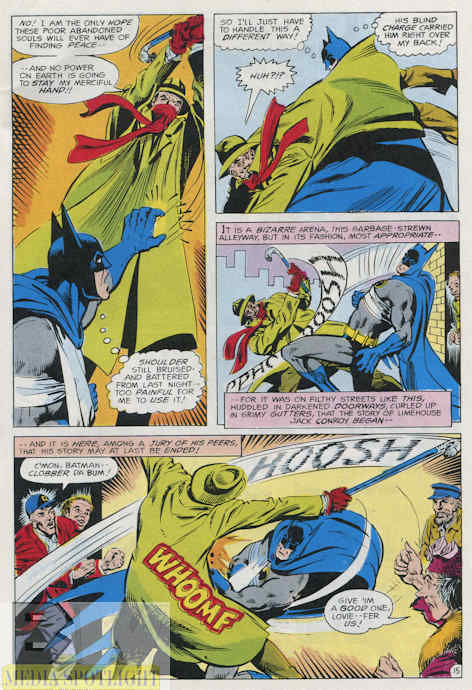
A fight scene in the dark that I can see stuff and isn’t using blood as the only color? The heck you say.
Again, wrongly credited, the same as Tim Burton. Batman was already returning to his darker nature while still being a good read for kids and adults alike. People who saw the TV show didn’t read The Dark Knight Returns, and to this day whenever “normie” newspeople discuss superhero comics they use the onomatopoeia that flashed on the screen when they punched a bad guy.
Frank Miller: The notorious old TV show, the one with Adam West and Burt Ward. I mean, that was a goof. It was basically a snide take on stuff that I remember that I absolutely loved. I loved the comic book characters and the TV show was constantly telling you how stupid the comic book was.
Zack Snyder: Yeah. Because it was counterculture against authority and they sort of saw Batman as the man. And so I just felt like they were making the man out to be sort of an idiot.
Frank Miller: Yeah. So, without question, I was rejecting that damn show more than anything when I did Dark Knight Returns.
Zack Snyder: You were like, literally, this is the opposite. This guy is the opposite of what you think he is.
Frank Miller: Yeah, this guy is no joke.
Miller saved that for All-Star Batman And Robin.
Zack Snyder: One of the things you do in Dark Knight Returns with the voiceover, in the sort of very specific language that he uses in combat and how he analyzes the combat that he’s in, you go like, “OK, this guy is 100% more complicated in his combat style even, than you you can imagine.”
Frank Miller: I look at Batman as the self-made superhero. Bruce Wayne made himself Batman by studying, training, and exploring. Extraordinary feats come easily to Superman. He can fly and then the rest. I mean, just in terms of Superman, it’s like you think you can do it. He can fly for god’s sake. Whereas Batman needs a g-d car. I enjoy an effort.
You haven’t paid attention to Superman in the longest time. Clark had to learn to control his powers. His beliefs are mocked by…well, these two, for example. He learned how to hide his identity, how to deal with magic since he’s not invulnerable to it, he’s been mind controlled by the likes of Poison Ivy, Darkseid, and Maxwell Lord. Powers are nothing if you don’t learn how to control and use them. It’s like complaining about the natural swimmer when you had to train hard to get on the swim team.
Zack Snyder: The one thing I really loved about the way you did Superman also was, he’s sort of a tool of the U.S. government, but the Superman also in your version is self-aware. He knows what he’s doing. Because everyone’s like, “Oh, he’s like a big boy scout.” Well, it’s like, no, he understands the political complexity of the whole thing, and he’s just done the math and goes, “Look, this is the only way we are able to exist is if we do it this way.”
And that’s what I hate about Miller’s Superman. Let him respond first.
Frank Miller: Superman is an apologia worrywart and he’s concerned with keeping the world from blowing itself up. Batman’s this Dionysian character who’s out for blood, and they’re perfect opposites in that Batman is the reckless ego and Superman is the fearful superego.
Zack Snyder: That’s cool. I really love it, because I love that Superman is in charge of keeping this… In a lot of ways, the children are tearing the preschool down, they’re setting it on fire, and they’re out of their minds, and he’s really just trying to wrangle us so we don’t kill ourselves and Batman’s just like, “No, that’s what it is to be alive,” you know? That’s cool.
Frank Miller: Batman is the happier character.
Zack Snyder: 100%. Yeah! 100%.
Yes, so happy about the dead parents, growing up without their love and affection, not being able to connect to other people easily (I make friends easier), dealing with the most mentally disturbed people ever. Bruce just loves all that, then getting spit upon by society because they only think he’s a goodoff playboy living off dead daddy’s money, to the point that one of his enemies killed his parents so he could live like Bruce. Much happier than the guy who has the love and support of almost everybody in both identities not only on Earth but throughout the galaxy, sleeps most nights, and isn’t a tool of the government because it’s the country he loves and not the morons running it. Happier my foot!
Frank Miller: I wanted to abolish the pouty Batman.
The only thing I agree with him on besides the mythology part. The brooding loner bit is getting old and by now he should totally embrace the Bat-Family and not be as paranoid about the powered heroes as he is.
Zack Snyder: That’s cool. Look, you know how I feel about the work. It’s incredible. So, the heroes in your stories are often morally ambiguous or even sometimes antiheroes. How do you view the evolution of the hero in modern storytelling, and why do you gravitate toward these more complex heroes?
Frank Miller: I regard defining the hero as being the center and purpose of my work, and in order to find something you have to test it, prod it, attend it, and find new ways to portray it. And I find sometimes having a hero do wrong or take a wrong course is the best way to ultimately define what a hero is, especially with my Daredevil and my portrait of Superman. It’s again the deconstruction thing where you can get to a character’s essence by having them wander far astray. With Daredevil: Born Again, he essentially has a nervous breakdown. He loses control of his violence and his darker tendencies and essentially has to lose everything before he can turn into a better character.
Zack Snyder: Yeah, that’s cool. For me, if someone says in a hero’s canon, he’s not allowed to do blank, I immediately want him to do that thing because I feel like if a character can’t withstand breaking his own canon, then he’s not really worth anything, you know

Spoilers: Superman wins this fight without killing anybody.
Zack, what you did with the Zod neck snap and what Miller is about to describe are two different things. You had Superman violate his entire worldview, a worldview we saw in the comics and other media but not in your movie, and then cut to a gag about not wanting to be spied on. There’s a difference between challenging his morals and tossing them right out the window. To wit:
Frank Miller: Right. And then what defines him? I mean, at first, Zack, I approached this kind of thing almost like just a rebellious adolescent. I was told Batman could never fire a gun. I was told by the editor with absolute conviction. So, I came up with an excuse for him to fire a rifle, even though it was just a grappling hook into the side of a building, but it was just to get that picture of him holding it. I don’t like these absolute dicta.
Okay, that’s just stupid. The point is Batman doesn’t kill people with a gun, not that he doesn’t fire guns. Batman has fired guns. There’s a scene where Batman is having Robin shoot guns to understand their power, their killing potential. During the Final Crisis event, Batman shoots Darkseid with a special bullet that can actually hurt him, because there was no other way to stop him. In Batman Beyond, the reason Bruce retires as Batman is because he’s forced to use a gun to protect himself when his age finally starts to get to him at the wrong time. These are story reasons to make Batman violate his personal rule against guns, and in Darkseid’s case his “no kill” rule. It’s not that it can’t be done. It’s that Snyder didn’t do it for the right reasons or in the right manner.
Zack Snyder: Well, it’s cool because if you can create a scenario where Batman has to shoot a gun and someone says, “Well, Batman can’t shoot a gun.” And you’re like, “Well, what should he do in this scenario then?” And then if someone says, “Well, don’t put him in that scenario.” I’m like, “Well, that’s a weak character.” You can’t have a character where we’re modifying this scenario because he can’t exist in it. That’s not realistic. Now we’re just creating scenarios that his morality can work inside of, rather than the other way around.
Frank Miller: Absolutely right, Zack. That’s not creative.
That’s not what you did. You specifically created a scenario with THE GOAL of making Superman kill Zod. This isn’t a situation he couldn’t get out of, like in the comics where he killed Zod and his minions in a parallel world because they already destroyed Earth in theirs and was now going to go after his. Then he went on an intergalactic walkabout as a form of personal penance, trying to recenter himself with his morals and his worries about becoming…well, Injustice Superman. You decided to follow it up with a gag, putting no weight into Clark’s moral dilemma that you didn’t even properly set up, while at every step trying to talk him out of becoming Superman, not even calling him that and interrupting Lois and a soldier who both tried to say it during the course of the story.
Zack Snyder: And I think that’s what Dark Knight did for me, it was like, “Oh wait, Batman can actually live in my world,” which I think was cool.
Frank Miller: Batman can’t shoot somebody dead, he cannot murder, but that’s a completely different issue than using essentially a tool.
I don’t think Snyder understands that. Hey, I’ll credit Miller when he has a good point. I’ll credit Snyder if he ever has one as well. From here they talk about 300, a graphic novel by Miller that Snyder adapted, and Sin City, arguably the point where Miller went full noir and never came back, giving us the properly acronymed ASBAR. I have seen neither and don’t care. I’m not too familiar with his contributions to RoboCop outside of a comic preview, and I didn’t follow Daredevil because I’m a DC guy. So I’m going to move on. This is getting long as it is. I linked to the interview earlier if you want to catch the whole thing.
The point is I don’t like either take on Batman or Superman. They miss everything I love about both characters, but The Spirit aside, it seems Miller knows more than Snyder does about making a superhero story. Miller’s view is a bit warped but he does understand the basics. Neither are the hopeful time. It’s all grim and depressing with them, not getting why we love heroes, and why I love these characters, why Superman is my favorite superhero or what makes Batman cool to me from childhood to today. I’m just not into either of their takes on these characters or their own work. I’d rather they’d stay with their own work rather than continuing to ruin my favorites. Then again, that gave us Rebel Moon, so maybe just Miller should do their own work. Snyder needs a therapist and a return to film writers’ school.
Tell others about the Spotlight:
Related
 The Clutter Reports (my other site)


 BW Media Spotlight
Well look who said something stupid. Again.
I’m at a point where I’m willing to call Frank Miller overrated. Apparently he did some good stories, but I’m never exposed to them. Whatever good faith he earned with The Dark Knight Returns, a story I clearly don’t share the world’s opinion on, should have been gone with All-Star Batman & Robin and what he did to Wil Eisner’s The Spirit in the movies. Learning that he disagreed with Eisner in how the character Eisner created should be depicted by Eisner, I’m convinced that movie was Miller trying to prove he was right…and only succeeded in doing the opposite and killing any chance the character had to get out of the comics. Then again, Judge Dredd and the Punisher each got a second chance as a movie, so anything’s possible.
Then there’s Zack Snyder. You know, the guy who said if someone thinks superheroes wouldn’t kill they live in a fantasy world…ignoring the fact that creating fantasy worlds is literally his job. He made Superman kill and every attempt to defend that movie makes me dislike the movie more…and I’m the guy who said Man Of Steel was a good superhero movie, just a bad Superman movie. The more he forces me to think about it, the more I change my opinion. His Batman was sentencing thugs to death. This to him is what real heroes are, psychos and whiny boys. The man is the embodiment of what I was talking about earlier in the month when discussing the fading use of bright colors in Hollywood. I’m not surprised that Snyder is a huge Frank Miller fans. Both like bleak and depressing takes on heroes I love. Just Miller is more in love with cities and sleazy women.
So, what happens when two bad tastes are brought together like the peanut butter cup of my nightmares? You get this interview from the Inverse magazine site, as Zack Snyder interviews Frank Miller…and reminds me why I don’t like either of their takes on the superheroes that most created my tastes and got me through my young life. Of course I have to dissect this one after I heard about it. Bounding Into Comics just reported on it. I’m here to deconstruct the deconstructors. Hold on to your hard hats, kids! They think BATMAN is the happier character of the two.
Yes, so immature before Frank Miller came along…years after this comic page.
My first Batman comic, and longtime readers may be sick of hearing about it, was about a crazy person believing that they were doing homeless people a favor by killing them with poisoned coins. No gore, no multi-issue exploration of every character’s life. Just a simple Batman investigation that didn’t involve his usual rogues and a good crime drama. I was maybe 6-9 years old when I read it, and it wasn’t kid unfriendly, but I’d still call it adult. In other words it was accessible to any age group old enough to understand it and follow along. Mainline comics now are hostile to kids, and believe you can’t tell an all-ages tale with “real struggles and psychologically complex characters blahblahblah” and yet Batman: The Animated Series exists, as well as that Super Powers Team episode that longtime readers are also sick of hearing me bring up. Snyder gushes about Frank for a bit (and given we’re told the article was edited down I’m betting longer than we see) before starting the interview.
I have no problem with that. Those were original properties. Though I might take issue with things in them personally and even critically, that was in their own space. I’m not a Daredevil reader and don’t have a lot of interest in the character, so I can’t say if his time there was any good, though it did inspire the original Teenage Mutant Ninja Turtles comics, right down to having a version of Daredevil’s “The Hand” known as “The Foot”. It was a parody at some point.
Did those stories need that? Were the in the noir novels? You just wanted to see tits and gore. Just say it, Frank. I’m not versed in noir, so I only know Mike Hammer, which gets mentioned next in the interview, from when Stacey Keach played him on TV. My mom was into that show and Keach was fun to watch in that role. Find it if you have time. I also having read Ronin because that’s not my genre either. We pick up the interview at…
Achilles and Mercury. Each of those chosen patrons stood for one of the original Captain Marvel’s powers. Solomon for wisdom is right at the start. Hercules for strength, Atlas for stamina (kind of necessary when you hold an entire world up), Zeus for power, Achilees for courage, and Mercury for speed. I’m surprised he got wisdom, but of course he got all the power players, and not courage or speed. Look, I had to look up what each member represented and I don’t expect him to get it on the spot, but I do find it interesting what sticks in one’s mine. I knew the names but only remembered Solomon, Hercules, Atlas, and Mercury as far as what they represent, while I knew all the names that make up the acronym.
A happy superhero story for kids that an adult could still enjoy? The horror!
“Bastard child”? Nice way to put it. I’ve heard people call comics the “modern mythology”, with a range as diverse as Snyder himself to Michael “Professor Geek” Critzer, who hates Snyder’s take on Superman even more than I do. There’s some truth to that. I don’t think it’s right to call comics a “bastard child”. Comics are older than we think, and cases have been made about works that predate everything except prose and plays unless you want to claim cave drawing somehow. I would say that comics are a fusion of visual and prose, that if done right can make your brain fill in the audio, but that’s as close as I’d get. I will agree with Miller that Superman is more Moses than Jesus and Wonder Woman has run into Greek gods since her first appearance.
This might be why some commentators use “pantheon” to describe the heroes of a shared universe, the same given to any religion that has or had more than one deity that all hung out together and sometimes tried to conquer, kill, or just screw around with each other (read that last part anyway you want, and someone will fit it–Zeus especially couldn’t keep it under his toga). I won’t argue that the theory holds up. Superheroes (and supervillains) are how we discuss the world, but at the same time, doesn’t that mean changing a superhero too much changes their mythological purpose, the reason they were created? Compare Zeus and Hera in Disney’s Hercules to literally any other depiction out there and there’s a huuuuuuuge difference. Especially Hera, given all the crap she does to Hercules (any anybody who had a Zeus baby, whether he raped them or not…and in most cases he did) in mythology.
More like draining it of mythology, with no reconstruction to replace or restore what was lost.
That’s the problem, Frank. There is no reconstruction, and what passes for it is done for the wrong reasons. Currently it’s social pandering, but in the past it’s been someone using the brand to push their character because they don’t have enough faith in it. Maybe you did but…replay that last part.
First off, the 1970s beat you to it, not with mockery but restoring what the Silver Age forced out of Batman’s stories to make Werthan and the parent groups happy. Writers like Len Wein and Jerry Conway were already bringing the character back to its roots but with the advances in comic storytelling techniques the Bronze Age was using. Let’s see. Frank Miller is, as of this writing, 67 years old. I am 51. That means it was the Silver Age when Miller would start reading Batman, unless he had access to the Golden Age comics somehow. Maybe a relative held on to them. At any rate, the 1960s Batman show would be the Batman that you saw at 7 years old, which is why I don’t hate that incarnation. It was also mockery, as the creators have said, but it wasn’t too far off from the comics of the day. So what the hell are you talking about, Frank?
A fight scene in the dark that I can see stuff and isn’t using blood as the only color? The heck you say.
Again, wrongly credited, the same as Tim Burton. Batman was already returning to his darker nature while still being a good read for kids and adults alike. People who saw the TV show didn’t read The Dark Knight Returns, and to this day whenever “normie” newspeople discuss superhero comics they use the onomatopoeia that flashed on the screen when they punched a bad guy.
Miller saved that for All-Star Batman And Robin.
You haven’t paid attention to Superman in the longest time. Clark had to learn to control his powers. His beliefs are mocked by…well, these two, for example. He learned how to hide his identity, how to deal with magic since he’s not invulnerable to it, he’s been mind controlled by the likes of Poison Ivy, Darkseid, and Maxwell Lord. Powers are nothing if you don’t learn how to control and use them. It’s like complaining about the natural swimmer when you had to train hard to get on the swim team.
And that’s what I hate about Miller’s Superman. Let him respond first.
Yes, so happy about the dead parents, growing up without their love and affection, not being able to connect to other people easily (I make friends easier), dealing with the most mentally disturbed people ever. Bruce just loves all that, then getting spit upon by society because they only think he’s a goodoff playboy living off dead daddy’s money, to the point that one of his enemies killed his parents so he could live like Bruce. Much happier than the guy who has the love and support of almost everybody in both identities not only on Earth but throughout the galaxy, sleeps most nights, and isn’t a tool of the government because it’s the country he loves and not the morons running it. Happier my foot!
The only thing I agree with him on besides the mythology part. The brooding loner bit is getting old and by now he should totally embrace the Bat-Family and not be as paranoid about the powered heroes as he is.
Spoilers: Superman wins this fight without killing anybody.
Zack, what you did with the Zod neck snap and what Miller is about to describe are two different things. You had Superman violate his entire worldview, a worldview we saw in the comics and other media but not in your movie, and then cut to a gag about not wanting to be spied on. There’s a difference between challenging his morals and tossing them right out the window. To wit:
Okay, that’s just stupid. The point is Batman doesn’t kill people with a gun, not that he doesn’t fire guns. Batman has fired guns. There’s a scene where Batman is having Robin shoot guns to understand their power, their killing potential. During the Final Crisis event, Batman shoots Darkseid with a special bullet that can actually hurt him, because there was no other way to stop him. In Batman Beyond, the reason Bruce retires as Batman is because he’s forced to use a gun to protect himself when his age finally starts to get to him at the wrong time. These are story reasons to make Batman violate his personal rule against guns, and in Darkseid’s case his “no kill” rule. It’s not that it can’t be done. It’s that Snyder didn’t do it for the right reasons or in the right manner.
That’s not what you did. You specifically created a scenario with THE GOAL of making Superman kill Zod. This isn’t a situation he couldn’t get out of, like in the comics where he killed Zod and his minions in a parallel world because they already destroyed Earth in theirs and was now going to go after his. Then he went on an intergalactic walkabout as a form of personal penance, trying to recenter himself with his morals and his worries about becoming…well, Injustice Superman. You decided to follow it up with a gag, putting no weight into Clark’s moral dilemma that you didn’t even properly set up, while at every step trying to talk him out of becoming Superman, not even calling him that and interrupting Lois and a soldier who both tried to say it during the course of the story.
I don’t think Snyder understands that. Hey, I’ll credit Miller when he has a good point. I’ll credit Snyder if he ever has one as well. From here they talk about 300, a graphic novel by Miller that Snyder adapted, and Sin City, arguably the point where Miller went full noir and never came back, giving us the properly acronymed ASBAR. I have seen neither and don’t care. I’m not too familiar with his contributions to RoboCop outside of a comic preview, and I didn’t follow Daredevil because I’m a DC guy. So I’m going to move on. This is getting long as it is. I linked to the interview earlier if you want to catch the whole thing.
The point is I don’t like either take on Batman or Superman. They miss everything I love about both characters, but The Spirit aside, it seems Miller knows more than Snyder does about making a superhero story. Miller’s view is a bit warped but he does understand the basics. Neither are the hopeful time. It’s all grim and depressing with them, not getting why we love heroes, and why I love these characters, why Superman is my favorite superhero or what makes Batman cool to me from childhood to today. I’m just not into either of their takes on these characters or their own work. I’d rather they’d stay with their own work rather than continuing to ruin my favorites. Then again, that gave us Rebel Moon, so maybe just Miller should do their own work. Snyder needs a therapist and a return to film writers’ school.
Rate this:
Tell others about the Spotlight:
Related
Posted by ShadowWing Tronix on October 23, 2024 in DC Spotlight, Movie Spotlight and tagged Batman, commentary, Frank Miller, Interview, Superman, Zack Snyder.
Leave a comment
About ShadowWing Tronix
A would be comic writer looking to organize his living space as well as his thoughts. So I have a blog for each goal. :)