
The Literature Devil showed this clip on Wednesday’s Morning Nonsense stream, and that got my waking brain going.
The obsession with “canon” and “that’s not the lore” absolutism is the most embarrassing thing about nerd culture. https://t.co/LWrThR41d1
— PleasantKenobi (@PleasantKenobi) November 25, 2024
The above clip and corresponding tweets on X-Twitter (hopefully it’s coming up for you since the rebrand has messed with embeds) features James Gunn basically stating that because story is fiction canon is “whatever you want it to be”. Remember, this is the guy creating an entire universe, has had trouble deciding whether or not his DC movies and shows will or won’t be canon to the new movie continuity (they’re his so of course they are, even recently stating they’ll be using the recon bomb to force season one of Peacemaker into the new Gunniverse of movies and animated series to explain the Snyder Justice League cameo), and will be in charge of this universe going forward. He does not believe in a set canon according to that clip. I don’t know what podcast is from so I can’t confirm the context, but if accurate this does not bode well for Warner Brothers’ latest attempt to challenge Disney on the superhero front as the new DC Studios seeks to go head to head with Marvel Studios, who have themselves ditched respecting the comics like they did with the MCU first began and Paramount was doing the distribution.
There are times I’m worried the horse is so beaten that the glue factory can’t work with the remains, but then some necromancer pops up and restores the horse. The debate over canon has more resurrections than Optimus Prime at this point, as many writers out there are more interested in stories than continuity. Canon is the cohesion of a continuity for a series or a shared universe. That’s not what they want to make, though. What they’re really asking for isn’t a shared or even ongoing universe, but an anthology, something more akin to The Twilight Zone or even Golden Age comics than what a series or franchise is supposed to be. Marvel Studios is forgetting that, DC Studios seems poised to never learn that lesson, and both of the comics that spawned the movie studios that spurn their parent media are losing the ability to do this as well. Stories do not a series make. I think we need to learn the difference.
Looking over a lot of the replies to both posts connected to that embed (hopefully it’s not just showing up in my page preview) I notice people saying that continuity meant nothing to them. That they just want good stories. Continuity isn’t the enemy of that, however. One example I use a lot is an episode from the original He-Man & The Masters Of The Universe in which the episode’s title villain, Dark Dream, returns to attack Eternia. They give us a quick history of what his deal is, how he returned despite being locked away, and why he wanted revenge on the heroes. We don’t need to see the first story because everything we need to know is right there.
Good thing, but that is not just his only appearance in the original series, he hasn’t shown up again anywhere on the franchise. And the 2003 series brought back Evilseed. Continuity can restrict when done wrong or when the continuity is so inflexible that you might as well end the series and start a new franchise because there are no more stories to tell in that world, at least with these characters but the world itself allowing new characters to have their own adventures in that world. That said, those new adventures do have to deal with the past or future fallout (depending on where in the timeline it takes place) of the events in the other series, or you should have never used those worlds again. A similar world with new rules but a sense of familiarity works for the Final Fantasy franchise. Change too much and it could just be a new franchise.There are ways to use continuity to create a living world not unlike the one we’re trying to escape by diving into fiction. Our world but cooler and hopefully better.
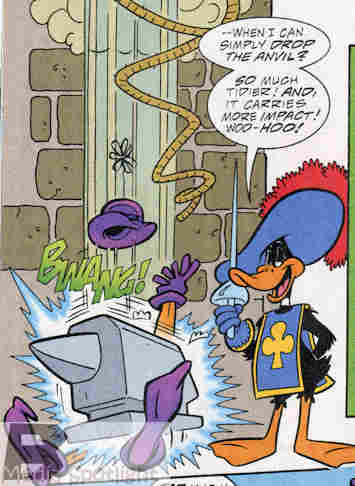
Unless you’re a toon or a 5th dimensional imp, this should kill you.
Continuity forms the history of these characters. Their past adventures, chronicled for the audience or not, form who they are and what they do, and inform on the world around them. I love a bit of worldbuilding, but setting the rules of that world is part of worldbuilding, as well as establishing how to break those rules and which ones are allowed to be broken before the story itself is broken. Thus it is important to make that world feel lived in and believable no matter how far its rules, culture, and science differ from our own. Their world must stay true to the worlds created for them. The Looney Tunes and Merry Melodies put Bugs, Daffy, and other in all kinds of situations and I can’t understand why Bugs is worried about dying by shotgun when Daffy just puts his beak back in place and moves to the next shooting, sometimes in the same scene. I accept it because that’s the rules of their world: the more evil you are the more immortal you are. I guess the good really do die young in Looney Tunes world…or did I get the wrong lesson here? The rule is “if it’s funny, it’s possible”. Bugs not being in danger doesn’t give us a story, and we’ve seen Bugs take his share of “should have killed us” lumps over the decades.
I’ve been reviewing Golden Age comics on Fridays and the only continuity in those stories tend to be “hey, we met this guy before”. Blue Beetle having random powers grew more ridiculous as the stories went on and played musical publishers until Charlton tossed out everything and created a namesake with a new origin. They liked the name but even the namesake got replaced by a brand new Blue Beetle, but his origins were still tied to the previous name holder, which would hold true with DC and their original Blue Beetle decades after DC bought Charlton’s hero pantheon. Rookie patrolman Dan Garret never crossed paths with The Flame, another Fox Features hero, despite both them and others having their adventures told in the pages of Mystery Men Comics. He also never met Dan Garrett the Egyptologist and master of every other form of science the story needed because writers think scientists know ALL the science.
Even then there is still some connection within the individual series. Speed Centaur doesn’t turn out to be a science experiment led to believe he’s the survivor of the last bastion of centaurs, at least as far as I currently know. (Now I wait for Cornelius Featherjaw to give me the bad news.) If that happens, then the series threw out what they already established in favor of a “better idea”, which we see today from the like of Retcon Geoff Johns. Retcon Geoff will even change his own continuity and established lore if he thinks he has a more interesting story.
So why should I care?
If someone I know dazzles me with their many adventures they’ve had in life, whether personal drama or scaling Mount Everest because they were bored, and then suddenly tells me none of that happened and this is what “really” happened, am I going to care? If I knew he was making it all up, fine. If they lied all this time and led us to believe the lie on purpose, we aren’t going to believe them. We know our lives exist from day to day, and our pasts make up parts of who we are and who we’ll become. That’s how a good writer approaches a character in a series.
That isn’t to say that in an anthology or a one-shot story the characters are somehow less real, but until some greedy studio or publisher comes along demanding a sequel that’s all they are: one time characters. You can still connect with Jim Hawkins on his great adventure, but that’s because a one time story only has to accept it’s own continuity for a short time. If Long John Silver’s backstory and personality kept changing all story beyond his duplicitous nature and growing respect for Jim even as the boy has to overcome his friendship for the sake of his conscience and doing the right thing, the story wouldn’t be the classic it is today. In a series you have more than one story to tell, and consistency makes the story feel like a world you could live in, rather than a series of stories.
I review novels a chapter at a time on Mondays, but if something in chapter 14 was counter to something that happened in chapter 5 without explanation, the story falls apart. Even within that set of stories, continuity matters. See my Chapter By Chapter review of The Merry Adventures Of Robin Hood, a collection of usually one-chapter stories that still had a shared storyline, and events mattered from one tale to the next, leading to a conclusion of those adventures that felt like a complete tale. You actually felt like you spent time with the bandits of Sherwood Forest instead of just reading about stuff that happened in the news. Robin’s actions led to events in later tales as did the actions done to him or his friends.
Continuity makes a story matter. For example, I could do an interesting story in Jake & Leon where we meet Leon’s parents. They could tell us all the funny stories of Leon growing up, and there’s possibly gags in there that will tell us more about Leon as a chara…wait, isn’t he an orphan? While I don’t remember if I established when that happened yet, he grew up in an orphanage so it clearly had to be early on as a child, if he met them at all. Could I change that? Maybe, but then what was the point of establishing his history, or Jake’s close family ties, if I’m just going to ignore them for “something better”?
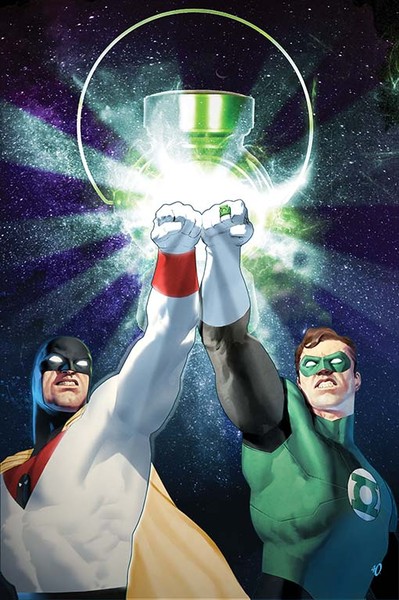
There’s a reason this team-up happened outside of either continuity.
I can’t even follow the Green Lantern ring lore anymore because that’s changed so much even after the introduction of the “emotional spectrum” and the Star Sapphires being retconned into being part of that whole thing. Not to mention how that way of thinking screwed up Hawkman and Donna Troi’s origins to complete incoherency. They have so many we stopped caring where they came from. TJ Omega, a reviewer I’ve used videos from many times over the years of this site, lost interest in the DC universe due to all the hard and soft reboots, stating that the continuity doesn’t matter anymore so there’s no reason to get invested. Why should I care if it’s just a series of stories? That could be an anthology. What we end up with is anthology, but with a shared branding, and that’s not a series or an anthology. It’s just a bunch of stories that don’t need to be all Superman, Batman, or Spider-Man.
Marvel is kind of responsible for bringing continuity to comics. While Batman and Superman hung out there were no consequences to their stories. The Justice Society hung out and swapped tales and that was it. They were just empty stories without any connection and didn’t even need to have the same characters. Realizing it would help the drama and form a cohesive universe not unlike our own, Stan Lee and his colleagues changed that. Characters crossing over weren’t just cool, they had weight and impact. Peter’s life felt more like an actual existence instead of just some story that happened to have the same names from this other story, and things that happened in one book could be important later as heroes met other villains (everybody whose anybody has dealt with Doctor Doom at least once) or made friends with characters from other books. Depending on current events, Spider-Man gets along with the Fantastic Four, though their first meeting was less than friendly. These weren’t just some random stories, it was a world we could get lost in.
If James Gunn isn’t even going to bother having an established history or future, then he won’t have a shared universe, which is what Warner Brothers wants from DC Studios. Instead it will be an anthology of characters we know, which we’ve already had up to this point with Superman and Batman before Snyder ruined their first live-action meeting, but may not recognize since even the core concepts don’t matter to him. Ask fans of the original Guardians Of The Galaxy in Marvel Comics, which may be the point where the adaptations began to fail. Call it anything else and all you lose is the brand name. If that’s all you care about, go make an anthology, but those names only matter because of the establishment of who those character are. Changing them in an adaptation loses what made those characters into people for the fans. Treasure Island doesn’t need a sequel, but you do need to be sure that events follow through in their adventures and their experiences. Any sequel some greedy company tries to make should reflect those changes but remember who the characters are. That’s why Luke’s turn to the emo side doesn’t work in The Last Jedi, not that he lost his way (that just ruins fan desire) but WHY he lost his way that failed his story arc and previous development.
If you want to make a series of one shot stories, go for it. Plenty of writers and TV shows have done it. Once you return to a particular set of characters, however, they must feel like the characters you knew, or have a good reason why they changed so much since high school when you last saw them. Otherwise you aren’t writing a series, you’re writing an anthology using previous names as cheap branding promotion. You can tell a bunch of different stories with a character called Superman, but if he doesn’t feel like the Clark Kent I knew growing up, I’m not going to care. That’s why I can’t get into the Absolute DC universe and why I’m staring to suspect I won’t care about James Gunn’s DC anymore than I did Zack Snyder’s. I want to see my old friends and heroes again, not someone that just has their name. There are a lot of John Smith’s in the world, but only one of them had TARDIS.



 BW Media Spotlight
[…] Continuity Vs Anthology: I still maintain that continuity is important in a series whether or not it’s in a shared universe. Marvel Studios used to be good at that and now even the comics are struggling because writers are more interested in their stories than their characters’ stories, even the ones they create. That’s not a series, that’s an anthology. […]
LikeLike