
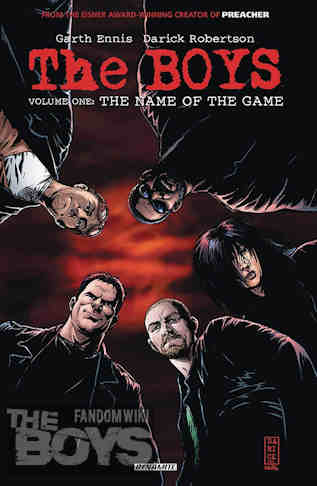
The Boys is a comic series turned streaming show about a group of people who keep superheroes inline or kill them off. They’re a vicious bunch, totally messed up, and have ties to either the superpower-inducing chemical Compound-V or those who were given powers by it, claiming to be superheroes while not being very heroic. Not that you’d know that without a hint of research because all anybody talks about is Homelander, the evil Superman stand-in who might as well be DC’s Ultraman rather than Superman.
You can guess that this is not my kind of story. As someone who loves superhero stories and has since childhood, I’m not all that interested in superheroes that are evil…or as we used to call them, supervillains. The only reason I have Watchmen and two of its sequels is I won them in a contest last Free Comic Book Day. The problem is most of these stories come from a cynical place, the idea that the superhero universe couldn’t exist in real life not because the science is wrong but the morality is wrong.
Enter Garth Ennis, a creator whose work I’m not familiar with because he never works on anything I would enjoy. So I can’t judge the quality of his work, though he comes from a point in time where getting more work required talent (and the occasional “who you know”) than what could be a good news story whether they can make a good comic story or not. There’s a reason Amazon Prime chased this to make a series out of during the 2020s superhero craze. So we’re going to assume he’s a good writer and that everything I’m about to disagree with him on is opinion, taste, and preference. In an recent interview for the English version of El Paīs, Ennis joined interviewer Ángel Luis Sucasas Fernández (I had to copy/paste that) in a cafe to discuss why he created his comic, telling me why he’s not the best choice for superhero comics because he doesn’t really understand what makes the superhero story so beloved. Yes, The Boys has a strong fanbase behind it, but either they can accept the contrast or they just share his views on a superhero world. This is all personal perspective. I’m not trashing the man…but I really don’t agree with him.
“What would happen if superheroes existed in the real world?” That was the question asked of Garth Ennis, 55, at the recent 30th edition of the Avilés International Comic Book Festival. His answer was simple: “A nightmare.”
Ennis is one of the greatest comic book writers in the history of the medium. He created his own influential series that defined the 1990s and 2000s, such as Preacher, Hitman, and Crossed, and he has also written iconic runs on characters that marked an era, like John Constantine in Hellblazer or The Punisher, Marvel’s most violent superhero.
I wouldn’t call Frank Castle or any of the attempts to replace him “superheroes”. At best the Punisher is an anti-hero, but none of those books ever claimed to be superhero stories. The Punisher lives in a world with superpowered beings and Constantine didn’t start out in the proper DC universe. Hitman probably thinks he is bout I don’t know anything about the other two except that Preacher existed.
But it was with the television adaptation of The Boys, his savage satire of the superhero genre for streaming giant Amazon Prime Video, that the popularity of his work reached an extraordinary peak. In its fourth season, The Boys drew 55 million viewers worldwide in just 39 days, according to figures released by Amazon Prime Video; the fifth and final season is expected in 2026. Why did Ennis, in a genre he isn’t particularly fond of, create his own major superhero saga — a comic spanning over 1,700 pages across 72 issues? The reason was to answer another question: what would happen if beings with near-divine powers walked among us?
You told us the answer in the first paragraph: in his view it would be a nightmare. Not surprising that it gets compared to Watchmen.
“Watchmen [Alan Moore’s masterpiece, included by Time on its list of the best novels of the 20th century] already answered that question,” the Irish author tells EL PAÍS from a sidewalk café in Avilés. “And the answer was: things are not going to go well. Watchmen’s answer was: you terrify society with an external threat to force it to unite. Miracleman [also Alan Moore’s version], which I like even more than Watchmen, offered another possible answer: if you make everyone a superhero, no one can feel jealous of them, because they all have those powers.”
That sounds familiar.
My Hero Academia would answer the question with less cynicism. The few people who don’t have “quirks” are looked down upon unfortunately (if any universe needed a Tony Stark type it’s that one), but everyone else? Some people do become heroes and there’s even a school for it. Then again, Japanese media has given us a school to learn how to play a children’s card game. Not everyone uses powers to fight or commit evil from what I’ve heard. (I need to watch that and Tiger And Bunny). Some just use powers in their normal lives. In a world where everyone had powers, which technically The Boys and its various comic and Amazon Prime spinoffs don’t, people would still just be people…with powers.
“The Boys answers in a different way,” he says. “My superheroes have the ego of a young pop star — but they also act as active members of society, perhaps saving the world or preventing disasters. That puts them somewhere between a pop star and a politician. Finally, they would be owned by major corporations — probably the most destructive force in human history. If superheroes could be real, Amazon and the others would have their own.”
I’ve seen other stories where kids get powers and go crazy, but the problem with Ennis is that he treats this as the default mode, the same as Alan Moore has in various works. Not surprising he’s inspired by Moore.
Ennis takes the most terrifying implications of this hypothesis to its extreme in chapter 21 of The Boys, which he co-created with illustrator Darick Robertson. Inspired by the 9/11 attacks, the episode follows one of the planes hijacked by terrorists, which, in the world of The Boys, the superhero squad attempts to save. The carnage that unfolds — culminating in Homelander, The Boys’s version of Superman, abandoning the plane as it plummets onto a New York bridge — is unforgettable. The shocking and horrifying sequence stems from a rarely explored premise in the superhero genre: what if the person meant to be the savior is utterly useless and incompetent?
The writer doesn’t know that the Boys aren’t the superhero squad, they’re the antisuperhero squad. The Seven is the name of the corporate superteam, but that’s me seeking clarity. The problem with this is that Superman has saved airplanes in the way Homelander fails to do here.
“They have no idea. They’re amateurs. They don’t have a plan. How does a plane work? Its aerodynamics? What happens if the tail falls off? [Homelander makes the insane decision to rip the tail off the plane, mid-flight, to try to save the day]. What happens, no matter how strong you are, if you don’t have any leverage? The thing is, these guys aren’t trained in combat. When the people on the plane rush at Homelander, the way he tries to get them off is like the squeals of a panicked child: ‘Get away from me, get away from me!’ But of course, with super strength, every time he pushes someone, he decapitates them. So it’s a massacre.”
When has any superhero story cared about that? Lifting a bus from the bottom is impossible. Building take more punishment and stay standing than they would in real life, which 9/11 demonstrated with the Twin Towers and the Pentagon. Heck, according to science Superman/Homelander’s powers shouldn’t even exist? When planes fly they use propellers, jet engines, and wings for lift and propulsion. How do these heroes do it? Look at Homelander’s power list. So many of those go against real world science. A world should be believable, set with its own rules of science. Ennis is cherry picking which rules of science to follow, going against what most superhero books do as part of his attempt to show what heroes would be like in the real world. From there the article goes into how violent Ennis’ stories in general and The Boys specifically are.
“Sometimes, I do it for satire. But in works like Crossed or The Boys, it’s for honesty,” says Ennis. “I try to be as honest as possible about the effects of violence. I think it’s something that needs to be weighed very carefully. In most superhero comics, violence has no consequences. People kick each other, punch each other, explode each other… And nothing happens. Death doesn’t mean anything in those comics, because every time someone gets killed, you know they’re coming back.”
“I prefer to show, sometimes, that the truth is that the consequences of those acts are terrible,” he continues. “That extremely horrendous things would happen. That’s why, generally, in my stories, when someone dies, they stay dead. And I think I’d like to encourage other writers to do this: to explore the consequences of violence.”
That takes the fun out of it. Again, he’s adding in some real world science while ignoring others. It still doesn’t reflect superheroics in the real world any more than his cynical take on how people would react to having superpowers. What’s weird is the final paragraph has him talking about how pessimistic he is (because of a certain two-time President, of course) and that “idealism is dying”, but Ennis is part of the problem rather than the solution. Few if any of his heroes are heroic. He insists that anybody who has superpowers or access to magic would immediately be evil or at least sociopathic/psychopathic and obnoxious. I have to wonder if that means that if he had superpowers would he suddenly turn evil? Or does he already have the personality that, were he to wake up with Homelander’s powers (in defiance of science) he would be evil? Anybody who assumes everyone with superpowers would be sociopaths, psychopaths, or jerkish scumbags is the LAST person I’d want to get superpowers because they already know they’re evil, or assume their the exception, which could lead to other problems. I don’t know how you can write heroic characters, especially superheroes, with that view of the human race?
Superheroes owe their success to being fun, to exploring the heights of humanity not because of the hero’s powers. Homelander is using a power set that’s become the standard for powered heroes throughout superhero stories, in the tradition of what became Superman’s most well known power set. What makes Superman and Homelander super is not what I care about. It’s what they do with those powers. It’s why I want to read Superman, to see how to be a better person (depending on the writer) and apply it to my superpower-free life and world. Homelander is everything I don’t want to be, and everything I don’t look for in a superhero story. Superheroes should be better people, supervillains worse, an example of how not to live and the embodiment of the obstacles we face in our lives (not necessary any one person or group unless you’re an activist). Seeing the hero overcome, save the world or their corner of it, and doing it because it’s the right and moral thing to do is what I come to superheroes for because I have seen people be better. I believe that humans can be good while acknowledging they can also be pure evil and somewhere in between all that. I don’t think everyone with superpowers would immediately want to conquer the world. I’ll take Superman and all the other powered and unpowered superheroes any day because I want to believe that good people exist and would use their powers like that. If not, I still want to visit that fantasy from time to time and hope for a better world.
If you’re against the rising pessimism, stop being part of the problem and be part of the solution.


 BW Media Spotlight
I thought about going on a short tirade about how the Superman/Homelander comparison is glaringly apples-to-oranges for a myriad of reasons, but instead I think I’m just going to say that The Boys comes off as an attempted “Take That!” from an angsty emo teenager who can’t stand anyone liking something he doesn’t, and delusional enough to think anyone actually cares. Maybe traditional superheroes are unrealistic, but I’ll take the artificial optimism of Superman over Ennis’s kiddy pool of bitterness and cynicism any day.
And we should really stop calling Frank Castle an anti-hero and call him what he actually is–a mass murderer.
LikeLiked by 1 person
[…] Garth Ennis And Why Hating Superheroes Is A Bad Way To Write Superheroes: When “hated character syndrome” spills over to an entire type of character, maybe you shouldn’t be writing it. This praise of The Boys gets confusing the more you read it so I have to comment on it. […]
LikeLike
I think you miss a lot of the points of the boys. The reason very few of the characters in the boys are heroic is not because it’s not Superpower= Evil. But rather corporations/ military industrial are what control Superheroes and exploit them. Homelander isn’t a character he’s a corporate product. That said Ennis comments on his love of Superman in Superduper where it’s kinda clear Auntie Sis is a stand-in for for Superman ( legion of Superheroes).The one good Superhero is the Love Sausage because he’s the one outside of Coporate landscape. The Boys themselves are not good people but because Butcher is without moral’s he’s the one to best defeat the Supes because he has no reservation. And yet the ending message is that Hughie at his core is the moral center of the book. He’s the one who has empathy. Butcher’s cynicism is just as amoral as supes he’s fights.
LikeLike
My title may then bit a bit off but he’s still following the “superheroes in the real world would all suck” approach. I’ve other stories with corporate superheroes (the anime Tiger & Bunny comes to mind…I should finish that) and the ration of actual heroes to scumbags calling themselves heroes leans more to the hero side. Tiger even wants to bypass the corporate system and be an actual hero. Plus I’m sick of all the evil not-Superman characters like Homelander because it’s all these deconstruction stories want to make him out to be where are more ways to deconstruct the Superman type beyond that. Even Marvel’s The Sentry tried to do something different, and you can make the case that The Void still falls partway into evil Superman. It’s one of the reasons I don’t care for deconstruction stories.
Also, sorry this somehow ended up in the spam block. Glad I caught it before it self-cleared.
LikeLike