
Yes, this is now an official article series. You’ll find all the previous chapters and one important sidebar in the BW Prose library. That’s also where I debuted the fancy logo above.
For new readers (hello and welcome) this started out as me combining the Primus and Quintesson origins into something more science-fiction in format. As I thought more about my issues with Cybertronian history in recent incarnations I started following up on that with a series about how I’d write the history of Cybertron, how and why the war started, and how Transformers functions as robotic lifeforms. None of that pseudo-organic stuff. In the second installment I went into how Cybertronian life works, with how Sparks are created and what components keep a Cybertronian functioning as a living being. No “organs” or “DNA” knockoffs here. Maybe with technorganics, but I’m hardly worried about that right now. We don’t even have a functional Cybertronian society.
To get there we need to dig a bit deeper into how Transformers work both mechanically and as lifeforms. I thought I was going to dig more into the various alternate modes the toyline has produced, since making the toys the source material is important to how I approach the lore. After rereading part 2, I don’t think that’s so necessary anymore. So instead I’ll play with other toy gimmicks and go over different types of transformation, size classes, and a basic overview of functionality that I’ll go over in more detail as we form Cybertronian and Autobot society. [Additional commentary outside of our Chronicler character will formatted this way.] So let’s return to the Chronicler as he tries to explain Cybertronian basic perspectives to his fellow organic beings.

While I’ve already discussed the various types of alternate modes in my previous report on Cybertron’s early years and the nature of Transformers as a race, there are a few more details into designs and their own mechanical advancements before, during, and after the various wars and skirmishes that have developed over the centuries. Alternate modes–whether they’re some kind of vehicle, animal, tool, or other forms–are chosen by individual transformers based on their body type design, personality, and in many cases chosen function. For example, a rescue worker will usually chose a rescue based vehicle. Law enforcement or military units will chose a form for their function, and the same for a cargo transporter. If they’re, for a random example, the equivalent of a banker, wouldn’t need a specific alternate mode unless they transport the hard currency, so they have more options available to them. It’s like how organic people choose clothes or a vehicle, except for them it’s the same thing.
These are of course ideas that Cybertronians developed themselves when forming their society, the phrase “form follows function” means more here than in architecture. It was coined by Louis Sullivan, with the idea that a building should designed for its function. You don’t make a bank with the same ideas as a house, though in the early 21st century the idea of renovating one building into another or finding multiple purposes for a living space became common. The expression “clothes make the man” and “dress for the job you want” also come to mind and certainly fits more when your entire body has to match either your function, your lifestyle, your personality, or some combination of the three. There are a few further factors that play into how a Transformer chooses an alt mode that we could also get into.
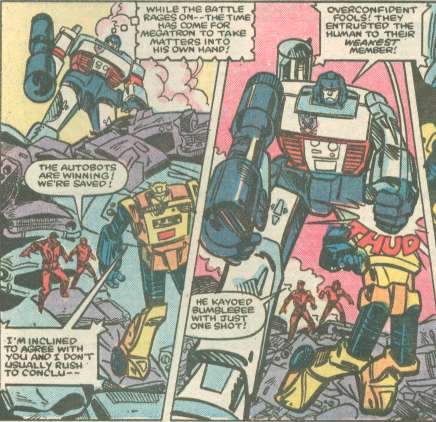
Did he crush Bumblebee’s head or smack him in the chest?
Size Class
This one is hard to follow because the various names of how Transformers designate size class has changed so much over the years, especially after the ending of the Great War allowed for more advancements than new types of weapons and transformation techniques. I tried asking bots of a more recent generation about the Mini-Car, a classification I caught in early research, and they looked at me funny. I think that’s what they did. One bot had a faceplate and visor while another seemed to have a dumb expression the whole time. Probably not the best sampling of their generation at the time. It doesn’t help when later research and talking to historians and technicians of various genders showed that most if not all former Mini-Car robots upgraded their bodies and thus that classification (also referred to as “mini vehicles”) no longer matters. Deluxe seems to be the only one that survived the early days of Cybertronian size classification as other names have been reclassified for various design reasons. Even the “Titan” class is a relatively new term for city-sized Transformers like Metroplex.
In fact, “size” might not be the right definition of this classification. Internal components and part shifting engineering seem to play a larger role in the classification these days. Further confusion comes from scale issues. In the early days of contact with organic worlds like Earth and attempting to disguise as the planet’s vehicles to blend in for various reasons, plus the later researchers using organic beast modes, didn’t always match the vehicles and lifeforms of that world. During first contact and the awakening of the lost crew of the Ark, there wasn’t time to check those details. They needed rebuilding and the computer who had little research on vehicles didn’t have time to get those details right. Such discrepancies have continued to this day. Thus the size of the alternate mode, whether altered to match native vehicles, animals, and other forms, are also not a good way to understand this classification.
In short, good luck working this one out. I’m moving on and this is my job. If the Cybertronians themselves are having trouble…well, I guess some things are just normal whether you’re a biological or technological civilian at the whims of the “smarter than you” people.
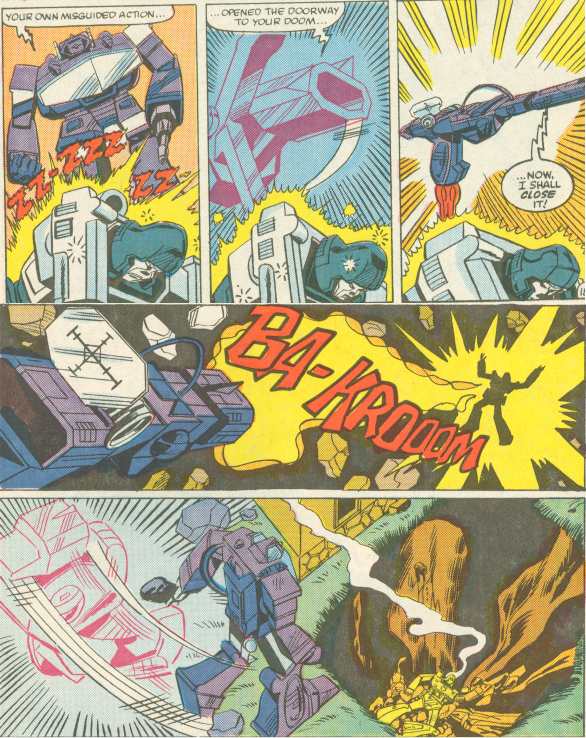
“But I thought you were sycophantly loyal beyond common sense.” “Wrong continuity, Megatron!”
Transformation types
This will be the bulk of this report. While my last report went over alternate modes, it didn’t go over the various types of transformations. Many were developed during the war. Headmasters, for example, were a creation of the Great War, when a group of Autobots and Decepticons arrived on the planet Nebulos. Additionally, there are Cybertronians who prefer to stay in one mode or the other for various reasons. I’m not a Cybertronian psychologist and I’m not getting into that. To each their own.
I’m not going to rehash the various vehicle types or other alternate modes themselves, or that’s what this whole article would have been and originally was going to be until I reread the previous one. I think that’s enough data. However, various design features in certain body types make for different forms of transformation either on purpose or by nature of the design. The majority of Transformers simply have two modes, a pretty simple explanation. There are some interesting outliers in transformation I want to look at in this section because it may come up in later reports as they stand out from the normal and more simple “robot to (x)” designs.
Multiformers: There are some Transformers who, through clever use of their design, extra components, and manual manipulation of their transformation cog (the component that controls the configuration change between robot and other mode), alter their various forms with bits of the other. For example, using robot feet to act as a battering ram in vehicle mode, or becoming a flying car. This is not what I mean by “multiformer”. This is more like a human with the skills of a contortionist.
A true multiformer has the ability to assume a completely different alternate mode. For example, instead of a flying car he or she might be able to become either a plane or a car without scanning a new vehicle. Typical multiforming has at least two alternate modes besides their base robot mode, referred to as “triple changers”. Some have been known to have three or even six without semi-reconfiguring like the flying car example. One even bragged ten modes, but some of them in my research seemed more like a combination of multiforming and manual manipulation. That could just be my perspective, however. There is even the oddity of a robot with a second robot mode rather than a second alternate mode, but that’s extremely rare.
There are also artificial “Mul-T-Cogs” used by the Rescue Bots that force multiforming into their bodies without extensive retooling of their existing body or normal transformation cog, whether it’s capable of multiple forms or not. Most of these were lost during the Great War, much like the Rescue Bots themselves until one team was awakened from stasis and reformed the group, though a small number of Mul-T-Cogs were found by coincidence after the return of Rescue Bots during one of the many post-Great War skirmishes. Using these requires practice and training, and really only work well for Rescue Bots. It’s not as good as actually being designed with a “natural” multiforming transformation cog.
Amalgamation is a precursor to the Combiners technology created during the Great War in teams like the Protectobots (who kept the spirit of the Rescue Bots going until their return, commander Hot Spot being a former Rescue Bot). [Yes, that’s personal headcanon. Technically, so is this whole series. By the way, this is also me explaining Amalgamous Prime, who I think is supposed to be based on Combiners as to me many if not all of the 13 Primes are based on prior toy gimmicks. Having the Combiner as we know them seems weird for pre-war technology.] It utilized a reverse engineered combination–no pun intended–of multiforming and this older technology that actually came from the Quintessons. A robot or vehicle that can split into multiple operated machines has its benefits, though for living robots it proves to more often than not be more trouble than its worth. It requires the robot to either split their Spark between components, operate them by remote, or to basically have an AI drone for an arm.
A modern Combiner can have between two to six robots form a larger robot, while the old Amalgamation bots are limited by what they can control. Drone Combination has also been utilized recently but not with a great deal of success and has currently been abandoned for further research. Amalgamation these days are reserved for Combiners though there have been robots who can split their own bodies into two or more separate units, like the Duocons. Otherwise they tend to be simple components like separate bases or repair stations or something along those lines. Some can even combine with these components for armor or extra modes, a partsformer take on multiforming.
I should explain: a “partsformer” is a type of amalgam transformation where their pieces don’t operate on their own but is basically a pile of parts connected to one body. Some partsformers can also combine with another robot as extra gear. Yes, it can get confusing as technology advances and new terms aren’t invented. These are the same beings who can stick to the same size classification, after all.
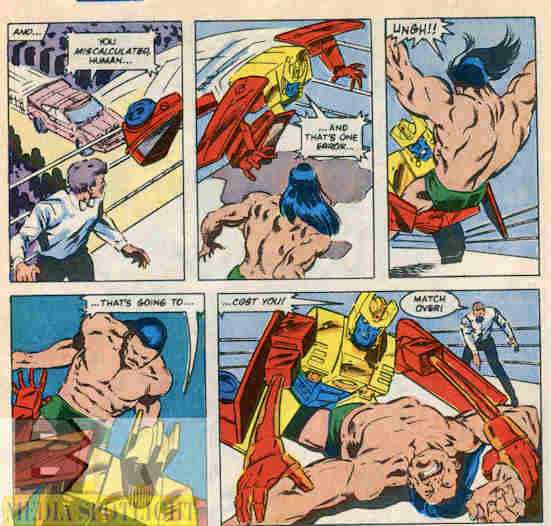
The three-count is redundant at this point.
Micromasters may or may not go here but I’m not sure where else to mention them. They’re a mix of size class and transformation type and also have an impact on Transformer society–their version of “dwarfism”–and on what alternate modes are available. There are no recorded examples of a Micromaster taking on a non-vehicle mode, for example. Whether this is by choice, mechanical engineering, or cosmic coincidence I couldn’t tell you, though you’d think taking on a tool mode with limited need for mass shifting (with no record they even have that system) would lead to at least one. Micromasters in robot mode tend to be human sized, but they were around long before the Head/Target/Powermaster technology.
I wouldn’t be surprised if their design didn’t connect to them in some way, but despite sharing the “master” suffix they are not formed from Nebulan “Mastertech”. They’re simply smaller robots, who do utilize Combination, amalgamation, and other component usage but not many of the other types. No multiformers, no beast modes as mentioned, though only slightly more respect from the larger robots. Whether or not that’s tied to the “Mini-Con” incident, a discussion for another time, is something I’m not well informed on. I kind of doubt it, personally though modern day Mini-Cons have hidden out as Micromasters. At any rate, there’s a reason Micromasters created their own city and series of bases, and how they’re treated by larger robots play a huge role, only getting any real respect during the Great War when their smaller size meant using less of the planet’s then dwindling Energon reserves. They get along better with humans due to a shared size and different concerns about the larger robots.
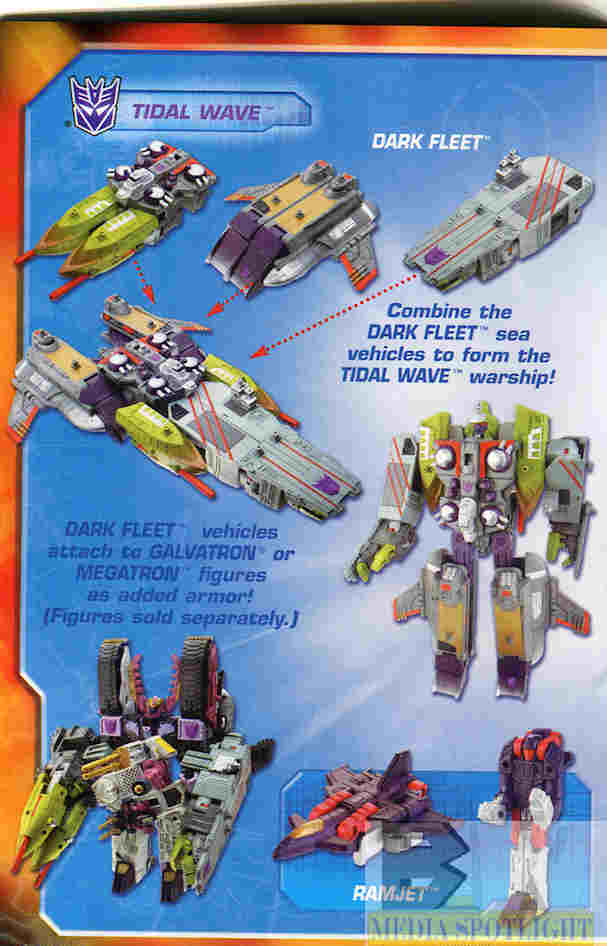
No wonder Tidal Wave is so dumb. His mind is all over the place.
In Conclusion
This doesn’t include other unique but self-explaining transformation types. Robots with quick transformations like the Jumpstarters and Battlechargers, or more recent “Flipchangers”. I also didn’t get into types of Combination and varied enough to have its own report if requested, as that was later tech, or other unique shared team gimmicks. This could get long and boring if I went over everything here. (Hopefully it hasn’t already.) [So say we both.] This is only an overview of what existed as Cybertronian society and culture began forming once the Transformers claimed the planet for themselves. These were Quintesson ideas and designs that the robots later used and advanced before, during, and after war.
We’ve looked at transformation itself and how it happens, and now we have the various types of transformation: from manual reconfiguring to full alt modes, from size differences to being in multiple parts, Transformology (the study of the art of transformation) fascinated me in my early years. However, this series is about Cybertronian history, not Transformology. I think we have all we need, but if other details are required I’ll provide more through the site’s host or a later report if necessary. Next time I want to look more into functions, the Cybertronian version of a “job”. While alternate modes may play a part there as well, it’s the next step in how they formed Cybertronian society and culture.



 BW Media Spotlight