

While this isn’t going to be a weekly series I did want to at last start the first one. For more about the comic, how I got it, why I’m reviewing it, and all the biases coming with it, check out the introductory article to this series.
You’ll also notice I amended something from the when it was originally posted. Tales Of The Black Freighter being an allegedly popular comic in the Watchmen universe rather than anything with superheroes gets talked up alot. They even made a direct-to-video animation of the thing to coincide with the movie. I always assumed the story itself showed up in the pages. I have since learned only covers show up. We don’t actually get a story within the story. Apparently it was an actual DC comic published in our world, and there’s a spiritual connection between the two works or something, but there won’t be a section devoted to that comic after all. I will, however, still give the documentation it’s own review section.
With that, I guess we just go into the first issue.
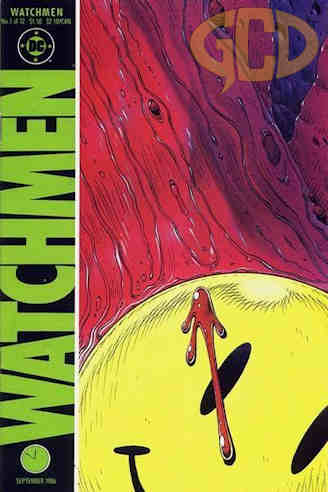
I’m not cleaning that up.
Watchmen #1
DC Comics (September, 1986)
“At Midnight, All The Agents…”
WRITER: Alan Moore
ARTIST/LETTERER: Dave Gibbons
COLORIST: John Higgins, who never gets credit, possibly because he’s not a co-creator of the concept and characters.
I’m working from the 2014 “New Edition”, a reprint of the “Absolute Edition” which redid the colors. Higgins is still credited, but I thought I’d bring it up. Images used to prove a point or break the text wall come from scans of the original 1986 comic, or so the site I’m using would let you believe. Yes, I’m using a pirate site, who in turn stole it from a DIFFERENT pirate site, which is kind of appropriate given Moore’s current opinion of DC and the pirate comic showing up as what he thinks would be the popular comic in that universe. However, my reviews are coming from the edition I personally and legally own. All I had to do was draw the right game piece out of a bag, but it’s still legally my copy.
The story opens on narration from Rorschach’s journal, setting our date as October 12, 1985. It doesn’t really tell you much about the world we’re about to enter other than he sees the streets of this city as a large sewer covered in blood, talking about a dog who I guess got hit by a car. We start zooming out from the infamous smiley button with a drop of blood on it just as it’s about to be washed down the drain with the rest of the blood on the street. Rorschach goes on about all the corruption and evils of the city and the usual stuff, and then gives a line about how all the corrupt people will look up and say “save us”, and his response will be “no”.
It gives the impression that Rorschach thinks himself above the corrupt city, believing people should have followed “good men” like President Truman. I’ll leave you to your own judgement on that. As the camera zooms further up the building we meet our first characters, police detectives Steven Fine and Joe Burquin, which are the names listed in the Watchmen wiki because they don’t use names in this scene. We see Joe looking out a window, commenting that it’s a long drop. This does draw you in. The button appears to be important and the camera coming up tells you someone took some kind of fall. Also, I mentioned on Literature Devil‘s “Morning Nonsense” stream (in the chat; I’m not interesting enough to be a guest and I’m usually waking up anyway) that I was doing this series and he pointed out something in the panel.
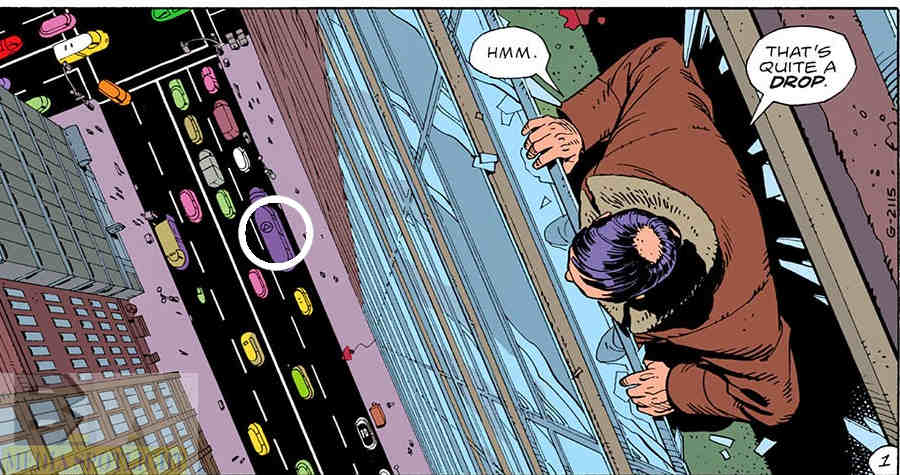
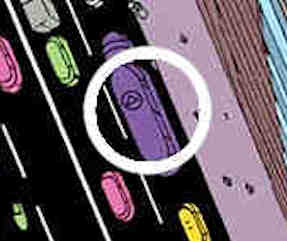
I don’t know how well you can see it on your device, but the circle is around a symbol that apparently foreshadows the responsible party to the murder scene. Let me zoom in.
The detectives start talking about the scene and the victim, which sets up exposition organically. The victim, Edward Blake, was clearly beaten up before being sent out the window to die punctured on a fence or something. As the detectives discuss what they think happened, the art goes back and forth, giving us the killer’s POV of what happened. We learn Blake knew Vice President Ford, that he recently did some ambassadorial work (in keeping with what Peacemaker’s alter ego Christopher Smith), and that this was likely personal. However, one detective tries to tone things down, worried that Rorschach will get involved. He will, but not for reasons Joe thinks.
We also learn that after the Keane Act passed in 1977, the only legal superheroes work for the government. They will not get involved as far as I know, but it does make me wonder why not? They would know Blake’s identity, or at least have it on file. Joe wants to keep them out of it as well, the usual struggle between law enforcement divisions and vigilantes in worrying about the government heroes and Rorschach. As they talk they don’t even realize they walked past the very vigilante they were worried about, but he isn’t wearing his mask until he begins his own investigation. He finds the secret room in the closet that reveals Blake’s superhero costume, which is somehow sillier than Peacemaker’s. I don’t know why he lies it on the floor, but one black and white photo gets his attention.
That same picture is hanging on the wall of a kitchen were two men sit, talking about their glory days. One is named Hollis, and the younger, Danny. Hollis tells Danny that he was the better Nite Owl, and it’s too bad he was kicked out of the business, probably because of the Keane Act. He disagrees, but the two head home. We also learn that a former villain called The Screaming Skull found Jesus and reformed. Supervillains reforming happens now and then and it’s nice to see. From there we watch Danny go home. It takes almost a full page of just walking home, but what pulls this off my usual pet peeve of such things is the atmosphere. We get a sense that it’s a lonely walk home. Some dude’s listening to talk radio on a boom box…which I don’t believe anyone who would buy a boom box fit for street performers would be listening to talk radio. It’s the established mood that makes this moment work and creates the cinematic feel Gibbons might have been going for. That’s what these kind of extended scenes are usually missing.
Rorschach is waiting for Danny when he gets home. He had plenty of food to choose from, I’d assume, but he went for the beans. Uncooked. Dude’s been on the streets too long. They go into Danny’s secret underground base and discuss the death of The Comedian, which turns out to be Blake’s former superhero identity. Apparently he didn’t know he was investigating the Comedian’s murder until then. Danny suggests that it might have been political, that Blake (not sure in which identity) had been taking on Marxists in South America. He also suggests a regular robbery, which Rorschach quickly shoots down given who they’re talking about and his skills. Rorschach leaves, with Danny still thinking about the good old days and wondering what happened. Rorschach easily answers “you quit”. We see a dejected Danny next to his Night Owl costume, clearly inspired more by Batman than any version of the Blue Beetle.
The next day he goes to a bar looking for information on Blake’s murder. Apparently this isn’t a new experience for the barkeeper. Rorschach mentions Blake was a friend and some guy mouths off about Rorschach actually having friends. It’s kind of amusing watching Rorschach slowly walk up behind him and his own friend deciding now was a good time to use the restroom…as Rorschach breaks two of the dude’s fingers asking about Blake’s murder. I guess they know his rep so they say they don’t know anything and would you please stop breaking this guy’s fingers. We don’t need the narration to tell us this is not his first visit here. Of course, we also didn’t need it to tell us that his landlady’s a slut and he’s sure they’re all pedophiles in the bar. Rorschach is…interesting.
His next visit is to Adrian Veidt, a very wealthy man from the looks of it. He also suggests that the murder was politically motivated, and Rorschach notes that since the US has Doctor Manhattan they wouldn’t bother. He’s convinced he was killed for his superhero life, a “mask killer”, but Adrian doesn’t appear to believe it. Rorschach also chews him out for leaving the superhero life, which he did two years before the Act was put together. Now he has a line of toys based on his old identity, Ozymandias.
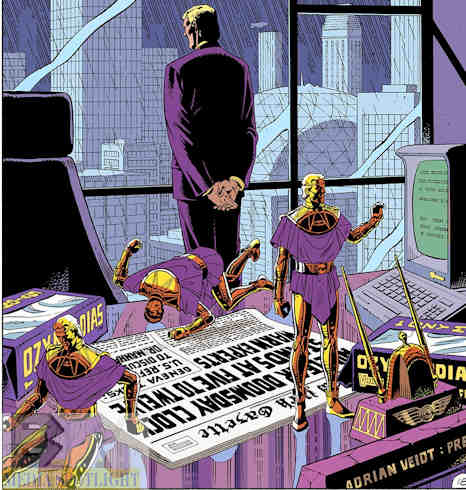
There are three things to note on this desk. One is the newspaper, insisting there’s a doomsday clock that will end the world in 12 years tops. It would take longer than that before we got Doomsday Clock, but we’ll get there sooner. We also see action figures of his old hero identity, so despite not wanting superhero comics apparently kids still want a superhero figure? I’m also drawn to that one at the top and the pose he’s in. I’m not sure why the head is backwards, but I sense there’s something to that pose. I could be wrong, though.
Rorschach continues in his journal about other former heroes he went to check out. Some have gone nuts or killed, and he apparently thinks Adrian is gay because Moore is trying to make us not like Rorschach. You know that if this were still The Question he’d be purposefully messing with his reputation, given he probably rejects Ayn Rand himself. Funny. Rorschach is coming off as a conspiracy theorist since this is one murder, and I have to wonder if this came back to alter The Question himself in the DCAU, which has become the default for Vic Sage. Finally he reaches the last two on his list, Dr. Manhattan (the only hero with real superpowers and still works for the government) and his wife, Laurie Juspeczyk, the latter not happy to see the wanted nut job. He tries to warn them about the mask killer, and again it’s blamed on other nations getting revenge, but this time he gets Laurie mad for standing up for Blake simply because he fought for his country. He also tried to rape her mother once, and we’ll see worse of him before the story’s over. So Dr. Manhattan teleports him off the military base they’re working on. Odd that Moore seems so against the character but Rorschach still has qualities that has given him fans among readers. Nobody here isn’t a jerk so you take the lesser jerk’s side, and he’s at least partly right about the motive for Blake’s murder.
For the first time in a while we get off of Rorschach as Dr. Manhattan and Laurie fill out more of this world. Manhattan’s working on a science project, Laurie mentions that Rorschach has a monotone way of talking, explaining the difference in word balloon styles but I would have gone with something more square and formal myself if “monotone” is what they were going for instead of gruff and gravely (I think the movie went that route, and it would match up occasionally dropping words from sentence–like that), but what do I know? Since Rorschach mentioned Danny, she decides to call him up. We get a sense that despite helping Laurie a few minutes ago he seems more interested in his science project. Even Reed Richards would tell him he’s making a mistake.
After more journal exposition, we see the tail end of Laurie and Danny’s dinner. They get to talking about old times, like a “villain” who was just into…being beaten up. Yeah, I didn’t need that. It does get them to laugh. Laurie’s happy to not be a hero anymore. She and her mom don’t get along. Again, she reminds me more of Black Canary and her mom than Nightshade. Danny, who has the Comedian’s badge that Rorschach left behind, notes that the reason they don’t laugh, or maybe the reason they are now, is that the Comedian is dead. Apparently nobody liked the Comedian. Rorschach is only doing this because he has a need to purge evil and whatever else Blake was, someone murdered him. We get that same pan up from the badge, this time showing the full city around Laurie and Danny as the main story ends, and leads to the first document.
Under The Hood
Yeah, my brain wants to add “red” in there as well. I wonder if that inspired the Jason Todd animated story? Mentioned a few times during the book, Under The Hood is written by Hollis Mason, the first Nite Owl, and tells of how he ended up there. These are excerpts from the book, with two chapters. Frankly, the first one was unnecessary. The idea is that Mason was told by a writer friend to start with the saddest thing from his life to get the reader’s sympathies. So we get to hear about how his family moved to New York, how his dad wanted to prove to his own father than he didn’t need life on the farm and wouldn’t be corrupted by it. By the time the story is over, his dad’s boss at the auto mechanic is revealed to have a bunch of naughty collectibles like dirty books and a pen that drops the girl’s swimsuit when turned over. His wife leaves him via a letter on the day he decides to play a joke on the mailman by wearing false breast. The hilariously tragic scene of him learning that his wife ran off with his chief mechanic, accidentally making everyone laugh as he declared this while still wearing the false breasts, and later killed himself that night…yeah, this is an Alan Moore work. Except to me it’s very much pointless to the story.
The second chapter is a bit better, going over what inspired Hollis to become Nite Owl. The first inciter was his moralistic grandfather, the one who hated his son taking his family to New York. The second were pulp heroes. Though they were more violent that grandpa would have liked, they still had a strong sense of morality. The third was Superman. In this world superhero comics did exist but I guess fell out of fashion when real superheroes, the appearance of “Hooded Justice” being the final inciter, started appearing. I don’t know. We had military comics and police comics, and those still pop up now and then. I don’t think the real thing would have stopped fiction being made of them. It would just be harder to find a superhero name not currently in use.
The first two drove Mason to become a cop, which fits with the character’s inspiration. Dan Garret was a rookie patrolman when he became Blue Beetle, and Charlton’s magical reimagining into archeologist and every scientist’s helper Dan Garrett was inspired by Charlton trying to create their own Superman type hero. It’s also nice to see fictional heroes as part of the inspiration for him becoming a superhero. That used to be Barry Allen’s backstory in becoming the Flash until more cynical minds reworked his origin.
Final Thoughts
Well, I could do with out the depravity mentioned, but thankfully it’s only mentioned. I know it’s adults, but Moore seems to be trying to prove Mason’s grandad right about the city being scum central. The worldbuilding is on point outside of the first chapter of the in-world novel. We get introduced to our various characters and where they currently are. One is rich, the other is poor, two are with the government, one is having his old life flashed on him, and one is a corpse. I also see Moore is already obsessed with sex talk, given the auto repair shop’s owner, constant references to characters being sex fiends, perverts, gay (which back then would have been listed under perverts whatever you may think now or he thought then), or pedophiles. Or at the very least the accusations were there.
Rorschach is interesting, coming off as the dirty bum of vigilante crimefighters, one that seems to be ignoring the anti-superhero laws (unless you’re a government sponsored hero and we only hear they exist). Dr Manhattan is…big and blue. The others have no connections to their superhero pasts except memories. Laurie is happy to be out of the life, but Danny (getting his first name from Blue Beetle though he’s more like Ted Kord) may not be so sure. The Comedian is dead, but we’ll see him in flashbacks as we progress. Critically the setup is fine. Personally I have yet to be proven wrong in avoiding this comic all these years. I have my own preferences for superhero stories, and whether or not this can be the exception we’ll have to wait for the rest of this series to examine. When I have a chance to read and review issue #2.


 BW Media Spotlight