

As I write this it’s very cold and rainy outside. Seems like a good time to read another issue of Watchmen. Plus it’s the first time I’ve been able to do a longer-to-write article just for the buffer.
The story so far…
The Comedian is dead. Falling from a very high window onto a spiked fence will do that to you. The only one that seems to care is Rorschach, the only hero who is still technically a vigilante. Ozymandias is writing his memoirs and living off his brand. Dr. Manhattan, who was working with the Comedian as a government superhero, is busy with his science studies. Silk Spectre II is happy to be out of the superhero game since her mom forced her into it. The only one that seems to miss the old days without still living them is Nite Owl II. None of the particularly liked the Comedian and they don’t consider Rorschach their friend either. I’m assuming we’ll find out why as the story continues.
We also started reading excerpts from a biography written by the first Nite Owl, telling how he was inspired to be a superhero due to the old pulp heroes. We’ll see more from that book, but first we’re going to check in to the murder investigation.
If you’re new to me reading this series, here’s the introductory article and my review of the first issue.
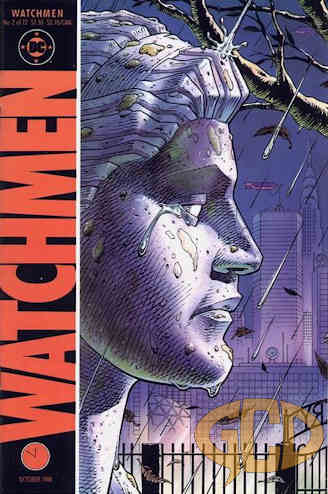
“Every time I forget my umbrella….”
Watchmen #2
DC Comics (October, 1986)
“At Midnight, All The Agents…”
WRITER: Alan Moore
ARTIST/LETTERER: Dave Gibbons
COLORIST: John Higgins
The opening scene is cut in-between Laurie meeting with her mother, the first Silk Spectre, and Eddie’s funeral. Personally I think superheroes should be buried under their secret identities…though considering how often they come back would make it harder to resume their lives: “we thought you were dead for real this time”. Also, when your husband can alter reality you’d think he could make transporting easier on the stomach. Maybe that should be his next science project. Dr. Manhattan had to go for official reasons, which is also the reason they give for making him put on clothes and not “nobody wants to see your big blue bodypart during a funeral”. Also, we have a guy with a “The End Is Near” sign, something that pops up a lot in this miniseries.
Laurie tries to keep from her mom that it’s the Comedian’s funeral but even though she’s sick (or “lazy” as Laurie claims) she still reads. She’s let go of that experience because she’s old. She’s no longer the hottie she used to be, so being sent a “tijuana bible” (1940s fan porn comic…like Moore writes these days) of herself in younger days she find it cute. She actually seems to have a healthy attitude about life, knowing that being in her 60s means she’s not the spry young lass she used to be and looking back to her younger days. She picks up a picture of the Minutemen in times past, of which she is now one of three, which triggers the first flashback. Gibbons tries to do this like it was in a movie, where we see the picture, then a flashbulb, and then the photo shoot, but while it probably worked in the movie, this is a trick that doesn’t work in a comic. Sorry, Dave, but comics have their own way of doing things. The flashbulb is just a white panel.
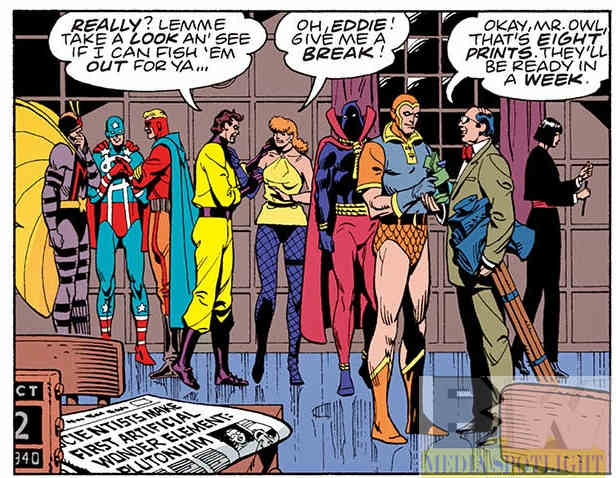
(l to r: Mothman, Dollar Bill, Captain Metropolis, The Comedian in his original outfit, Silk Spectre 1, Nite Owl 1, a photographer, and Silhouette
The Minutemen are getting a publicity photo. Afterwards they have normal hero banter, about the war that the US isn’t in yet for example. Comedian really wants in, but Hooded Justice would rather go back to the streets than even be here, nevermind getting involved in politics. (No comment.) Nite Owl invites everyone back to his place for a beer, but Silk Spectre I, who we learn is named Sally, says she’ll join them after she changes. While she’s changing, the Comedian walks in ready for force himself on her, sure that she wants it because of her outfit. Sadly this isn’t a point of view we have completely lost in current days but more people are aware of how wrong it is. I’m not going to get into that debate further because this isn’t that kind of site. She lets him have her fists just as Hooded Justice walks in. He calls Comedian out on his actions but his response is whether HJ gets off on this. Note that Comedian is currently on knees bleeding in front of him, the implication I think is that the hooded man is gay. The “hero” leaves and when she tries to thank HJ, he just tells her to cover up like she’s responsible for what happened. A different time, but sadly not different enough.
Sally snaps back to the present as Laurie continues to complain about the porno, which has her getting the rough treatment as Comedian accused her and Hooded Justice of wanting, so her response is noting that she’s sleeping with an “H-Bomb” and making it sound like Laurie is the government wife. You know, like government cheese, a wife supplied by the government. Not sure if that’s true but we’ll see as things go on. Right now, the focus shifts to the funeral, at least for a short time. Adrian is attending, which is curious. By now I think we all know his part in this, but there’s no reason for him to be here. Eddie and Adrian didn’t know each other, the Comedian and Ozymandias did. It’s Eddie Blake being buried.
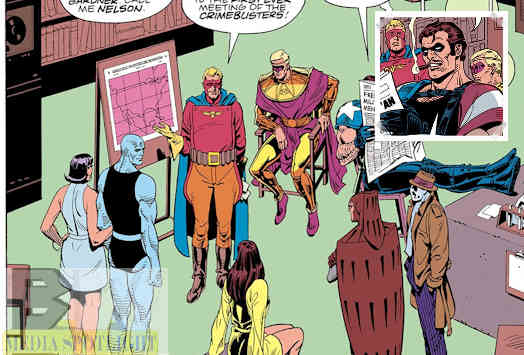
up top left to right: Janey Slater, Dr Manhattan, an older Captain Metropolis, Nite Owl II, Ozymandias, The Comedian’s second outfit (with insert of newspaper not blocking his mask). On the bottom is Silk Spectre II, Nite Owl II, and Rorschach
Adrian thinks back to the debut of his team, the Crimebusters, put together by Captain Metropolis. This is a better transition. Panel of Adrian at the funeral, panel of the same shot but at the meeting and Adrian in his Ozymandias outfit. That takes better advantage of flow in a comic rather than trying to be a movie. I’ve debate on whether or not comics can be called a visual medium with someone last week. His take was that comics don’t need dialog, that there are comics which have never had written words. This is true but most comics do have dialog, or something in the page to be read like a newspaper clipping to tell parts of the story. In most comic stories you have to read and watch, so I treat it as hybrid media, not just a visual or text one. For example the Comedian, in a new outfit, is reading a newspaper with the headline about France leaving NATO. While not what he’s reading, we’re meant to read it to set the time period.
Also in attendance are Rorschach, Nite Owl II, Silk Specter II, and Doctor Manhattan, but that’s not Silk Spectre on his arm. Comics.org tells me her name is Janey Slater, who I think is going to be important later but she’s not even named here. Captain Metropolis lists his reasoning for forming this team: to tackle drugs, crime, and…promiscuity? How does a superhero fight that? Especially with the Comedian on his team. Nite Owl and Rorschach, who have teamed up before, sees the benefits, Ozymandias thinks it could work with the right guy in charge, which the Comedian points out Ozy thinks it’s him due to being the smartest man on Earth. Don’t berate him too much, Ed. It’s more initiative than his inspiration ever showed in his own comic.
Comedian burns Cap’s display and walks off, ranting about how the nukes are going to drop in 30 years anyway so none of this matters. Shows what he knows, and our world didn’t need a giant squid to avoid it. By now the threat of a nuclear war is only a concern of a small group of people but back then all of the “safety warnings” (propaganda) was going on not just in the time of this flashback but in the time the comic was written. So that’s going to influence the story, with Cap’s notation that somebody should do something about this as we transition back to the funeral the same way we transitioned into the flashback, with Adrian in costume first this time. It’s still a better transition, and makes you wonder what Adrian is thinking now after remembering that. We all know what he’s thinking, but we’ll wait to get there.
We don’t spend long in the funeral setting before we get our third flashback, with Doctor Manhattan this time. Seems the Comedian’s story is our focus this issue. We have twelve issues so we have time for this, and since he’s been involved with so many of the characters in this story it tells us about them and their reaction to the still alive Eddie Blake. It should be noted that for this series I’m reviewing as I read so I didn’t know at the time how right that was. Doctor Manhattan’s flashback does tell us about his character as much as the Comedian’s. We also learn of a change to history thanks to Manhattan’s presence: in this reality the US WON the Vietnam War. At this point only these two are working for the government and Doctor Manhattan is the only one with superpowers, and one of the most powerful heroes in comics due to altering reality itself. His muse, Captain Atom, could only alter his own form, and while Firestorm (a DC hero MADE for DC) could alter the atomic structure of others, he’s not even close to Doctor Manhattan’s level in that field.
The war is over, the President is here to celebrate, but the Comedian couldn’t care less. The war is over and he’s ready to go home. To him the whole thing is a joke, which he seems to indicate is where his “hero” name comes from. “Once you figure out what a joke everything is, beint the Comedian’s the only thing makes sense.) The naked blue man finds it strange to treat everything they saw in war, listing some horrific stuff, as a joke, but “I didn’t say it was a good joke”.
Then a Vietnamese woman walks in, months pregnant and apparently the Comedian is the father. Not that he cares. He’s taking the first helicopter out and leaving everything behind, including her. Her response is to burn his face with a flare so he kills her. Doctor Manhattan calls him out on that but he fires back that the guy who can instantly restructure anything could have stopped him a bunch of different ways, and that the overpowered blue man is clearly losing his humanity. That’s why he left Janey, which we have to assume is the girl from before without research, and it may end up the same with Laurie someday. Doctor Manhattan contemplated it then and seems to be doing so now as well.
Dan has the final flashback of the funeral, but not the issue. This was in some of the promotional images for the movie, Nite Owl II in his flying ship during a riot, with the Comedian in a gimp outfit (because Alan Moore and I’ll spare you that one) as they try to chase everyone away. We learn that he and Rorschach don’t partner up anymore. Comedian says all the heroes are nuts now and points out a scribbling he’s seen before: “Who Watches The Watchmen”, one of the signature parts of the story. Comedian is happy dropping tear gas grenades (we assume it’s tear gas) and shooting rubber bullets, especially when they start taunting him, “they” being a blatant feminist, a dude demanding the “real” cops, and some woman yelling gay slurs and yelling about how her son is a cop. It seems that at this point the public are rejecting superheroes, but frankly the only one who isn’t a jerk here is Nite Owl, though he’s doing about as much to calm the Comedian down as Doctor Manhattan did earlier. In the present, Dan drops the Comedian’s now clean pin into the grave when nobody’s looking.
Someone leaves the funeral without talking to anyone. Rorschach follows him and smashes into his place. He’s the former supervillain Morloch, Rorschach’s next witness to forcefully interview. We get our final flashback unless you count revisiting Blake’s murder. Blake showed up at his place half in costume and all drunk, going on about something he saw on some island that was so horrible he actually seemed remorseful for the stuff he did in Vietnam. Then he leaves. This gives Rorschach a few more clues, but not much else. He visits Blake’s grave, pondering if any of them get to die in bed instead of violently. The investigation continues.
“Under The Hood” chapters three and four
If you wanted straight up proof that this book is a rejection of superheroes and other costumed crimefighters, chapter three of the first Nite Owl’s book will convince you. It actually started out interesting for a superhero fan and creator like myself as he goes over the various steps of becoming a superhero and following the example of fictional heroes like the Shadow or “real” heroes (in his world) like Hooded Justice. He goes over designing the costume and the various changes made during it like putting the mask on with spirit gum instead of string. He apparently follow Brad Bird’s “no capes” rule by showing Dollar Bill, a superhero hired as the protector of a bank chain, died because his cape got caught in a door and show point blank. Then he goes on about how superheroes were accused of being Nazis (apparently Hooded Justice started being on Hitler’s side until Pearl Harbor…for some reason) and perverts, and then claims people were right. You want me to hate your superhero story? That’s how you do it. Make superheroes look bad. This is the type of propaganda I expect from supervillains, or movie directors in the 2020s.
The next chapter is a short history of the Minutemen, and it sucks even more fun out of superhero stories. It also starts good. Captain Metropolis, a military strategist, decided that having heroes group together to compare notes and team up was a good idea. He called Silk Spectre because he had an agent, and I guess Sally and Laurie’s identities are now public knowledge as he doesn’t try to hide it, but doesn’t give away the identity of Mothman (I checked the wiki and he does have one–and comes from somewhere here in Connecticut before going insane), Silhouette was later kicked from the group when it was discovered she was a lesbian in the 1940s, with her and her lover killed a few weeks later. He went over other deaths we know and don’t know. There’s more hinting that Hooded Justice was also gay since it sounds like Silk Spectre I was acting as his “beard” until she married her manager. Apparently Mason didn’t pick up on it since unlike Silhouette it’s not outright mentioned.
Final Thoughts
Critically this is a good chapter. While chapter one focuses on introducing the main characters, this one is focused on the life of the Comedian and how he affected people around him, usually to the negative. It doesn’t really set any suspects up. There’s talk of some island, which could further suggest the theory everyone but Rorschach had, that it was tied to his activities as a government agent. What he saw there was apparently so horrible he was drunkenly repentant for his actions. Whether or not he was actually repentant we may never actually know.
We also learn a few things about the heroes that were around him. Doctor Manhattan is losing his humanity. The first Silk Spectre has learned to forgive if only for her own sake while her daughter still refuses to do so. Adrian was inspired in some way by both his actions and Captain Metropolis’ comments at the failed attempt to form the Crimebusters team. With the other two, however, we only learn about the Comedian. Nite Owl questioning what they’re doing only furthers Comedian’s reasoning for his “hero” name while Rorschach doesn’t have a memory of his own. Instead it’s the former supervillain Morloch who has a flashback mostly to show the Comedian’s mindset before his murder and give us our first real clue.
It’s the autobiography that really ruins the chapter for me. Villains don’t break out of prison. Superhero life is horrible, as are the superheroes themselves. I can see why Dan DiDio loved this story so much. This was right up his alley. This is everything I don’t like about the hero deconstruction trend, and then I remember this comic is ground zero. And the bombs will keep on dropping when I can get myself to read the third issue of this series.



 BW Media Spotlight