This may be the most unrealistic thing in Star Trek. Including what Abrams and Kurtzman came up with. 🙂 Also, I’m pretty sure those are damaged starships but I can’t pin the episode down. I did comment on the video “I forget the episode title off-hand but the footage seems to be from the episode where they find a starship “sargasso sea” debris group. It’s a form of recycling.” Got me a laugh from another commenter. Filmation was part of the various anti-pollution campaigns of the time, including an episode of Manta & Moray from The Super 7 that I used in Saturday Night Showcase.
I want to call what they used on Thawne a “speed trap”.
I put more detail work into this comic than usual. I wish the characters had been drawn better, but I still like what I did here. Also, I don’t buy the idea that somehow some evil speedster from the future is so good at time travel that he and he alone is capable of altering time without massive side effects, or that Reverse Flash would care if he did. With all the heroes–and villains–tied to time travel in the DC Universe I’m sure somebody could fix this mess. Of course, the only reason this situation exists is that DiDio’s Darker DC, which is technically still going on despite DiDio being gone, can’t imagine that a man could be inspired by a comic book to be a good person and want to fight crime even without superpowers. Heaven forbid comic creators actually believe in the power of storytelling in a comic. Nope, kill mom off and make every origin Batman-style.
So what happens this week, barring incidents? Well, I would like to get a Finally Watched in but no promises there. I will be continuing the Chapter By Chapter review of Star Trek: The Vulcan Academy Murders and finishing off the Free Comic Inside look at the Aliens: Space Marines minicomics, finishing that story off because it’s a lot of little comics. I also have one last physical comic I can cover. A co-worker years ago was into Fraggle Rock and asked me to order a collection of Star Comics Fraggle Rock stories collected by Archaia when they had the license. Unfortunately she left the job while we were waiting for it to actually come out and I didn’t have a way to contact her. It’s still here, with the first four issues as a trade. I’ll review those four in place of the completed Ninja Turtles run, and then it’s more article links on Tuesdays. Otherwise we’ll just see what comes out of the storytelling landscape this week. Have a good one, everybody!
Well, here’s a Showcase I never thought I’d have, even for a brief time. Thank the folks who run the Throwback Toons YouTube channel. That means this is officially licensed and everything. Of course, if that does go down (they stopped carrying the Iron Man anime for example), you’ll have to find it online elsewhere, and it looks like I can’t simply embed it like I though, but tonight is a special night.
Forget that disaster Netflix tried to pass off as an adaptation, nothing beats the original Cowboy BeBop, an animated series clearly designed with animation in mind, but since it came from Japan it doesn’t have to be “underground” or “indie” to not be a kids show. If you’re reading this you probably know the story already. In this future setting, “cowboys” are bounty hunters bringing in “bounty heads” around the galaxy. The crew of the BeBop consists of Jet Black, a former cop turned bounty hunter, Spike Spiegel, a former mob enforcer who grew a conscience, Faye Valentine, a woman who was trapped in hibernation following a warp gate accident and was comatose for most of her childhood, Edward, a teenage girl hacker whose kind of screwy, and Ein, a “smart dog”. Our heroes, or as best as we could get under the circumstances, are beloved around the world and that live-action demake showed how little they understood any of them.
Knocking On Heaven’s Door, known in the US as Cowboy BeBop: The Movie, puts our group in their most dangerous adventure yet, when terrorists start creating a dangerous situation on terraformed Mars. I’m not sure when this takes place in the show’s timeline (it might not, much like the DragonBall Z movies), so it’s still a question of whether or not our crew will come out of this alive. Forget everything you learned from the Netflix show, because they ignored everything that worked about the anime. Enjoy…although apparently it’s age-restricted so they make you go to YouTube. I didn’t know that at the time and I don’t have time to replace it! You can also find it on Tubi if YouTube’s nonsense annoys you, and both versions are in English.
I reject the notion that you can write anything for kids and call it a day without any real effort. Some of the best shows for kids are ones that stick with them as adults, even if they still aren’t stories for adults. Kids do not know anything about themes, or the “hero’s journey”, or context, but they understand a good story that interests them.
Author Mark Cecil, in an article for Lit Hub, goes over how telling stories to his kids was instructive in how he tells a story, even if he isn’t writing a story for kids. If you can grab a child’s attention, you’ve got a great story idea there.
Everytime I consider ending the site, usually after a readership drop, something comes up that reminds me why I keep going. I have learned the most interesting things since starting the Sing Me A Story article series for example. Sometimes I even learn interesting things about stuff I’m not normally interested. Take the sci-horror Alien series. You know what I just learned?
The character of Colonel Hicks also survived the second movie in the Alien franchise, Aliens only to die offscreen in the next movie, Alien 3, in a text report about his stasis pod failing and getting impaled. Possibly because the actor, Michael Bien didn’t want to die to a chestburster and they said “screw you, die in a lame manner”, but that’s a guess on my part. Also, Bien wasn’t the first actor chosen to play Hicks, and was a last-minute replacement when the chosen actor was found on drugs two weeks into filming. Bien is also Reese from The Terminator so this dude has a habit of playing heroes who die. Poor guy.
Meanwhile, Hicks being dead messed with various Dark Horse stories that expected one of the survivors of the second film to not suddenly die out of some strange insistence that Ripley be the only not-dead person at the start the next movie in the series except for the time she died and was cloned. So in reprints of adventures that Hicks appeared in very much alive the character was renamed “David Wilks”. What does that have to do with minicomics?
For those of you who haven’t figure it out, we’re back to the minicomics connected to the Aliens: Space Marines toyline, or as I like to call it during today’s research “not @#$%$#% COLONIAL Marines, SPACE Marines! That’s a different comic you stupid search engine!” This one came with the Colonel Hicks action figure, so no love for you Wilks fans. Apparently the minicomics exist in some alternate timeline given how many other characters aren’t dead despite being so at the time the toyline came out. After all, you need more than one human, especially a girl in a boys line, to fight the various types of xenomorph. So let’s check out another installment of Ripley And Her Not Dead Friends.
This is actually a multi-part story, and do you know how many times I’ve had to rewrite this? Get the Marine, and then get the xenomorph introduced, rinse and repeat. Every time I think we’ve reached the final issue, the story gets continued. Considering how short they are, that’s hardly the bargain it sounds. I finally got to #8 before I stopped. I guess the comic story isn’t the only thing that’s going to be a multi-parter.
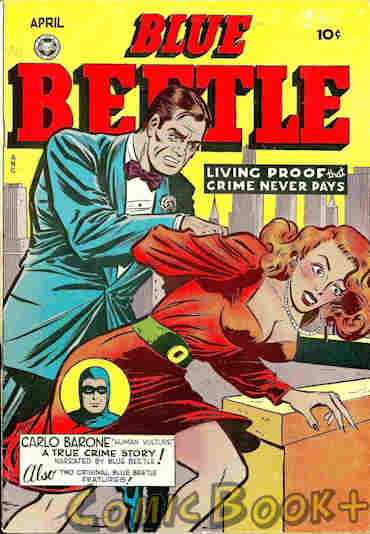
Either Dan & Joan have a kink or they forgot to put the title character front and center again.
Blue Beetle #55
Fox Features Syndicate (April, 1948)
It continues to disappoint me that they’re not even using the title superhero on their cover, except in a circular inset to tell us he’s narrating. If you want to make a true crime comic, make it its own title and let the Blue Beetle have his comic back. It’s a variant of the problem we have in comics today. Make the comic you want and if you can’t find someone to do this comic right, end it. Apparently they don’t think the superhero is really selling the title or he’d be the star of the front cover and there wouldn’t be a true crime back-up feature where Dan starts narrating but has to change into costume before the story proper starts.
What is the point of that framing device, anyway? You really want the Blue Beetle to do the narration for some reason? Fine. But why can’t he either do it as Dan or just start him off in the Blue Beetle outfit?









 BW Media Spotlight