Well thanks a lot, guys. Now I have to push CBS Transformers off of the schedule this week because you drop this as people were going to bed last night. I had TWO installments auto-scheduled so today I could focus on getting my Christmas comic out by Christmas, but instead we have to talk backstage nonsense. Figures.
In case you somehow missed the buzz today, Netflix has won it’s bid to acquire Warner Brothers and everything that comes with it. Note that this is not yet a done deal. Final negotiations still have to happen, Paramount’s new owners Skydance, the most favored of the bidders, is raising a ruckus, and part of the deal is for Discovery’s side of things to take some stuff with them when they go, but for all intents and purposes the paid streaming service has won the day, the Warner Brothers back catalog, and the resources to make more theatrical and TV/streaming shows. Apparently everybody wants Warner Brothers…except people who own Warner Brothers. It wasn’t that long ago that Discovery Networks took this off of AT&T’s hands after they got it from AOL Turner Time-Warner.
Of course everyone involved with discussing the entertainment media have thoughts on the deal. I share some of those thoughts, and yet there are a few that aren’t being brought up that probably should. No matter how you look at it, this may be great news for Netflix and for David Zaslav’s accountant, but for the movie industry, fans, and various corners of geekdom this is not a good sign for the future. Let’s discuss.
Never bring a fist to a knife fight…when you can make it a gun fight.
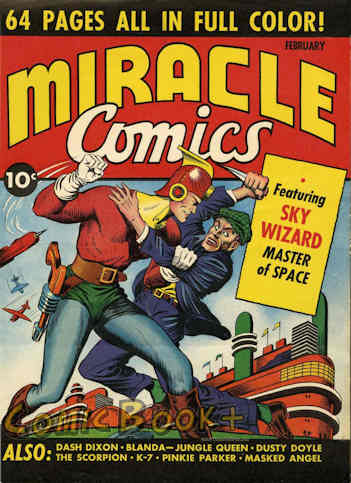
Miracle Comics #1
Hillman-Curl Inc. (February, 1940)
A new title and from what I can tell a new company. So we’re about to see some brand new characters that never made it. Miracle Comics seems to have only lasted four issues while the publisher continues on. That does not bode well, but unless the stories are really bad I might go through all four issues when they come up on Comic Book Plus’ virtual newsstand. I could use some new old material.
Apparently he didn’t catch the skip when talking about Thundercats. Tigersharks was the action show from the anthology The Comic Strip. The only other segment I liked was “Karate Kat”.
From what little I know, the Helldivers game franchise is a Starship Troopers (first movie) style parody of militaristic worldviews or something. All I know is it’s not my prefered type of game, but it only matters because the latest news about an upcoming movie sparked the commentary. Neither of us need know anything about these games.
The director of the movie adaptation sure doesn’t. And it’s apparently a selling point to his getting the job.
Spencer Baculi of Bounding Into Comicsis reporting that Justin Lin of “Fast & The Furious” fame is set to make a Helldivers movie, and that not knowing the source material is what got him the gig.
In waving the reddest flag possible ahead of Super Earth’s next major deployment, a live-action Helldivers film is now in production under the helm of Fast and Furious franchise director Justin Lin, whose winning pitch reportedly “leaned into” the fact that he has absolutely zero familiarity with the video game medium, let alone Arrowhead Game Studios’ acclaimed democracy simulator.
So a guy who doesn’t know Pac-Man from Cloud Strife is going to adapt a game he probably doesn’t know contains neither of those characters. At a time when bad adaptations are rampant in both Hollywood and comics, it seems that ignorance isn’t just bliss, it’s welcome. As the article goes on, I don’t need to know about the game to feel sorry for the fans because I’ve seen it happen to far too many of the shows, comics, games, and old movies I DO enjoy. It’s one thing for the studio system to not learn from past mistakes. It’s worse to see them double down on stupid and treat it like a good thing, which I’m expecting shill media to start telling us is a plus. No, it’s one of the problems with Hollywood, and while it tends to be a long standing one, it somehow gets worse when banking on the success of existing properties’ pre-existing audience runs into people who hate or at least look down on those properties and where they came from. So let’s go over this again.
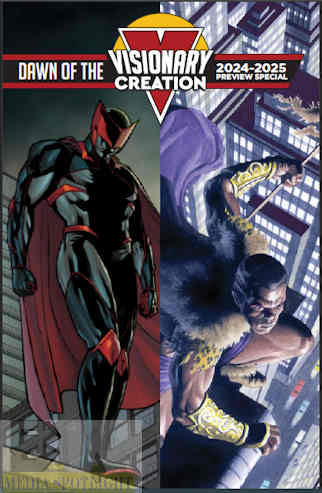
Visionary Creation is the main Visionary superhero universe, from what I can tell primarily the years long design of C. Edward Sellner, finally made into a comic. For some reason trying to bring the actual page from Drive-Thru Comics for this comes with an error, but it was still in my library so I’m checking out.
The preview contains short tales from various titles in this shared universe, so we’re going to speed through these.
Yes, it’s that time of the year again. Pine trees are decorated with lights and little art pieces of Christmas symbols. Gingerbread Houses are built but never eaten because the only thing harder are fruit cakes, or so the lore goes. Children wait for Santa Claus with the hopes they were good enough to get presents. Christians honor the birth of their Savior, the reason we actually have a Christmas, which is why the Christmas haters hate Christmas. And moviephiles take to social media, podcast panels, and the occasional physical gathering to debate the big question: is Die Hard a Christmas movie?
Loosely based on the 1979 novel Nothing Lasts Forever, the sequel to Roderick Thorp’s The Detective, Die Hard follows NYPD police detective John McClane, in Los Angeles to spend Christmas with his estranged wife and hopefully see their young daughter. Meeting up with his wife at an office Christmas party, trouble arises when crooks posing as terrorists try to rob the building’s vaults. During a party. With a lot of people. This seems like a very dumb idea, but I’m not a psychotic crook posing as a terrorist. It’s up to John the police everyman to get past and take down the bad guys and rescue the hostages despite the police being of little help and having to gather his resources along the way, like weapons and combat skills. Originally panned by critics, today’s critics praise it for pretty much the same reason: the action and characters. While the novels and the story of Joe Leland end here, McClane would continue through a series of increasingly panned sequels.
It also the source of a huge debate as film geeks argue every December whether or not the July released movie (long before the whole “Christmas In July” sales campaign) qualifies as a Christmas movie. It’s a huge, fiercely argued debate. Well, here’s my opinion: I DON’T CARE ANYMORE!!!!!!!!!!!!!!
I don’t mean “I don’t care” in the same way I don’t care about the Superman Vs. Batman debate as to who would win (I want to see the heroes fight VILLAINS, not each other) or Unicron Vs The Death Star (Unicron at close range, Death Star at a distance, now shut up). I mean the level of rage and insistence of being right that I see has gotten me to the point that I don’t want to even hear the debate. I don’t even want to watch the movie when it isn’t Christmas, nevermind when it is, to protest both sides. Now for the record, I do have a definite opinion, and maybe it will leak out in this commentary to anyone not fixed on their view as “the absolute truth”. However, I’m not going to state it here officially because doing so will miss the point that I’m sick of both sides of this argument, both from the pro-“Die Hard is a Christmas movie” and the anti side. You’re both draining the fun out of it and now taking other movies with you, and I just don’t want to hear it anymore. I stopped listening to a livestream recently as the host argued with his audience, allegedly in good fun but at this point I’m not convinced anything about this debate is fun. Rather than discuss my reasoning for whether it is or isn’t a Christmas movie, let me instead go over why I want this debate to die…and I will be taking both sides on for this because you’re both the problem!








 BW Media Spotlight
Netflix To Take Over Warner Brothers: What Does The Future Hold?
Well thanks a lot, guys. Now I have to push CBS Transformers off of the schedule this week because you drop this as people were going to bed last night. I had TWO installments auto-scheduled so today I could focus on getting my Christmas comic out by Christmas, but instead we have to talk backstage nonsense. Figures.
In case you somehow missed the buzz today, Netflix has won it’s bid to acquire Warner Brothers and everything that comes with it. Note that this is not yet a done deal. Final negotiations still have to happen, Paramount’s new owners Skydance, the most favored of the bidders, is raising a ruckus, and part of the deal is for Discovery’s side of things to take some stuff with them when they go, but for all intents and purposes the paid streaming service has won the day, the Warner Brothers back catalog, and the resources to make more theatrical and TV/streaming shows. Apparently everybody wants Warner Brothers…except people who own Warner Brothers. It wasn’t that long ago that Discovery Networks took this off of AT&T’s hands after they got it from AOL Turner Time-Warner.
Of course everyone involved with discussing the entertainment media have thoughts on the deal. I share some of those thoughts, and yet there are a few that aren’t being brought up that probably should. No matter how you look at it, this may be great news for Netflix and for David Zaslav’s accountant, but for the movie industry, fans, and various corners of geekdom this is not a good sign for the future. Let’s discuss.
Continue reading →
Tell others about the Spotlight:
Posted by ShadowWing Tronix on December 5, 2025 in Animation Spotlight, Comic Spotlight, Movie Spotlight, Streaming Spotlight, Television Spotlight, Video Game Spotlight and tagged commentary, DC Comics, DC Entertainment, Discovery Global, Hanna-Barbera, Netflix, news, Ruby-Spears Productions, Warner Animation, Warner Brothers, Warner Interactive, WB Games.
Leave a comment