Ah, the villain monologue, where the villain decides to tell the hero all about his evil scheme to gloat over his fallen foe, only for the hero to eventually stop his plan. There are people who look down on this exposition trope because they look down at everything that doesn’t align with their narrow, dark, depressing, grim and gritty perspective on the world. But thankfully NerdSync’s Scott Niswander isn’t one of those no-fun types and in this video defends the art of the villain monologue, using Syndrome from The Incredibles as his example.
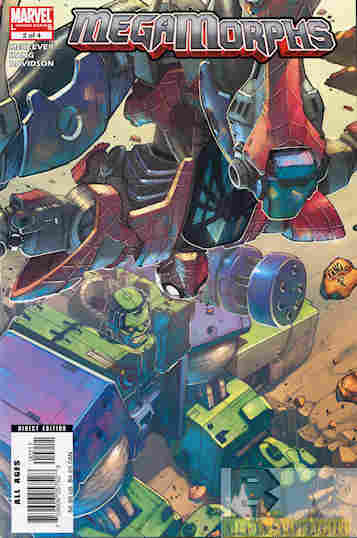
Mega Morphs #2
Marvel (October, 2005)
“200 Tons Of Doom”
WRITER: Sean McKeever
PENCILER: Lou Kang
INKER: Pat Davidson
COLORING: HiFi & Sotocolor
COVER CO-ARTIST: Ramil Sunga
LETTERER: Dave Sharpe
EDITOR: John Barber
image source: Wikipedia
AT&T, the communications company that just bought Time Warner and it’s various brands (Time, Warner Brothers and it’s library as well as the Hanna-Barbera and Ruby Spears library, DC Comics & DC Entertainment, and various other multimedia outlets), has announced their new name, and I admit it’s a pretty good one. They are now WarnerMedia, although I do wonder why their name is fused that way. Why not Warner Media? Do they think it looks cooler? Asked the guy named ShadowWing, who is not, has never been, and probably never will be cool? Are they trying to look like a screenname? Actually, I want to see what the logo will look like. You know how I am about logos.
This morning we talked about Fox trying to make their ads more interesting by having sponsored stories of real people overcoming bad situations. I’m all for that, because we need more uplifting stuff. But while you’d think the next step would be the return of fully sponsored shows (which would still be impossible for local small businesses, the real victims of a lot of these attempts to alter advertising) there is another way. What about if the advertising was in itself content. We’ve seen wacky ads but what about ads that actually have something that people would come back to for the next chapter or a short adventure that people might tune in for. It’s been done. In kids advertising.
I know, parent groups hate when something is marketed to kids because kids are stupid and easy to manipulate and totally not because said parents don’t want to be asked to buy something while they’re not doing anything of real importance but I want you to hear me out on this one. What I’m going to be showing tonight are only inspirations for what could be done. See, while some of you out there in the universe look at something like He-Man And The Masters Of The Universe or Transformers and see shows meant to sell toys (while happily waiting for the next Mobile Suit Gundam series and not seeing the irony because that’s not how it started) even as a kid I saw “good, fun stories that happened to be based on a toyline instead of a book, comic, movie, or prime time TV show”. So when I would watch these ads below that’s also what I saw. Some of these things I never even bought (or asked my parents to) but the ads to me were little action shows while I waited to see how Turbo Teen was going to turn into a car while locked in a freezer or something. (I think that was a cliffhanger. Ad breaks cliffhangers are also part of what got me into being a storyteller myself, something to do during the commercials.) It helped that I also grew up with Schoolhouse Rock, basically an edutainment short that popped up in commercials but felt like just another cartoon. Let me show you the base ideas and then go into how Fox or others could use some fiction alongside the uplifting tales of overcoming adversity.
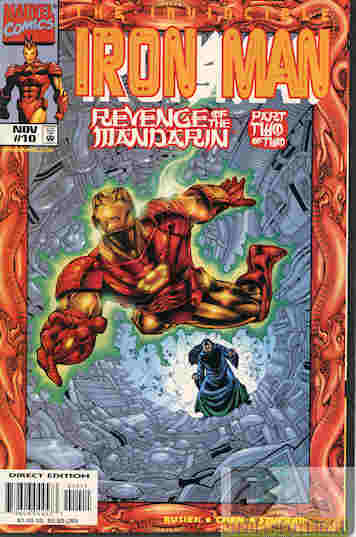
Iron Man volume 3 #10
Marvel Comics (November, 1998)
“Revenge Of The Mandarin” finale: “In The Belly Of The Beast”
WRITER: Kurt Busiek
PENCILER: Sean Chen
INKERS: Larry Stucker & Eric Cannon
COLORIST: Steve Oliff
LETTERING: Comicraft
EDITOR: Bobbie Chase

Like it or not, TV networks need advertising dollars to stay in business and businesses need ads to promote their products and services, especially small businesses who need that local ad break time to reach potential customers. But as Millennials are perceived as hating advertising of any kind networks are trying to come up with new ways to bridge the gap. Fox’s latest plan are sponsored stories of overcoming adversity. Making the advertisements into actual content may be the way to go. It worked when I was a kid. I’ll explain that one tonight.
Chapter by Chapter features me reading one chapter of the selected book at the time and reviewing it as if I were reviewing an episode of a TV show or an issue of a comic. There will be spoilers if you haven’t read to the point I have, and if you’ve read further I ask that you don’t spoil anything further into the book. Think of it as read-along book club.

You know, I’m just not in the mood to discuss death and mourning like I have been. Death is a part of life. It’s unavoidable, whether we die of natural or unnatural causes. (Or in the DC universe possibly supernatural.) Mourning is also important. It helps us to accept that death has happened, that someone we love and care about is no longer with us and our lives have to go on. And yet at some point we do have to go on. This may be an opening better served in the third arc, but you can focus too much on death that you never really live.
Take Batman for example. Actually, first take Spider-Man. Peter Parker became Spider-Man due to an accident but didn’t really become a hero until his uncle died. He also lost his fiance, which sent him into an emotional spiral for a while, but he ended up finding someone else, marrying (though Marvel wants to forget that–TOO BAD!), and living his life. Bruce Wayne on the other hand never really did. He had Alfred and later the various Robins and Batgirls to pull him from the edge (although some writers want to keep pushing him towards that edge), but the “millionaire playboy” persona is just an act, a way to help Gotham in ways a costumed vigilante can’t and to fund said costumed vigilante’s activities. But even in his purest incarnations, not too far over the edge that he’s dangerous to himself as well as others but not so far over that his adventures are downright silly (well, maybe a little silly on occasion to break up the tension) Batman is the “real” identity, an obsession of a boy who couldn’t save his parents to try to keep other children from suffering the same tragedy. Crimes that mirror his own victimhood tend to bother him more than any other because it’s more personal. He never can find love except with someone just as obsessed as he is or at least willing to accept that part of him. Really I don’t see this upcoming marriage to Selina going well. I could be wrong, since it worked in an alternate reality or two.
But right now this book is still in the grieving chapter, as characters come together to deal with their loss. The body is buried but the man who used to inhabit it was already gone. So….what now?