
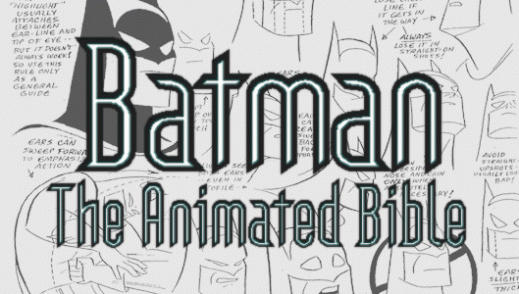
When I first considered doing this article I though it would be an amusing one-shot deal, a brief overview of the changes between the show bible for Batman: The Animated Series and the final product, plus where the show evolved with The Adventures Of Batman & Robin and The New Batman/Superman Adventures. As I looked over the pdf file (which was probably linked to in an article by Comics Alliance‘s resident Batmanologist Chris Sims), however, I saw enough data for a short article series. And for the next few Mondays that’s what you’ll be getting (barring some big news I want to comment on), a review of the show bible for the show many claim is the best adaptation, if not interpretation, of the Dark Knight and denizens of Gotham City.
But what is a “show bible” some of you are asking? In television and other media, the bible (small “b” and insert dirty Hollywood heathen joke here) is a set of instructions for writers and other creators (depending on animation versus live-action) for how the series is intended to work. In the case of B:TAS, there were some changes and some things that held true. For example, Renee Montoya’s history has one major difference from the DC Comics/Gotham version, while the Mr. Freeze origin we all know came from this series would have actually followed the original. I’m getting ahead of myself, though.
For this first installment we’ll be looking at how Bruce Timm, Paul Dini, and Mitch Brian, who worked on the writer’s bible for the show, planned to approach the series, namely the tone and basic premise, which mostly held true during the two Fox Kids shows. It should be interesting.
Night in Gotham City. Only the faintest of rays of moonlight break through the steamy darkness. Shadows are black, twisted, and frightening. The thick, night air carries many sounds; breaking glass, sputtering neon, harsh, bitter voices, and police sirens. Always police sirens. Most of Gotham’s daytime inhabitants have long since fled to the suburbs or into security-gated apartments. This is not a safe place after dark.
One thing and one alone keeps Gotham from drowning in a sea of corruption and despair. It is a grim being cloaked as much in mystery as he is in shadows. Like a bat he dives out of the night to feed on Gotham’s evil. To some, he is merely a legend. To others he is a dedicated avenger. And to criminals, he is their worst nightmare. He is…BATMAN!
That’s how the bible starts, showing their approach to the world of Batman from the start. Remember, this is the writer’s bible, not the pitch bible used to sell potential studios and networks on a show. And yet they sell it well. From there it goes on to a picture of Gotham City, that is not done justice as a photocopy. I won’t be showing too much of the art in this article. Then we get into the concept.
The adventures of Batman will incorporate many different elements of the Batman mythology. Our half-hour series will have a darker look and tone to it, keeping in line with the movie version and recent comic book interpretations. With a nod to the crime films and novels of the 1940s, we will combine both old and new in this “Dark Deco” visual design and create a fresh take on The Batman.

Batman as he was depicted in Batman: The Animated Series (1992–1995) (Photo credit: Wikipedia)
And that’s exactly what they did, creating not only a new take, but one that wasn’t trapped in any one era, a timeless look to Gotham and the Batman world. It’s an art style that helped put Bruce Timm on the map (while co-designer Eric Radomski is a name I only saw during research) and they salvaged as much as they could in the translation to Kids WB while being forced to match the Superman style. (Speaking of which I would love to see that bible someday.)
One thing the bible stresses here that I agree with and so would many fans to the point that someone actually collected them all, is that they will not be doing an origin story. (Interesting note: Paul Dini would actually go on to write an origin flashback for Batman: The Brave & The Bold.) While flashbacks did pop up now and then they were mostly abstract, more interesting in showing Bruce’s mind than that dark night that created the Dark Knight.
Afterwards was a list of other changes they would be making compared to previous adaptations of Batman:
“Batman is a solo act, usually working alone. Although he has allies in Alfred and Robin, it will be Batman who carries the bulk of every episode.
Not that Robin didn’t get a spotlight now and then. The teaming of the Dynamic Duo must have struck a chord with somebody important because it wasn’t too long (the next season) before the show was re-branded The Adventures Of Batman And Robin and the Boy Wonder would be joining him full-time (except for the occasional Batman-only episode). What about his other famous alliance?
Batman does not work directly with the police. He is not a member of the force or a deputized agent. There is no Bat-Signal or hotline, they can’t contact him. Batman’s on a one-man fight against crime, and, if he needs to inform the police of anything, he’ll phone them. His closest contact on the force will be Commissioner Gordon, who, while he holds an admiration for the Dark Knight, will not always approve of his methods.
This changed surprisingly quick. The Bat-Signal was added during the course of the first season and while Batman was never deputized as he was in earlier adaptations, he did work alongside Bullock and Montoya at times.
Robin is not Batman’s full-time partner. Although adopted and trained to be Robin by Batman, Dick Grayson now leads a separate life as a college student and solo crime fighter.
There was an episode that showed Dick sneaking back into college as Robin, but with this added bit of info I’m sorry we never got a spinoff, even in comic form, detailing those adventures. Imagine what “Robin: The Animated Series” would have been like?
Our stories will be hard-edged crime dramas with villains who play for keeps. Yes, many of them will come from Batman’s well-known Rogues Gallery, but they will be as wild, dark, and sinister as we can make them. Each episode will also feature a big SET PIECE, an incredible visual action visual (that’s how they wrote it in the bible folks – SWT) that will be a looked-forward-to element in each show. This will be the climax, centerpiece, or show-stopper of each episode.

Dick Grayson (Loren Lester) as Robin from Batman: The Animated Series. (Photo credit: Wikipedia)
Elsewhere the bible notes that they want to make these into short films of a sort, with cliffhangers at the commercial (not always a life-and-death one that the old serials always made, but more like any good action show) and a three-act structure (not counting the rare multi-parter I imagine). This is what that last sentence reminds me of. At least the show didn’t try to up the ante every episode. The stories all stand alone, and if some shine more than others, it doesn’t matter if the others were still really good. That’s how it should be done.
The next section deals with the writing style/structure for the writers’ episodes. They wanted to stress “economic, well-structured plots containing snappy, conversational dialog” but not “lazy, expositionary speeches”. They wanted locations to be properly established and using as much visual as they possibly could to keep viewers updated as to what is happening. This means less “as you know…speeches.
With our animated Batman we can “build” gigantic sets and create special effects that could never be realized with live action. Use this advantage!
We encourage writers to push themselves to create action and fight sequences in these larger than life settings. Keep the images and action clear and vivid. Give us details that will inspire the directors and animators. Utilize the power of the written word.
This is why I don’t treat animated productions as somehow inferior to the live-action material. I don’t prefer one over the other, but both have strengths and weaknesses to be taken advantage of, or overcome. Japan seems to be the only country that understands this, while everyone else seems to treat animation as something for kids only (except to be subversive), which is very limiting. Of course, I’m worried that if they DON’T keep this point of view that cartoons will be like comics and video games and slowly forget younger audiences, the ones who will continue the media format going after the current fans and gamers are gone. So as much as I want to champion cartoons for everyone, I have seen the history of “we must prove it’s not kids stuff by not making kids stuff anymore” too often to fight too hard.
Oh, and you know how we often compare this series to the old Flesicher Superman cartoons? Well, we were right on the money according to this thing.
Don’t forget, we have 65 episodes, so there’s no reason to throw kitchen-sink-and-all into every episode. We want to strive for identifiable, memorable adventures that audiences will want to see over and over again, as with the Fleisher “Superman” series (emphasis mine — SWT)
Finally we come to the “humor guidelines”, and I wish the DC movies would follow these, because B:TAS got this one completely right.
The humor in our version of Batman should arise naturally from the larger than life characters and never from tongue-in-cheek campiness. Dry lines in tough situations and occasional comments about the outlandishness of costumed villains is certainly within the realistic context of our vision of Batman.
As for the villains, dark humor and clever dialogue is great, as long as it seems to realistically reflect the character’s wit, as opposed to the writer’s. Of course, everybody shouldn’t sound like the Joker, and writers are encourage to find distinctive voices for all of their characters.
This would have the “Dark Knight Trilogy” or Man Of Steel so much better. They’re so afraid of the Schumacher or 60s TV show that there is no humor, which makes the story lifeless. Sometimes humor just pops up, as if God wants to keep us from forgetting life is kind of strange sometimes. Heck, even Gotham gets that right, and it’s a show about Batman created by somebody who hates Batman.
As an additional note, we want to keep “pop culture” references to a minimum. Occasional satire of significant cultural trends, along the lines of the more recent comic incarnations, is fine but should be kept to a minimum. After all, this is Batman, not Jonathan Swift. Remember, we want the humor to hold up in ten or twenty years, so we’d like to stay away from specific references that won’t be relevant in the future.
Forget DC, I wish more comedies would remember this. The crew put a lot of work into making this show as timeless as they could and it shows in that we all enjoy it so far after for reasons beyond nostalgia. And it’s here that we will end our look at the Batman Animated Bible for this week. Next week we see how they wanted to depict Batman and as many allies as space allows.



 BW Media Spotlight