

Thus far we have seen the Comic Code decide what kinds of stories are good for kids, not realizing that (A) not every comic book was produced with six-year-olds in mind and (B) it isn’t the depiction of but how it’s depicted. For example, an episode of the family friendly version of Buck Rogers In The 25th Century did a take on vampires that didn’t involve bloodsucking people to death, as did an episode of Super Friends, and who hasn’t done some form of werewolf in anything involving science fiction or fantasy?
But now we get to the really stupid part. Advertising. In case you thought this…
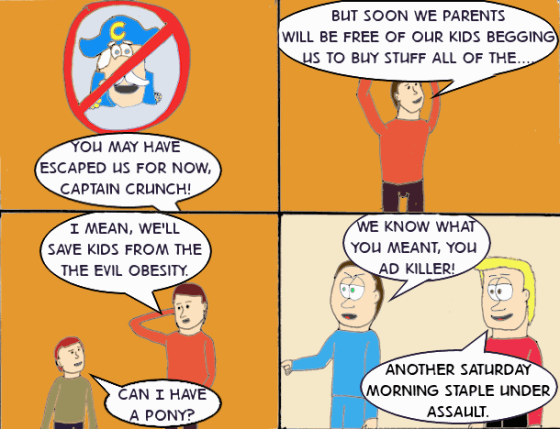
I don’t even eat the stuff.
…was new, people have been trying to get out of buying things for their kids for years. They rationalize it by saying “we’re protecting kids” when really they hate any form of advertisement, despite ads being how they found out about most things to begin with. Yes, advertising can be out of control but they do serve a good purpose…even if only as entertaining skits. As a kid I never ate Cap’n Crunch cereal and the only reason I use Crest toothpaste is they have a flavor that isn’t mint. I hate mint. And yet I enjoyed watching the Cap’n turning his boat into a giant robot to battle sog-crazy creatures or fight monsters who liked making holes in tooth-walled island cities.
And don’t get me wrong, I’m not some big pro-ad guy so much as I don’t immediately consider advertisements to be the enemy. Every version of, say, laundry detergent, offers something different and ultimately it’s up to the buyer to decide which one he or she prefers. Ads are we find out about something new that would either entertain us or be beneficial to our lives, sometimes in minor ways. Bad advertisements are still bad. (I do have an article series called “Commercials That Need To Die”, which I’m considering relaunching as video to make sure I can still show these to you guys with better odds the ad won’t be taken down, either by force or by the poster.)
So naturally a code of writing that dictated how to write about crime, monsters, and sex is going to get on the case of advertisements. Again remembering that this group didn’t think anyone old enough to drive read comics, what restrictions were put on comic ads?
Liquor and tobacco advertising is not acceptable.
Advertisement of sex or sex instructions books are unacceptable.
Although every magazine on the planet still carried tobacco ads until recently and you can still find ads for liquor and beer, so apparently only the comic books were banned from the first one. Comics…actually, comics only advertise other comics the company produces…if that? Ads might bring the prices down on comic. Just after a video game movie is released from an American studio that’s a good adaptation. Again, if this was just kids comics I would agree. But thanks to newsstands afraid to sell any comic that doesn’t have the CCA symbol on it that’s all they produced except in certain…less than kosher establishments.
As for the sex instruction books…you’d have to be kind of sick to be marketing that in the pages of Richie Rich. And we don’t really know how much instruction Archie needed.
The sale of picture postcards, “pin-ups,” “art studies,” or any other reproduction of nude or semi-nude figures is prohibited.

1926 US advertisement for “French” postcards. (Photo credit: Wikipedia) This just came up in my suggestions and it fit so well.
I could see not putting semi-nude pictures in a comic, but not selling even art studies books? That’s a bit far. There is a big difference between figure drawing and Playboy. And could they sell picture postcards if they were full-clothed or if no people were in it? And what qualifies “semi-nude”? If you can wear it to the beach you should be able to put it in a postcard. Look, I’m old fogey enough to not get bikinis that look like pixelated censoring via dental floss and a pastie (oh man, one of my spell checks knows what a “pastie” is, although that also appears to be the name of a form of pastry) but I’m not seeing why it would be banned from a picture postcard………..
WAIT A MOMENT! Look at that again. It doesn’t say advertising the sale of those things…it says “the sale of…is prohibited”. Don’t think some group didn’t try to use that somehow. The Comics Code didn’t (in theory and without technicality) have any legal standing but it could be used to pressure certain stores just the same and if you don’t think anyone would have tried you’re new to crusading “protect our kids” do-gooders. And remember, I’m a conservative Christian. If certain things were to disappear I’d be happy, but there’s was a time “fire and brimstone” was misused. I’m not sure why there would be nude picture postcards. Would YOU risk one being sent to your mom?
- Advertising for the sale of knives, concealable weapons, or realistic gun facsimiles is prohibited.
- Advertising for the sale of fireworks is prohibited.
Well, that was certainly dropped by the time I got into comics. Heck, they advertised a RAMBO play weapon series in the 80s. You could get switchblades in those ads that would be one box in a sea of ad panels, and I’m not sure anybody followed the “no gun facsimiles” rule. I mean, that did include toys, right? It seems like something they would do. I don’t remember fireworks being advertised in comics, unless you count cherry bombs.
Advertising dealing with the sale of gambling equipment or printed matter dealing with gambling shall not be accepted.
What about gambling addiction support? Again, they assumed all comics were for elementary kids. Who would waste time advertising gambling equipment to elementary kids? Now I’m just waiting for Snell to post or link to a bunch of these.
Nudity with meretricious purpose and salacious postures shall not be permitted in the advertising of any product; clothed figures shall never be presented in such a way as to be offensive or contrary to good taste or morals.
I’m just going to let you make the jokes or comment here but some bits write themselves. I know I keep stating this and in our final installment I’ll go more into why, but they thought comics were for kids, and what point would there be using sex to sell to someone who still thinks the opposite gender has cooties? Sure, they didn’t plan on times to change. Victoria’s Secret advertised in comics at one point, but (for example) Marvel was smart enough to keep them out of Star Comics books.
To the best of his ability, each publisher shall ascertain that all statements made in advertisements conform to the fact and avoid misinterpretation.
This may be the weakest of the bunch. Publishers don’t have time to investigate every claim made. That’s why Consumer Reports came along. This is a lawsuit waiting to happen in modern times.
Advertisement of medical, health, or toiletry products of questionable nature are to be rejected. Advertisements for medical, health or toiletry products endorsed by the American Medical Association, or the American Dental Association, shall be deemed acceptable if they conform with all other conditions of the Advertising Code.

AtomicWar0435 (Photo credit: Wikipedia) I wonder if this ad would have been approved under the Code. Oh wait, it apparently was.
So unless the AMA or ADA approve your product you can’t advertise it? No wonder it took so long for more natural remedies to be made aware. No, I’m fighting to find anything to say here because, and I’ll keep reminding you, these are people who possibly wanted to ruin EC Comics believe comics are for kids. I can understand maybe advertising toothpaste for kids (although oddly kid-flavored toothpaste and mouthwash/rinse wouldn’t come out for many, many years) but otherwise this just seems unnecessary in the Comics Code. Actually, the fact that is a section dictating how comics and comics alone can advertise (unless these rules were also in the magazines of the time) feels unnecessary.
This is the end of the rules to be granted the little logo that would allow you to sell your comic book on newsstands and wherever else you could get comics back in those days. Some rules have changed or have been given workarounds. In these installments I’ve reviewed what I thought were good and bad ideas about the code from one particular angle, which I’ve harped on over and over for a specific reason. In our final installment I’ll go into why I think the Code was a good idea in theory but like so many things the implementation was all wrong, and whether or not we’re better off without the Code, or at least the Authority, today.
 Breaking The Comics Code: Backstory



 BW Media Spotlight