

For you live readers: I was planning to make this a Friday series, but this is the second week in a row I had to drop it on Tuesday. We’ll see what happens. In case you missed last week’s post, we’re looking at the sales pitch for a new television series called Star Trek. I don’t know if this was the pitch to NBC or to Desilu or a general pitch before shopping it around to anyone. I’m admittedly lite on the history here. I found it on an archival site for writer’s guides and story bibles, linked to in the previous post if you want to follow along. Once we’re done with these 16 or so pages we’ll get into the actual writer’s guide.
This is the first draft, with Gene Roddenberry as the sole credit. The first four pages asks the question in the article title, and that’s what we’ll be looking at in this first official article. Remember as we go through this that at the time there was no “Star Trek”. It was still just a concept, with names changed between here and the story bible, and concepts that were refined between the two pilots and the series we all know and love. The point is to see all the changes and speculate if the changes were a good idea or if there was some merit, and what aspects of the original ideas made their way to the end product, or were even homaged in later productions either out of a desire to see those changes or as easter eggs for fans who may know all the behind-the-scenes stuff that went on. Almost immediately there will also be ideas that did get made into actual episodes.
Roddenberry’s goal was to sell a television studio and network on his science fiction series. The earliest production credit I found on a quick IMDB search was a writing credit for an episode of Mr. District Attorney, where he was a consultant. Other credits prior to this include writing shows like Highway Patrol, The Detectives, Dr. Kildare, Have Gun–Will Travel, and The Virginian. These are all crime dramas and westerns (except for the one with the doctor, of course, and there are others on the list), not science fiction. His first creator credit is 1963’s The Lieutenant, about a rifle platoon leader stationed at Marine base Camp Pendleton in California.
And here he is pushing a science fiction show when sci-fi was on a TV downturn. It was still around, but a lot of it was considered children’s entertainment, your Flash Gordons, Buck Rogers, and Captain Videos. How do you push a family-friendly but clearly more mature and thought-provoking hour long primetime series in that culture? Let’s find out.
STAR TREK is…
- A one-hour dramatic television series
- Action – Adventure – Science Fiction
- The first such concept with strong central lead characters plus other continuing regulars
The actual pitch doesn’t have them as bullet points. It was just easier for me to display it that way since it is written in three lines like that. That’s me nitpicking. That’s probably the most basic description of Star Trek but you’re pushing what didn’t clearly exist yet to people who are not yet convinced to give you money.
And while maintaining a familiar central location and regular cast, explores an anthology-like range of exciting human experience.
“Anthology-like”. That’s an odd description. Any non-serialized show would be “anthology-like” because every episode is a different story. I’m guessing the “like” comes from having the same cast each time. Does that mean Jake & Leon is “anthology-like”? I’ve heard the term “procedural” used recently for stuff that isn’t following the modern serialized trend, something closer to soap operas than old movie serials. Roddenberry drops a few examples, and see if they sound familiar to you. I mean, they should. They were actual episodes.
THE NEXT CAGE: The desperation of our series lead, caged and on exhibition like an an animal, then offered a mate.
Not quite the original pilot, “The Cage”, later reworked into the two-part story “The Menagerie”. While Pike was in a cage and offered a mate, this quick idea sounds more like a zoo than a bunch of super brained sterile guys trying to repopulate their planet as a possible slave race to restore what was destroyed.
THE DAY CHARLIE BECAME GOD: The accidental occurrence of infinite power to dl all things, in the hands of a very finite man.
The clear comparison is “Charlie X”, a teen who was given great power to keep him alive, but lacking maturity due to his circumstances becoming a threat to the ship. This could also describe the final pilot, “Where No Man Has Gone Before”, as Gary Mitchell obtains similar power and also becomes a threat. The moral of Star Trek as a franchise is that gods are evil. See also every godlike being in this franchise.
PRESIDENT CAPONE: A parallel world, Chicago ten years after Al Capone won and imposed gangland statues upon the nation.
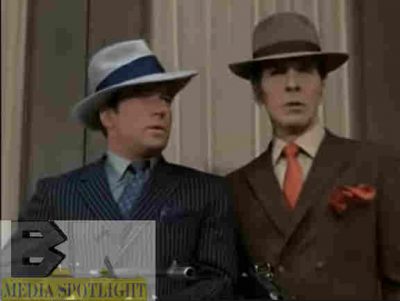
“I voted for Lucky Luciano in the last election.” “You would.”
Thankfully, in light of the episode where they apparently recreated the Constitution of the United States and American flag on an alien planet (which made no sense), that was heavily reworked into “A Piece Of The Action”, an imitation culture finding a book about gangsters in a crashed ship and creating a gangland society. It’s where my Jake & Leon character Fizzbin got her name, by the way.
TO SKIN A TYRANNOSAURUS: A modern man reduced to a sling and club in a world 1,000,000 B.C.
I mean…you could point to examples of elements of this in various episodes, but I can’t think of an episode this awesome ever being made, nor could it on a 1960s TV budget. You’d think someone would have done that for Filmation at least because now I want this story to exist for the title alone.
THE WOMEN: Duplicating a page from the “Old West”; hanky-panky aboard with a cargo of women destined for a far-off colony.
Not really “old West”, but clearly reworked into “Mudd’s Women”, the first appearance of everybody’s favorite con artist, Hardcourt Fenton Mudd, who would return for a second episode, an animated episode, some comics and novels, and we will ignore anything else claiming other TV/streaming appearances!!!!!!!
THE COMING: Alien people in an alien society but something disturbingly familiar about the quiet dignity of one who is being condemned to crucifixion.
I can’t off-hand think of an episode this correlates to, either, but given how this franchise treats religion of any kind, that’s probably a good thing. They upset enough Christians with “The Magicks Of Megas-Two”. The pitch promises more of these later on, but on the next page decides to get all “I am the smart” on us.
STAR TREK offers an almost infinite number of exciting Science Fiction stories, thoroughly practical for television. How? Astronomers express it this way:
Ff2 (MgE) – C1R11 x M =L/So
Folks, learning HTML back in the day just saved me a lot of trouble transcribing that formula. Education is your friend!
Or to put it in simpler terms, by multiplying the 400,000,000,000 galaxies (star clusters) in the heavens by an estimation of average stars per galaxy (7,700,000,000,000,000,000,000,000,000,000,000,), we have the approximate number of stars in the universe, as we understand it now. And so…
Gene, you’re writing for television executives and Nova won’t exist for a few decades yet. These are not the people to show off to. I won’t write the whole thing, and there is more, because I don’t hate my readers. You can find the pitch and check it out for yourself if you want to know. Thankfully, he does drop a summary, including a line Trekkies are familiar with when it comes to stories about the pitch.
STAR TREK is a “Wagon Train” concept–built around characters to travel to worlds “similar” to our own, and meet the action-adventure-drama which becomes our stories. Their transportation is the cruiser “S.S. Yorktown”, performing a well-defined and long-range Exploration-Science-Security mission which helps create our format.
Yes, the Enterprise could have been called the Yorktown, a name that has been reused for three starships and a starbase. I’m betting this is where the “Wagon Train to the stars” line comes from, but much like “beam me up, Scotty”, it’s not quite the line as we always hear it. The Mandela Effect for this show started earlier than we knew!
The time is “Somewhere in the future”. It could be 1995 or maybe even 2995. In other words, close enough to our time for our continuing characters to be fully identifiable as people like us, but far enough into the future for galaxy travel to be thoroughly established (happily eliminating the need to encumber our stories with tiresome scientific explanation).
You may all laugh now at how that worked out. Doctor Who suffered the same problem, as do a lot of “set in the future” science fiction stories. Those of us living in the future are either disappointed or relieved (depending on the world–possibly even both) that stuff didn’t come to pass…or disappointed/amazed that it did. As far as “tiresome scientific explanation”, it would end up being replaced by technobabble to explain the science, especially as the franchise started creating science. The cordless phone, predecessor of the smartphone, was inspired by the communicators, themselves probably inspired by walkie talkies. TNG had to introduce the “heisenberg compensator” to explain how the transporter worked. Science and Star Trek is an odd match.
One last page before we call it an article:
“Parallel Worlds” concept is the key…
…to the STAR TREK format. It means simply that our stories deal with plan and animal life, plus people, quite similar to that on earth.
I have to break the paragraph to ask why it’s written that way. If the “Parallel Worlds” sentence was meant to open the next few paragraphs, fine, but it doesn’t. Each paragraph starts like a paragraph would. I wonder if it’s an idea Roddenberry dropped while typing this out?
Social evolution will also have interesting points of similarity with ours. There will be differences, of course, ranging from the subtle to the boldly dramatic, out of which comes much of our color and excitement. (And, of course, none of this prevents an occasional “far our” [his typo, not mine] tale thrown in for surprise and change of pace.)
Well, the show lived up to that. An episode where racism came about, then an episode where a salt-addicted creature changes into your girlfriend to…anything with Harry Mudd. Everyone remember the baby man in the giant globe? Then you see a story where Kirk chases a Romulan vessel with one crewmember suspecting Spock is a traitor. Good times. Good times.
The “Parallel Worlds” concept makes production practical by permitting action-adventure science fiction at a practical budget figure via the use of available “earth” casting, sets, locations, costuming, and so on.
Or have an episode where the entire planet has less of a backdrop than an episode of one of the old Westerns Gene worked on in a recreation of the OK Corral gunfight. Or a rock quarry. Sci-fi loves rock quarries.
As important (and perhaps even more so in many ways) the “Parallel Worlds” concept tends to keep even the most imaginative stories within the general audience’s frame of reference through such recognizable and identifiable casting, sets, and costuming.
Sci-fi before this did like to show off how “in the future” they were, and while Star Trek would do that as well, it was stuff that made some kind of sense, and would actually inspire real world scientists while still taking liberties. Instead of being cool, they went a bit more practical, and I haven’t really thought about that before. So I could be talking out my backside here.
That will do it for this round. Next time we get to meet our happy crew of the USS Enterprise SS Yorktown, including characters you may recognize, and one you have to be a deep fan to have heard of.



 BW Media Spotlight
[…] for Star Trek continues. Not to be confused with the pitch for fan series Star Trek Continues. In our previous installment we saw the ship was originally planned to be named the Yorktown rather than the Enterprise, as […]
LikeLike
[…] in our “trek” through the sales pitch for the original Star Trek series we saw the concept and met the crew, nothing the changes between what was initially planned and what finally made it […]
LikeLike
[…] that kind of gave us this episode, but none of these really made it to the original series. Oddly, we started the pitch on story ideas that we actually got. This is how the pitch ends, with no further comments. Well, […]
LikeLike