

Back in the pitch part of this subseries of story bible/writer’s guide reviews, we looked at the crew of what was then the SS Yorktown, who would become the USS Enterprise crew in the original pilot. Of course only one of them would make it to the pilot that was actually picked up, “Where No Man Has Gone Before” (and yet the story about the shapeshifting salt vampire siren was the first aired, “The Man Trap”). The rest have only shown up in stories going back to Christopher Pike’s days, while Robert April is basically a trivia note from the Animated Series and various novels and comics.
In this installment we get a look at the crew we got. I would love to see the listing from the original draft or second draft, before scripts were written and maybe not every main and supporting regular character had an actor to go with them. This third draft came out between seasons one and two, so while Pavel Chekov is not yet part of our merry band (tell that to Khan) most of the rest of the regular and recurring members of the people who got to visit the bridge should be there. In the same vein, I wouldn’t mind seeing the later draft where he was added, and if I ever get to see the guide for The Animated Series we can also learn about M’Ress and Arex.
DeForest Kelly’s Doctor McCoy wasn’t in the opening credits for season one, and wasn’t even in the pilot, yet the first aired episode centered on him. Everyone else we know among the regulars, right down to Yeoman Rand, are here for us to meet. It’s only five pages, but I’m expecting these to be interesting enough to cover one article. In fact, while writing this I realized just going on the main three was taking up a lot of time when going over the history of the characters, so we’ll have to do the rest of the crew next time. Kirk, Spock, and McCoy, now recognized as the main three of the show, each get their own page while the characters who were only in the closing credits despite how often they appeared share the final two. So what does the writer’s guide have to say about our heroes going into the second year of their mission?
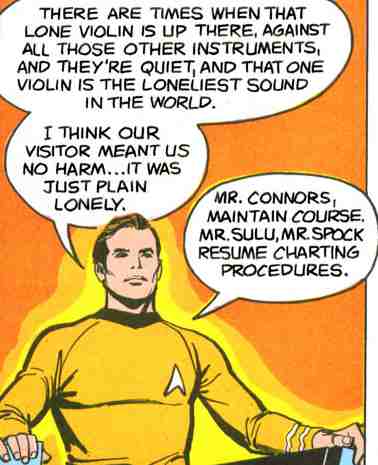
The guide really doesn’t mention his penchant for speeches.
CAPTAIN JAMES T. KIRK
played by William Shatner, Kirk is about thirty-four, an Academy graduate, rank of Starship Captain. A shorthand sketch of him might be “A space-age Captain Horatio Hornblower”, constantly on trial with himself, a strong, complex personality.
I don’t think Kirk (the “T” would officially stand for Tiberius after it was used in the Animated Series, ignoring the “R” from the pilot, which is waved away as Gary Mitchell having godlike powers but still being human) was indecisive, though he did rely on Spock for the logical thing to do and McCoy for the emotional thing to do, deciding which was ultimately the right thing for that particular situation. We did occasionally saw him wrestle with his decisions as Captain and in life, with that time he was separated into his “passive” and “aggressive” sides being one example and the “naked” time the virus that messed with your head had him exclaiming that his career and duty to the ship came before an actual relationship, something we also saw in Generations“.
With the Starship out of communication with Earth and Starfleet bases for long periods of time, a Starship captain has unusually broad powers over both the lives and welfare of his crew, as well as over Earth people and activities encountered during these voyages. He also has broad power as an Earth Ambassador to alien societies in his galaxy sector or on new worlds he may discover. Kirk feels these responsibilities strongly and is fully capable of letting the worry and frustration lead him into error.
The underline emphasis is from the guide here and at the start of the next paragraph. The guide appears to be showing Kirk’s faults. Despite his years in service (and ability to listen to Spock, McCoy, and at times the rest of his crew), he can’t be written perfect, or be right because the plot says so. It was one of my issues with “The Apple” that mentioned in the previous installment, and with Katherine Janeway in general on Voyager. Kirk’s experience means he doesn’t make so many mistakes that he comes off as incompetent (Jonathan Archer) but he has to be seen as human. The incident with Edith Keeler comes to mind. While his love for her is why Harlan Ellison wanted to have Kirk be the one held back, it doesn’t quite match his personality, so it ended up being McCoy, with Kirk having to deal with the results of what he had to do to preserve the timeline and ensure America entered World War II to tip the war in the Allies’ favor. (Though some historians question if that was just something that sped up the Allies’ victory against the Nazis after America defeated Japan, who had joined the Axis.)
He is also capable of fatigue and inclined to push himself beyond human limits then condemn himself because he is not superhuman. The crew respects him, some almost to the point of adoration. At the same time, no senior officer aboard is fearful of using his own intelligence in questioning Kirk’s orders and can themselves be strongly articulate up to the point where Kirk signifies his decision has been made.
Important–Although Kirk will often solicit information and estimates from Spock, never does the first officer act as Kirk’s “brain”. Our Captain is a veteran of hundreds of planet landings and space emergencies. He has a broad and highly mature perspective on command, fellow crewmen, and even on alien life customs, however strange or repugnant they seem when measured against Earth standards.
Unless your god is a computer. Then he’ll earn the title of “god slayer”. Also when he meets actual “gods” or beings with godlike powers, though it’s never clear if Trelane actually did use a device or not. Given the later appearance of the Q Continuum or people like the Thasians or those supposed witches. Actually, why DID Kirk have a hard time believing Trelane had his own powers after meeting Thasians? As I said before, Kirk listens to his crew, with Spock and McCoy often representing two valid points of view, and Kirk having to decide which was ultimately the right one, often choosing one or the other. From briefing rooms to conversations, Kirk would listen, but would make a command decision and live with it. He was a good captain.
On the other hand, don’t play Kirk like the captain of an 1812 frigate in which nothing or no one moves without his command. Spock, McCoy, Scotty, Sulu, and Uhura are a trained team and are well able to anticipate information and action Kirk needs.
Aboard ship, Captain Kirk has a few opportunities for anything approaching friendship. One exception is Mister Spock, a strange friendship based upon logic, high mutual respect and Spock’s strong Vulcan loyalty to a commander. Another is with ship surgeon, Dr. McCoy, who has a legitimate professional need to constantly be aware of the state of the Captain’s mind and emotions. But on a “shore leave”, away from the confines of self-imposed discipline, Jim Kirk is likely to play pretty hard, almost compulsively so. It is not impossible that he will let this drag him at one time or another into an unwise romantic liaison which he will have great difficulty disentangling. He is, in short, a strong man forced by the requirements of his ship and career into the often lonely role of command, even lonelier because Starship command is the most difficult and demanding task of his century.
I’ve said before that Kirk’s “ladies man” status is something of an exaggeration. He’s had more affairs than the rest of the crew, but it’s not like nobody else was getting any action. Heck, Spock could have gotten more if he let Nurse Chapel have what she wanted, but he, McCoy, Scotty, and Chekov had their fair share of encounters. Granted we never saw one of them dressing near a woman sitting on his bed doing the same. Still, in 79 episodes he only had a handful of love interests. He’s gotten more action in ancillary media than in the main show, the animated show (where he didn’t have any while Mr. Scott almost became that kind of furry the internet seems to think all furries are), and even the movies.
Enough about Kirk, though. Time to go to the next page and the only character to have been in all three original Star Trek versions.

“Finally, someone I can have a proper Vulcan conversation with.”
MISTER SPOCK
Played by Leonard Nimoy. This is the ship’s Science Officer, in charge of all scientific departments aboard. As such, he is the ship’s Number Two ranking officer and now holds the rank of Commander.
I don’t think you need to be science officer to be second in command. None of the other seconds in the franchise were, but that’s what the guide makes it sound like. Come to think of it, who were the science officers on all the other ships in the classic timeline? I know Defiant probably didn’t have one because it was designed as a battleship and not an exploration vessel.
His bridge position is at the library-computer station which links the bridge to the vessel’s intricate “brain”, a highly sophisticated and advanced computer which interconnects all stations of the ship. From his central panel Spock can tap resources of the entire computer system–including a vast micro-record library on man’s history, arts, sciences, philosophy, plus all known information on other solar systems, Earth colonies, alien civilizations, a re…
Wow, this goes on. Just call him the exposition dump of the show and move on. Some of this should have been reserved for a section on the function of bridge stations, not the description of the characters. One additional paragraph goes by and then we get back on track.
Mister Spock’s mother was human, his father a native of the planet Vulcan. This alien-human combination results in Mister Spock’s slightly alien features with the yellowish complexion and satanic pointed ears. Thus he is biologically, emotionally, and even intellectually a “half-breed”. He is considerably stronger than his human crewmen, he can endure lack of water and higher temperatures for a longer period. His hearing is particularly keen. He also has a strange Vulcan “ESP” ability to merge his mind with another intelligence, read the thoughts there. He dislikes doing so since it deprives him of his proud stoic mannerisms and reveal too much of his inner self. Also, the physical and emotional cost of this is quite high.
They almost make it sound like Mr. Spock has superpowers. At least they aren’t saying Spock has Superman levels of hearing and strength, and all of his abilities are simply the result of growing up on a desert planet with higher gravity. I guess they wanted Spock to stand out a bit from everyone else besides pointy ears, so they gave him limited telepathic abilities and increased strength. It certainly worked for him. Ladies were crazy for Spock, in and out of universe.
We now realize that Spock is capable of feeling emotion, but he denies this at every opportunity. On his own planet, to show emotion is considered the grossest of sins. He makes every effort to hide what he considers the “weakness” of his half-human heredity.
There are some good in-universe explanations for this. First there was his teasing by kids, which you wouldn’t think Vulcan kids would do but kids will be kids. Vulcan also had a rather violent past and Surak’s teaching of suppressing emotions to change that is how the planet survived to become a technological power by the 23rd century and space travellers by the 22nd. Vulcans do not lack emotion, or they wouldn’t be very good artists or marry for anything other than breeding purposes. I hate when writers try to act like Vulcans have no emotions at all. They aren’t the Borg.
One final note: Nimoy played the character differently in both pilots from what we know. In “The Cage” he speaks loudly, and in “Where No Man Has Gone Before” he almost considers it quaint when discussing “one of (Kirk’s) Earth emotions”. I like what they came up with.

“Don’t worry, this is my medical phaser.”
DR. LEONARD “BONES” MCCOY
Played by DeForest Kelley [mistakenly given a small F in the guide–SWT], Dr. McCoy is Senior Ship’s Surgeon of the U.S.S. Enterprise, head of the Medical Department. As such he has medical responsibilities for the health and physical welfare of the crew of the Enterprise and broad medical science responsibilities in areas of space exploration.
I’m not sure why the first “responsibilities” is underlined in the guide. Not having seen the first guide or the notes the guide came from, I don’t know if McCoy and Spock were supposed to represent what they’ve come to as far as Kirk’s decision making process. Like I said, Kelley wasn’t even in the original intro.
As Senior Ship’s Surgeon, “Bones” McCoy is the only man who can approach Captain Kirk on the most intimate personal levels relating to the Captain’s physical, mental, and emotional well being.
Minds out of the gutter, people! Besides, slashfic writers tell me that’s a Kirk/Spock thing. I hate slashfic.
Indeed, he has the absolute duty to constantly keep abreast of the Captain’s condition and speak out openly to Kirk on this matter. McCoy is portrayed as something of a future-day H.L. Mencken, a very, very outspoken character, with more than a little cynical bite in his attitudes and observations on life. He has an acid wit which results in sometimes shocking statements–statements which, under close scrutiny, carry more than a grain of truth about medicine, man, and society.
McCoy is a Southern doctor, with all the stereotypes that go with it minus the racism. Sure, he likes pulling Spock’s chain now and then, but Spock gives back. It’s why watching Kelley and Nimoy play off each other is so fun. It’s too bad they didn’t get to meet up in anything else like Nimoy did guest starring on Shatner’s cop series TJ Hooker. Fun fact: all three actors have done Westerns in the past and at least one sci-fi appearance prior to Star Trek, especially Kelley. He did a lot of Westerns in the black and white days in guest roles. Nimoy played an Injun once.
Of all the men aboard our starship, McCoy is the least military. He is filled with idiosyncrasies which fit the character and are his trademark. For example, he loathes the Transporter System of “beaming” personnel from the ship to planet surfaces and loudly proclaims that he does not care to have his molecules scrambled and beamed around as if he were a radio message.
Have I ever mentioned that Dr. McCoy is my favorite character from classic Trek? His scene with Data in the first TNG episode is just great, and I have a novel I hope to get to for Chapter By Chapter that’s just Dr. McCoy teaming with the Federation’s first Horta member to get out of a Klingon legal trial. His filibuster moments are something I wish I could properly convey in that format.
McCoy is highly practical in the old “general practitioner” sense, hates pills except when they are vitally needed, is not above believing that a little suffering is good for the soul and the maturity of the individual. He has a great fear that perfect medicine, psychotherapy and computers may rob mankind of his individuality and his divine right to wrestle a bit with life. He’s a superb physician and surgeon–often seems to be treating the wrong ailment–but usually is proven right in the end.
Some of that never show up. In fact, in Star Trek IV he cures a patient with a pill he brought with him, a bit of 23rd century medicine. I’ve never seen him confused of treating the wrong ailment, either. Not sure his opinion on suffering, never seemed to hate computers unless they were interfering with a man’s emotions, or discuss psychotherapy. I don’t even know what “perfect medicine” is.
Dr. McCoy is 45 years of age, was married once…something of a mystery that ended unhappily in a divorce. He has a daughter, “Joanna”, who is 20 and in training as a nurse somewhere. McCoy has provided for her, hears from her as often as intergalactic mail permits, but his duty aboard the starship keeps them apart. We will suspect that it was the bitterness of this marriage and divorce which turned McCoy to the Space Service.
While Joanna would show up in comics and probably novels she and the divorce are rarely mentioned if at all in the TV shows. I think the Kelvin timeline movies did more with this idea than anything else. I’ve never seen intergalactic mail, physical or email, in any part of the franchise (though some of you might correct me on the email–still no space postmen).
He was born in Georgia in the United States and can be something of the gallant Southern Gentleman in social life, particularly with females. When the moment is right, a trace of his Southern accent will be heard.
More than a trace, probably something Kelley brought with him from actually growing up in Georgia. It’s not a heavy accent like Scotty and Chekov, but it’s there enough to come off as the good ol’ Southern doctor we know and love.
There is something of a “feud” between Dr. “Bones” McCoy and Mister Spock. The Doctor, like most cynics, is at heart a bleeding humanist. Spock appears to regard McCoy as an archaic, bumbling country doctor, usually achieving cures through luck. On the other hand, McCoy likes to regard Spock as little more than a sometimes useful piece of computer equipment. But, while disagreeing constantly, they do work well together when it becomes necessary and we’re never sure but there could be some affection hidden behind their constant battles.
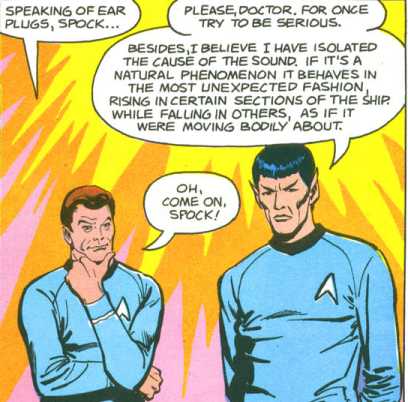
“I was being serious. Your enhanced hearing will require stronger earplugs before even you go insane from the noise monster.”
Spock and McCoy’s “arguments” are some of my favorite scenes of the show. In addition to the two sides for Kirk to think about in major decisions I’ve brought up multiple times in this installment, their general point of view differences are some of the funniest to watch. You can tell they’re friends and they enjoy (as much as a Vulcan can enjoy) messing with each other. While Kirk sometimes has to play referee (or babysitter) for these two, it is the strength of their friendship and teamwork that was the heart of that show, and they chose the right three actors for the assignment. It’s a shame we lost both Kelley and Nimoy so we’ll never get to see all three of them together again, but at least we got five seasons combined of television and a bunch of movies to see them in action.
This went way longer than I was expecting, and I’m sorry, readers. I couldn’t separate these three even though they each got a full page and a lot to discuss. We’ll save the rest of the crew for next time.



 BW Media Spotlight
[…] the last installment we looked at the third revision writer’s guide bios on the three Enterprise crewmen who got […]
LikeLike