

Well, it looks like this one may take multiple parts, a subseries in our series on the sales pitch and writer’s guide for the original Star Trek. Last time we looked at the sets. This time it’s the stuff on those sets.
Knowing your terminology is important in making a believable world. Whether it’s medical terms in a hospital drama or police terms on a detective show, the words already exist, and you only make them up if they’re not normally things they deal with, like a new disease or testing a new way to stop speeding cars. Otherwise, you don’t have to waste time making them up. Meanwhile in science-fiction, some words exist and some you have to make up for your advanced futuristic alien technology or things you found in space.
Terms can also evolve as a show goes on, never mind multiple continuities like Star Trek has, with three timelines taking place over different centuries. For example, in the original The Transformers Energon was simply the same of the storage cube Soundwave generated to hold and convert Earth’s energy resources. Before season one was out and well into the next two seasons, Energon became the actual energy source of Cybertronians, and later series and continuities have made it everything from crystals to ore to a liquid, while the original series couldn’t decide if Transformers ate the Energon Cubes or drank from them. Setting this stuff up beforehand in your story bible helps keeps things straight between episodes.
So you may think you already know these terms, but how well do you really know them? Let’s take the first batch of terms and see if there have been many changes over the years.
TRICORDER
A portable sensor-computer-recorder, about the size of a large rectangular handbag, carried by an over-shoulder strap. A remarkable miniaturized device, it can be used to analyze and keep records of almost any type of data on planet surfaces, plus sensing or identifying various objects. It can also give the age of an artifact, the composition of alien life and so on. The tricorder can be carried by Uhura (as Communications Officer she often maintains records of what is going on), by the female yeoman in a story, or by Mr. Spock, of course as a portable scientific tool. It can also be identified as a “medical tricorder” and carried by Dr. McCoy.
Maybe there’s a later term for it, but McCoy also had that little handheld scanner that looked like a lip balm container with a spinning light. Tricorders would get smaller in later series, especially in the 24th century shows where it was a handheld device with a flip-up screen. By the technology of the 1960s, however, this would be a “miniaturized device”.
THE PHASERS
Hand weapons. At present we have two phasers, (1) the “hand phaser”, which is hardly much larger than a king-sized package of cigarettes and (2) the “phaser pistol”, which consists of the hand phaser snapped into a pistol mount, the handle of which is a power-pack, which greatly increases the range and power of the weapon.
I have a replica phaser and this confirms the need for the handle. We also get why they might want the weaker weapon.
The reason for two phasers–in some instances, such as friendly calls and diplomatic missions, our landing party would not want to beam down to a planet with the larger phaser pistols hanging from their belts. The hand phaser (along with the communicator) is worn on a belt hidden under the shirt. At other times, the story does require that the landing party be conspicuously armed and the larger phaser pistol hanging visible from a weapons belt fulfills that requirement.
There’s a parody song that includes the line “we come in peace, shoot to kill, shoot to kill”. That’s not the impression you want to give. As a kid I had a Star Trek role play kit that included a communicator and a disk firing phaser pistol. (No removable hand phaser on that one and the disk firing gimmick actually broke BEFORE I lost the disks.) It also had a small handheld tricorder, slightly larger than the ones used in the 24th century shows. Phasers are cool looking guns, but by the time of TNG Roddenberry became anti-gun and now they look like remote controls. Which led to actually remote controls designed to resemble a phaser. You know, as catharsis if the show you’re watching sucked.
A “phaser rifle” is presently being designed. It will consist of the phaser pistol adapted into a rifle mount, thus having even greater range and power.
This makes it sound like the phaser pistol connected to the rifle in the same way the hand phaser did to the phaser pistol. If memory serves for the rare times they broke it out, that wasn’t what we got, but it was still smaller than what the first pilot used.
Both the hand phaser and the phaser pistol have a variety of settings. The ones most often used are the “stun effect”, which can knock a man down and render him unconscious without harming him, and “full effect”, which can actually cause an object to dematerialize and disappear. The phaser is also capable of being set to cause an object to explode, or to burn a clean hole through an object. In some stories we have used the phaser as a tool, such as a cutting torch. Phasers can also be set to “overload”, resulting in a power build-up and explosion which destroys the phaser and anything in close proximity.
Someone even tried to kill Kirk with an overloaded phaser hiding in his quarters. I guess it’s technically safer than a nuclear-powered gun since there’s no radiation fallout (in case blowing them up didn’t kill them?). We’ve seen them stun, kill, disintegrate, cut through doors, and even heat rocks on a cold planet in place of starting a campfire.
COMMUNICATORS
A portable “intercom”, about the size of the hand phasers. Not generally used aboard vessel, since there are communications panels strategically located everywhere on the shp. The principal use of the communicator is between elements of the landing party on a planet surface, or from them to the U.S.S. Enterprise in orbit. The communicator, activated by lifting the antenna-grid, also pinpoints that person’s position on the planet surface, so that the Transporter Crew aboard the vessel can beam that person or the entire landing party up aboard the vessel.
The walkie-talkie was probably already a kids toy by this point, though my role-play set had no electronics. I did see working ones as a kid, but that was way after the show, when miniaturization had gotten smaller. The first movie played with the idea of a wrist-worn communicator but that was dropped in later series, explained as not working as well. By the 24th century the communicator became a pin worn by the crew and was used on ship as well as off. Today’s tech hasn’t gotten quite that small, but the creator of the cordless phone was inspired by the old show’s and movies’ communicator, and of course now we have cell phones. I have use for my smartphone when I’m out, but it just isn’t as nostalgic geeky kid cool as the flip phone even though it does a lot of what the communicators and tricorders could do and things they can’t. (Imagine Spock playing Solitaire on his communicator.)
I think there’s time for one more before we call this session.
TRANSPORTER
As discussed and described earlier, it is essentially a device which “beams” crew or cargo to and from planet surfaces and/or other space vessels. It converts matter temporarily into energy, beaming that energy to a fixed point, then re-converting it back into its original matter structure. Its range is limited to about 16,000 miles.

Yes, I do realize that I didn’t use the alien whose name is an homage to Star Trek.
And of course the other debate:
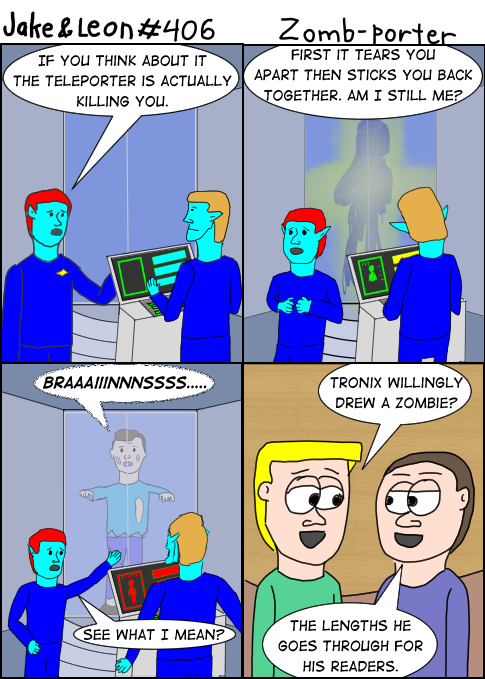
Taken from Robert Kirkman’s fake pitch for The Walking Dead. Untrue story.
The transporter, as mentioned before, was the result of necessity. The prop for the shuttlecraft wasn’t ready in time to film “The Cage” so they tossed this idea together. It wasn’t a new concept. Atom Man Vs Superman, the second Superman serial, had the first live-action Lex Luthor using such a device with the same principles. That might not have even been the first time it was used. There have been moments that involved issues with the transporter splitting people in two, carrying a monster in the beam, being used to hold someone in storage for decades, and so on. So it wasn’t just a fast travel option, it could be a plot device.
This seems to be a good place to stop. Next time, more terminology. Will we hit technobabble? Join me next time and find out.



 BW Media Spotlight
[…] I mentioned last time, knowing the terminology of your world is important, especially if there are a bunch of writers who […]
LikeLike
[…] don’t know what else I can say that I didn’t already say in part one and part two of this section of the writer’s guide. It’s a long one, though not as long […]
LikeLike
[…] WAS AN ENTIRE PART FOR IT IN THE TERMINOLOGY SECTION OF THE GUIDE! THEY JUST WENT OVER IT AGAIN IN THE LAST […]
LikeLike