

I swear this is almost done.
If I sound like I’m getting tired of this, I’m really not. I do find this interesting. Yes, it’s taken longer than I thought and I’m worried readers are seeing this as going way too long. This has been a deep dive through the original pitch and the season two writer’s guide, and maybe it feels longer than the previous story bible reviews. Currently, the YouTube channel glib facsimile (apparently he can’t afford capital letters–kidding, Glib) is doing his own series on the writer’s guide. I’m going to watch it when I’m done here, which should be by the end of the month, start of next month at the latest. This still isn’t as bad as going through Seduction Of The Innocent and I pray to God nothing ever is.
It doesn’t help that this part of the Q&A guide, and one question in particular, doesn’t make sense. Some of this is in the guide itself, and I still don’t know why they added this section. I haven’t read the previous drafts so I don’t know if this more of a FAQ based on season one writers’ questions, or if they didn’t think what they had would be clear enough. If you needed clarity, just rewrite the section. Does the guide going into season three add a section for Chekov or is there a “tell us about this new Russian Davy Jones you shoved into this year?” question? (Not kidding, that’s what they used for his early hairstyle, Davy Jones of the Monkees because their fellow NBC show was doing amazing ratings with the younger set and the network or Desilu wanted them to get in on that.)
So this section goes into more lore building, but will we learn anything new about intentions? Let’s head in and find out.
The mission of the U.S.S. Enterprise? Isn’t it something like that of, say, English warships at the turn of the century?
Very close. As you recall, in those days vessels of the major powers were assigned to sectors of various oceans, where they represented their government there. Out of contact with the Admiralty for long periods, the captains of such vessels had broad discretionary powers in regulating trade, bush wars, putting down slavery, assisting scientific investigations and geological surveys, even to becoming involved in relatively minor items like searching for the lost explorer or school mistress.
Turned out they ran off together…sorry. I don’t know why they didn’t try to sell the show with that. Seagoing swashbucklers weren’t doing what Westerns were doing at the time, but they still did okay. I guess it would make the network think of Errol Flynn movies or something closer to Firefly, Blake’s 7, or One-Piece where the Federation would be the bad guys (literally in Blake 7‘s case), but it would be more fitting than “Wagon Train to the stars”, which fits the original Battlestar Galactica more conceptually as far back as the original Adam’s Ark concept. (Now there’s a pitch & guide review I’d like to do, compare Adam’s Ark to Battlestar Galactica.) And yes, someone’s going to note that some of the British Navy did misuse their power, may have been behind slavery (and they probably focused more on putting down white slavery than slaves from Africa), and the like, but was that the norm or the exception? Historians, speak up!
Speaking of the starship U.S.S. Enterprise is it a completely military arrangement?
Semi-military, but without being heavily authoritarian. For example, we will not be aware of “officers” and “enlisted men” categories. And we will avoid saluting and other annoying medieval leftovers. On the other hand, we do keep a flavor of Naval usage and terminology to help encourage believability and identification with the audience. After all, our own Navy today still retains remnants of Nelson and Drake.
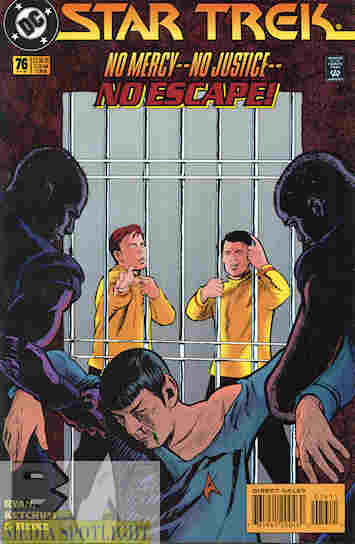
The crew versus their greatest foe: the fashion police!
A bit of commentary there about “annoying medieval leftovers”. The US Navy still uses salutes and ranks. Even cruise ships use a rank system, just one more in line with employer/manager/employee job titles and naval terminology. Starfleet does seem to be more into exploration and defense. Uniforms at this time came off the rack at Sears versus what we’d see in the movies and 24th century shows. And yet it was The Next Generation where they started to look more like remote controls.
Does our starship ever land on a planet?
No. It remains in orbit above the planet it visits, sends landing parties down via the Transporter device. This is an energy-matter scrambler by which people or equipment aboard the vessel are beamed down onto the planet surface at any given spot.
This is what I was talking about earlier. This is already emphasised earlier in the guide. Did you not read this thing? It does go a bit more into the effect the transporter has on the ship.
This requires an enormous drain on the cruiser’s power supply and can only be done at some intervals and across relatively short line-of-sight distances. A landing party or crew member who wishes to return to the vessel must have some form of communication to the vessel so that his exact position can be known and the Transporter beam focused there. Obviously, if the landing party is captured and their communicators taken, or they give them up voluntarily, they can be in deep trouble.
Then again, we have seen them search for the landing party/away team by having sensors tell them apart from the native lifeforms, or a small transponder under the skin when they need to be undercover. Oddly, nothing is said about not being able to beam through shields. I mean, they’re clarifying everything else.
Although avoiding landings was a budget consideration, it is perhaps even more important in permitting the writer to avoid all the time and technical problems of a vessel landing, allowing his characters to be placed into the heart of a story very early in the script.
In many ways the transporter, despite teleportation not be new in sci-fi, was a blessing in disguise. The Star Trek franchise basically made the teleporter a sci-fi favorite. When people, even the casual audience, thinks of teleportation they think of Star Trek and “beam me up”.
What is the Transporter?
THERE WAS AN ENTIRE PART FOR IT IN THE TERMINOLOGY SECTION OF THE GUIDE! THEY JUST WENT OVER IT AGAIN IN THE LAST QUESTION!!!
Yeah, this is the one that confused me as to why this section in general and this question in particular is here. Hindsight be scrapped, this is going into season two and you have all of the descriptions up to this point. If you can’t figure out what the transporter is by the time you get here, you clearly haven’t been reading this guide!
“Transporter” describes the device aboard the ship via which most planet landings are actually made. Briefly, for our purposes, it is a device (scientists agree it is possible)…
Let me stop there and note that scientists says what’s coming is theoretically possible but comes with so many caveats and asterisks as to make it near impossible in execution.
…whereby matter is converted to energy, and the bodies of crewmen, equipment, supplises, anything can be beamed down to a planet surface and reassembled in its original form there. Phraseology can be either “transported down” or “beamed down”.
Generally, we will use the Transporter Room seen in the pilot, in which you will recall seeing the Captain and the rest of the landing party shimmering away into nothingness, cutting down onto the planet surface, where we saw the reverse of it, i.e., the gossamer shimmering and the bodies of the Captain and landing party materializing into solidity. We will also assume the ship has other larger Transporter rooms, used primarily for the less critical beaming up and down of equipment, supplies, etc.
We really didn’t get to see cargo transporters until TNG. I’m curious when these writers saw the pilot? It didn’t air on television to my knowledge until the 1990s and an anniversary special event on the Sci-Fi Channel to my knowledge. “The Menagerie”, which included clips from “The Cage”, did air in season one but by then the entire season aired. If these were questions that came up making season one I would still think a rewrite would have been a better idea for this third edition we’re going by. Plus, the existing section and the previous question.
What about the ship’s main saucer-like section?
This is the portion of the ship in which we will be and which we will use most. It contains at the very top the ship’s bridge and general operation facilities. This “saucer” is approximately twenty stories thick at its widest spot, containing also primarily ship’s departments, living accommodations, recreational facilities, laboratories, and is in fact a completely self-sustaining unit which can detach itself from the galaxy drive units and operate on atomic impulse power for short-range solar system exploration. We have a model of the vessel available and can discuss any specifics about the vessel which are important as story points.
Now this almost makes up for the last two. We have never seen the saucer section detach in 23rd century shows. Not in the original series, not in the animated series, and in the movies not unless you count the ship going boom…which actually started in the saucer section. So this wasn’t just an idea created for The Next Generation to get the families to safety but was actually available to the writers for decades and nobody in television, movies, comics, or games ever did anything with it. As you know who would say, “fascinating”.
I understand the concept of most landings taking place on planets approximating Earth-Mars conditions. But will we never get to a planet where gravity or atmosphere is a problem?
Yes, assuming the right story. We probably should have it for a change of pace occasionally. Undoubtedly some story will take us outside our vessel into space for repairs or to investigate some strange object there. But generally we will avoid space helmets and weightlessness since such tales would more legitimately concern Earth’s present era of space travel. The aim of our format is drama based more on character than on details of technology and hardware.

“That’s not what I meant about wanting to see the galaxy up close!
The closest the show ever gave us to being in space was that time Kirk was trapped in between dimensions or whatever the Tholian’s capture web was doing to him, or that time they went onto a dead starship and got the drunk plague. The cartoon did have force field belts, and did manage to go to different atmospheres but same gravity. The comics got to play with this a bit more, but the movies are really the only place besides the comics (seen right) where they actually got to walk around the outside of the ship. If they landed on a planet with bad air, they were usually encased in some force field by aliens for torment.
One last question for the dodgy science section of the Q&A.
Obviously the U.S.S. Enterprise must exceed the speed of light to travel effectively through our galaxy. That isn’t possible.
So some say–now. Star Trek says it can be done via space and time warp. Out motive power is the two nacelles you may remember seeing as extending up from the engineering and cargo section and behind the main saucer-like portion of the vessel. These, without the “saucer”, make up the galaxy-drive unit. The two “outboard” nacelles contain matter and antimatter, a controlled intermixing of which creates stupendous power needed. We are presently searching for an optical effect in, about, or between these nacelles which will make their spectacular potential seem more obvious to the eye.
It would take the movies, possibly inspired by Star Wars, for that to become a reality, a multicolored streak going behind them. By the syndicated shows, special effects would advance enough to show them going into warp but for the original and animated series, and you’d think with Filmation’s always interesting special effect techniques they would have come up with something, the best you got is the stars moving faster. Even today, faster than light travel is more theory than fact, with concerns like time dilation being an issue the franchise has mostly ignored. Maybe it’s something in the dilithium or some other explanation like the transporters’ “Heisenberg compensators“, named for the guy who figured out why the transporters are near impossible. The Star Trek franchise has had an unintended impact on real and theoretical science since the beginning. I wonder if you can say that about what they put out now?
Next time we go back into the lore, but this time it looks like it might be stuff we don’t know about Earth historically and “currently” in the Star Trek universe. We might finish this series before Groundhog Day. We’ll see.



 BW Media Spotlight
[…] think we’ll finish this whole thing next week, if not the week after. Last time we continued the Q&A by looking at more of the science of Star Trek, and now it’s back to the […]
LikeLike