

I think we’ll finish this whole thing next week, if not the week after. Last time we continued the Q&A by looking at more of the science of Star Trek, and now it’s back to the lore.
Skimming through, I see that we actually are discussing some new things, looking into the history of the Star Trek universe and its current status. We know there was a third world war, because the 1960s were sure it would happen, that wiped out a lot of civilization (including television interestingly enough) but they managed to rebuild and become the center of the galaxy, because that’s also how the 1960s rolled. The 1960s were weird.
So how will the guide address Star Trek lore, and what changes were made throughout the classic timeline? I’m out of padding, short as this intro is on the homepage, so let’s just dive right into it.
What is the Earth like in Star Trek‘s century?
For one thing, we’ll never take a story back there and therefor don’t expect to get into subjects with would create great problems, technical or otherwise. The “U.S.S.” on our ship designation stands for “United Space Ship”–indicating (without troublesome specifics) that Mankind has found some unity on Earth, perhaps at long last even peace. References by our characters to Earth will simply be a logical projection of current science and social advances in food production, transportation, communications, and so on. If you want to assume that Earth cities of that future are so splendidly planned with fifty-mile parkland strips around them, fine. But for obvious reasons, let’s not get into any detail of Earth’s politics of Star Trek‘s century; for example, which socioeconomic systems ultimately worked out best.
Yeah, that didn’t last in later incarnations. The Next Generation decided that Earth no longer used currency, which Deep Space Nine would point out the flaws for. Earth visits, with minor exceptions that still never really got into cities and the like, were reduced to Starfleet, the Academy, or someone’s really nice land spread. Books and comics would try to get into the regular parts of Earth, but those are seldom official works. Plus the DC comics would mention people getting paid in at least one comic set in the movie time period before Roddenberry, the guy who added lyrics to the theme song to get a share of the royalties even though he didn’t use them (thankfully), decided we don’t use money anymore. Gene was a funny little man sometimes, wasn’t he?
I’m still confused about Earth of the Star Trek century. You said to make logical projections into the future, then turned down my story.
Now this is an interesting one, and might lend credence to the “these are questions that came up in season one so we should shove this in to address it for season two” theory. Obviously this is going to be more overview than specific example of “here’s what this one idiot tried…oh, that was you?” but we can still have fun trying to figure out what they’re referring to if an example comes up.
Because the basis of it was an autocratic, regimented, inhuman Earth of the future. We must have an optimistic projection from Earth of today if we are to approve of and identify with Captain Kirk, the crew of the Enterprise, and their mission. However, Earth colonies, parallel civilizations, and alien cultures, can present any range of inequities and problems leading to a story.
And yet modern Trek is so unoptimistic that the guy known for Family Guy made his own version. And they brought back TV as an available media form. Points to The Orville.
But projecting the advanced capabilities of your starship, wouldn’t Man by that time have drastically altered such needs as food, physical love, sleep, etc.?
Now you have me thinking of that Johnny Bravo episode where he went into the future and kissing was done through a machine even when the girl was right next to him. (I tried finding that clip.) Food, maybe. They did have replicators, which didn’t taste as good as cooking the old fashioned way. It’s the 60s so I don’t want to know what changes to sex would be. Sleep? What’s to change? We need sleep unless your freebasing the coffee beans, and even that you’d regret later. Of all the advances they could have gone with, these are odd choices.
Probably. But if we did it, it would be at the cost of so dehumanizing the Star Trek characters and surroundings that only a small fraction of the television audience would be interested, and the greater percentage of viewers might even be repulsed. Remember, the only Westers which failed miserably were those which authentically portrayed the men, values, and morals of 1870. The audience applauds John Wayne playing what is essentially a 1966 man. It laughed when Gregory Peck, not a bad actor in his own right, came in wearing an authentic moustache of the period.
There was an episode of Adam Ruins Everything where host Adam Conover and his writers took on Old West tropes, basically saying in the final segment that the Old West stories needed to die and be replaced with the “true history” rather than bring in elements of history that would still work. Things like some states demanding women have the right to vote before joining the union, the positive side of the old bordellos, air conditioning, and a one sided view of the conflicts between white man and red man, rather than showing the faults and virtues of both sides. Notice how few Westers we get these days? And when we do they’re dark, dirty, and depressing and only do well when they add something fun or feature a popular enough actor. “Realistic” didn’t kill the Western but it is rather comatose as we begin 2025.
Then must the starship crew be perfect humans?
No, you can project too optimistically. We went with characters with any believable mixture of strength, weaknesses, and foibles. Credulity is the key here. What kind of men would logically and believably man a vessel of this type? Obviously, they’d be better selected and trained than the wild enlisted shore leave group in Mister Roberts. On the other hand we hope they’re not too stuff to enjoy themselves on liberty in an exotic alien city filled with unique pleasure. (Possibly not a bad story here.)
Oh, we could spend hours discussing how the people who wrote season one of The Next Generation really needed to hear this. Sadly it wasn’t in their writer’s guide. I know because that was the second writer’s guide/story bible I examined.
But what about Earth men on other planets?
We’ll find them in colonies, scientific bases, mining claims, trading posts, and the like. These space colonies and activities can be anything which results in an entertaining, believable story, practical to photograph. As an example, a planet Starship Base might be pretty much a technical station which looks (and can be shot as) some highly modern local-location electronics plant, perhaps also with some of our existing starship interiors doubled over to become that base’s interiors.
I’ll shorten the next paragraph. It also mentions “peaceful agricultural” colonies and mining colonies or underground. We’ve seen all three over the course of the original series. The cartoon was needed to go oceanic, and and the ice planet wasn’t so much a Starfleet colony as the past of one planet about to go boom.
From here we shift from Earth to the “new civilizations”, and those few questions are what we’ll end on for this journey, starting with the simple question “and other civilizations”?
Be creative, but practical here, too. Any remember, our format envisions a great number of “parallel worlds”. We will find planets similar to many parts of our own–and with societies duplicating or intermixing almost any era in man’s development. For example, a society which has stopped cold at a sort of “1902 Earth” stage of development when a strong-man ruler decides that was “the best of all possible worlds” and in which the only capital offense is to alter anything at all. Or, what would Chicago be like today if Al Capone had won, and right is wrong and wrong is right? Jungle backgrounds exist on back lots, so what about primeval worlds? Or a pioneer-Indian type culture? We can find practical locations for these and dozens more.
We got all these. I’ve seen the “pioneer-Indian” one once so I never remember the name, but the jungle, or at least an alien forest, did pop up, and the “Chicago” idea included a fake card game that one of my comic strip characters are named after.
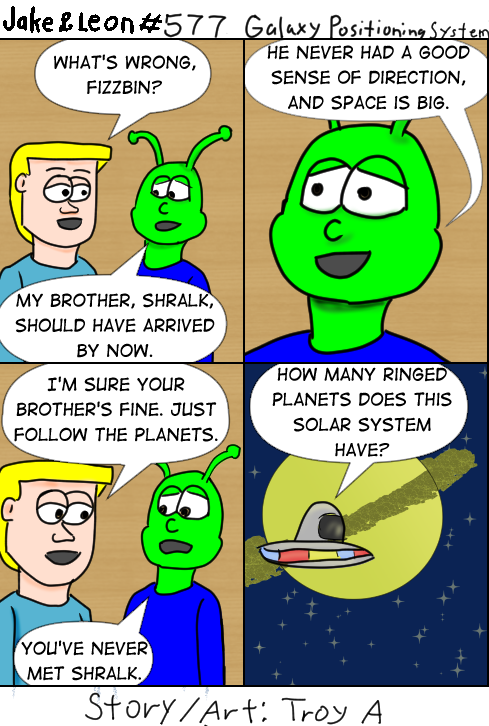
The sad part is that isn’t even Saturn.
AND her brother.
All right, I’ll agree that with some ingenuity there may be hundreds of choices–but what about the alien life on some of these worlds?
Man-like creatures are the easiest, of course, photos in the casting books notwithstanding. However, some modification of form, color and hair distribution can be accomplished without undue strain. We intend to do this where it makes story sense. But keep in mind at the same time that out of the collected best science fiction stories of all time, a surprising majority of them center on the more unique and often more thrilling variations in attitudes, values, morals, intellectual power and senses.
Not all that surprising. Writers and artists (either in comics, book covers, illustrators, or in the costume and art department) are a creative bunch. I’ve seen aliens that make no sense to their environment simply because the artist wanted to draw it. That tends to lead to aliens that look cool but are ultimately silly. For an alternate example, I don’t know what advantage Spock’s green blood has, but his strength comes from the increased gravity of Vulcan, which is where Superman used to get his superstrength before everything was shifted to the yellow sun and not just some of his powers. Spock also has better hearing for those windy desert landscapes. As for the mental powers? Since I’m theorizing, let’s say it’s easier to communicate than getting a mouthful of sand.
How does one talk with alien life forms?
In an intelligent sounding-using form, via the Communicator, the small hand-communications device seen in the pilot. It has a dual function: (a) communications between landing party members; and (b) a language-converter which computes and translate English into an alien tongue, and vice-versa. (To our surprise, after we had “invented” this language converter, we read a news item announcing a government project which is working on something similar.)
This makes more sense in the 24th century, where the communicator is on a pin on their shirt. The only time I see a hand-held language converter was not the communicator but a separate device allowing Kirk and company to talk to a living cloud being holding Cochran there because it was lonely. Other episodes in the franchise, and other franchises, have introduced the idea of a “galactic standard” language that always seems to sound like whatever language the movie’s been dubbed into or the native language of the country the movie was made for. For example, English for a US production or Japanese for a Japanese production, but that changes when dubbed into another language. But if you didn’t know that even back then the communicator does what an app on your smartphone can do nowadays, now you know.
The questions shift to more inquiries about writing stories set on the ship. We’ll save that and my final thoughts on this whole guide for the next and final installment in this series of writer’s guide reviews.



 BW Media Spotlight
[…] the goal is in sight. Last time we talked about life in Star Trek’s future, and now we get to discussing the last set of […]
LikeLike