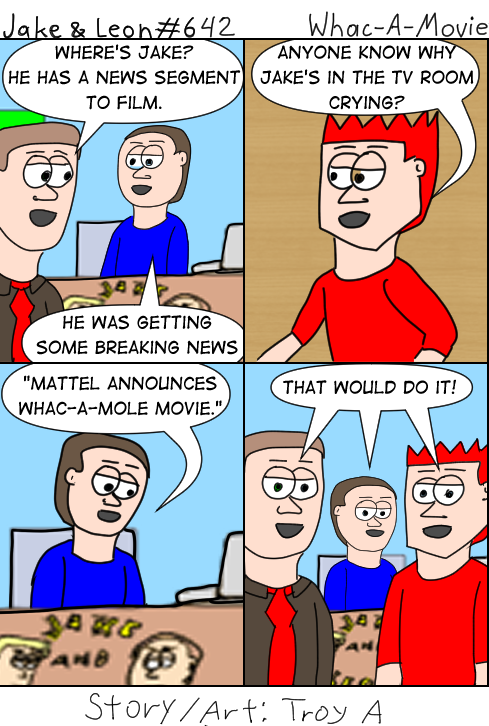
Jake & Leon #462> Whac-A-Movie

I wish I was kidding. No, I wish THEY were kidding.

I sadly bring proof.

Over at The Clutter Reports this week, due to what’s coming up during the week (namely more medical testing–yay, fun) I didn’t get any decluttering done as I tried to push to make sure there would be content here this week. So I posted a set of videos for streaming alternatives that allow you to actually own the media you purchased before the streaming owners lose the license or just censor it for the culture war.

I have the next Chapter By Chapter review of Tom Clancy’s Op-Center: Mirror Image ready to go and I’m going to get the last of the Free Comic Book Day offerings (technically one of them is a Batman Day freebee) done, but as for the main articles beyond Chapter By Chapter I’m not sure. I may have to use videos. If not I still want them set up so I have them. My birthday is in two months and I have a goal of having enough “evergreen” articles in the backlog that you never know I’m taking a break. Seeing as I’m about to lose at least one day if not two I want to still have something. Whether or not that something includes the first “official” installment of the Doctor Who BBC Reports & Notes I don’t know yet. That’s planned for Fridays unless something else grabs my attention that week. So there will be some kind of post. I just don’t know what yet.

Speaking of the comic reviews, I have two more Free Comic Book Day comics and a Batman Day comic, all from DC. That’s three days. Amazon “ComiXology” has the Phantom comic from Mad Cave I missed out on, so that covers Thursday. On Friday I will return to the really old “Yesterday’s Comics”, but I don’t know if I’ll do the Golden Age anthology or Space Adventure just to get that over with and finish the Captain Atom stories for our pre-DC look. We have three comics from DC and the Phantom had a short DC run, so Captain Atom would at least form a theme, but there’s a lot of Golden Age comics to go through. We’ll see what I have time for. It will be an anthology either way.

I’ve also made a category under the BW prose stories just for my Transformers universe concept. I think I’m going to work on that, get the worldbuilding brain cells going. That will be updated whenever I have something to post. No release schedule on that one since I have other things to work on.

Have a great week regardless, everyone. There will still be good reasons to stop by and say hello.

Saturday Night Showcase> Tabitha: The Two Bewitched Spinoff Pilots

Did you know Bewitched had a spinoff?

In 1977, the short-lived Tabitha followed the daughter of Samantha and Darren Stevens as she lived her adult wife, hid her witch powers, and worked at a TV station. Or a magazine. See there were two pilots, and both are very different.

In the original failed pilot, Tabitha Stevens worked as an “executive assistant” dealing with a mortal love interest like her mother while being bothered by her younger warlock brother Adam, who seemed to agree more with his grandmother in a dislike of mortals and living a “normal” life. In the second pilot that led to a one-season TV sitcom, pretty much everything is changed, including the actress playing Tabitha. The original pilot starred Liberty Williams as the grown-up Tabitha and Bruce Kimmel as her younger brother, Adam. It was not picked up but pilot writer William Asher would work on the series.

Said series apparently didn’t watch Bewitched before making the second pilot. Adam, who as someone that has watched maybe a handful of episodes in his lifetime I never knew existed, now has no powers and is Tabitha’s older brother, rectoning the original show. Nice job, guys. Instead he takes on his father’s position of trying to keep his now younger sister out of witchy mischief and nobody is trying to talk her into giving it all up, at least on the regular. Aunt Minerva apparently stops in now and then. Tabitha, now played by Lisa Hartman for the full series, is a production assistant at the same television station where her brother, now played by David Ankrum, also works. The show also is an early vehicle for Robert Urich, who my generation probably better knows from Vega$ and Spencer For Hire (the show where future space station captain Avery Brooks got his start).

Tonight I bring you both pilots. In the failed one, Tabitha tells her love interest that she’s a witch. Like mother, like daughter, while Adam keeps trying to tell her to leave all this mortal stuff. In the successful retcon-heavy pilot Tabitha is trying to get a guest for the show she works on. Which one do you think was the better one? Either way, enjoy.

Continue reading

BW’s Saturday Article Link> Pulling The Offense License

This comic is offensive because it sucks, not just the depiction of the Obamas.

You would think that an exhibit called “License To Offend” would tell you what the exhibit is about, in this case cartoonists whose work is considered art by some and offensive to others. And yet despite knowing what they were getting into an exhibition in Surrey, England was allowed to go as far as private viewings before being told to shut it down for being offensive. Okay. This was reported on by The Spectator but with the full article behind the paywall we’ll have to trust Avi Green at Four Color Media Monitor and Bleeding Fool (the latter is easier to read) is being honest as to how dumb this is. You knew what you were getting into when you greenlit it, guys.

Doctor Who: 1963 BBC Reports & Notes> Prologue

Here’s what Google AI has to say when I typed in “the state of science fiction in the UK in the 1960s”:

In the 1960s, British science fiction experienced a significant shift towards the “New Wave,” characterized by experimentation and a focus on social and psychological themes. This era saw the rise of authors like Brian Aldiss and J.G. Ballard, who explored complex social and psychological issues through the lens of science fiction. The New Wave also influenced the emergence of science fiction on television, with shows like Doctor Who and Out of the Unknown gaining popularity.

It also pointed to a Wikipedia (question both sources) page on British television science fiction:

Two important events for the future of British television science fiction occurred in 1962. The first was that the BBC’s Head of Light Entertainment, Eric Maschwitz, commissioned Head of the Script Department, Donald Wilson, to prepare a report on the viability of producing a new science-fiction series for television. The second was that Sydney Newman was tempted away from ABC to accept the position of Head of Drama at the BBC, officially joining the corporation at the beginning of 1963.

The BBC developed an idea of Newman’s into Britain’s first durable science-fiction television series. Taking advantage of the research Wilson’s department had completed, Newman initiated the creation of a new series, and along with Wilson and BBC staff writer C. E. Webber oversaw its development; Newman named it “Doctor Who.” After much development work, the series was launched on 23 November 1963. It ran for 26 seasons in its original form, through which first emerged many of the writers who, until the 1980s, would create most of the genre’s successful British shows.[example needed] One of the few science fiction series to have become part of the popular consciousness, its success led the BBC to produce others in the genre, notably the science fiction anthology series Out of the Unknown (1965–1971), which ran for four seasons.

What does that have to do with this?

While looking for the next story bible/writer’s guide to review I came across a series of Doctor Who related postings on this site simply called TV Writing that collects writer’s guides for study. That was after one of my other new go-to sites had one of these files, but going to a dead link. There doesn’t seem to be an actual writer’s guide for the original Doctor Who online on any of my choices. For all I know the BBC didn’t and still doesn’t use them. I’m not a historian. I’m a reviewer, semi-artist, and storyteller. Still, this site has some of those notes and early pitches for Sidney Newman’s long-running-with-a-long-break series and possibly the notes mentioned above. I didn’t know about any of this, but in this next series of articles, which I’m putting into my story bible category on a technicality, we’re all about to.

Welcome to a new article series.

Continue reading

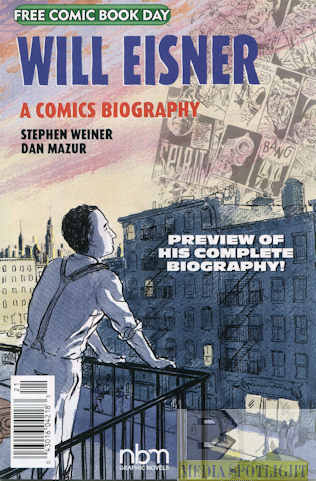
Today’s Comic> Will Eisner: A Comics Biography Free Comic Book Day Preview

“I don’t remember comic strips in the forecast.”

Will Eisner: A Comic Biography [FCBD preview]

NBM Graphic Novels (2025)

Stephen Weiner & Dan Mazur

This is a sample for a graphic novel in the Comic Biography series, and only touches on part of the story. Still, they managed to make a snippet that works for a done-in-one feel while still teasing the full graphic novel, which I very much appreciate.

Continue reading

BW’s Daily Video> A Missing Doctor Who Episode Update?

Catch more from The Confused Adipose on YouTube


Did Walt Disney Damage Literature?

At first this was going to be a full-on BW Vs article, responding to a recent pair of blog posts by author Brian Neumeier over at his Kairos Publication‘s blog section. However, he showed the same video I’ll be showing below, and it’s a kinder version of what he wrote. I’ll still refer to those articles and to part two of the video, which is out and a part three is teased at the end, but you come here to read.

The video comes from YouTube channel Cartoon Aesthetics, a relatively new animation discussion channel with only a handful of videos in it’s one year of operation. This is the first of a series titled “How Disney Stole Your Childhood”. In the video, the host discusses how Walt Disney’s adaptations of public domain tales from the past had a negative impact on reading those stories by becoming the definitive version of those stories. Unlike Neumeier, the host of the videos doesn’t believe that this was intentional on Uncle Walt’s part, but something that happened over time and through later owners and CEOs of the company as they shifted more towards business than storytelling, or that was my impression of both. While I’ve gone over that Walt knew business to a degree he cared more about storytelling than the business, certainly more than current CEO Bob Iger, and wanted his stories to be as good as possible, knowing that would bring the business.

This actually started from a discussion on Disney’s role in cementing the idea that cartoons are just for kids, the first article I linked to specifically about that. I don’t agree with that assessment because making kids cartoons weren’t new. As even some commenters pointed out, other studios were making cartoons for kids but there were also cartoons for adults. Betty Boop was brought up and what the Hayes Code did to her, but let’s also remember that the Looney Tunes were not entirely for kids. Some of their humor was clearly made for adults. It’s just over time the Looney Tunes and Merry Melodies shorts (and I’m not even sure what the differences in titles were), ended up being thought of as kids fare, even airing on Saturday mornings not only on parent group-patrolled network CBS but in syndication and later on Nickelodeon. This really could be a discussion for a later time, and both the articles and the videos bring up Japanese “anime” (short for animation so stop correcting people) as examples of how this is a Western position. So the question is for this response commentary…did Disney convince kids to not read books based on their adaptations? And if so, do we now have a way to fix that?

Continue reading