

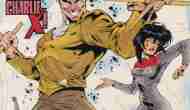

“Okay, that last burrito was a mistake.”
Hypergirl #1
Markosia Enterprises (2011)
“The Rise Of Pharaonicus”
WRITER/COLORIST/LETTERER: Ian Sharman
ARTIST: David Wynne
COVER ART: Azim Akberali

“Okay, that last burrito was a mistake.”
Hypergirl #1
Markosia Enterprises (2011)
“The Rise Of Pharaonicus”
WRITER/COLORIST/LETTERER: Ian Sharman
ARTIST: David Wynne
COVER ART: Azim Akberali
Catch more from WhoCulture on YouTube
Here’s a bonus one from me. Two different New Who episodes have the Doctor being able to communicate with horses like they’re people, one of which was even trans (because of course he/she was, and that was the Moffatt era as well as my favorite New Who Doctor). That means in the Whoniverse horses do in fact have a sense of self like other sapient species, and thus are victims of slavery because they can’t speak English even as well as a dog. That’s kind of dark for a lame joke.

Here we go again, kids.
For all the talk of embracing the goofier nature of comic books into James Gunn’s Superman By James Gunn, director James Gunn apparently can’t get his head around the idea of how Superman pulls off the “Clark Kent” persona. He joins not only a long list of people who seem to misunderstand how Clark’s trick works but other comic book favorites nobody questioned. James Gunn himself altered Peter Quill’s “Starlord” outfit while Sam Raimi could explain how Peter climbs wall (and a better one than comics actually gave us…some nonsense about gravity control or something if memory serves, while Rami had little “hairs” that worked together to help him stick to wall) but somehow “teenage science geek with a special interest in chemistry and engineering creating an instinctual substitute for a spider’s webbing” was too much for him. This always bugs me.
So James Gunn, working with Tom King (that’s was your first mistake), decided he needed to “fix” how the glasses work. As I’ve said on this site time and again it’s not just the glasses that allows Clark to pull off his dual identity, but of course the guy who admitted that it took him a long time to come up with anything he liked as far as a Superman story in his style has to do it the hard way. The comic cover above shows that what he and King came up with is technically canon in the Bronze Age pre-Crisis version of Superman, but it’s a lame explanation…which explains why they went with it, I guess.
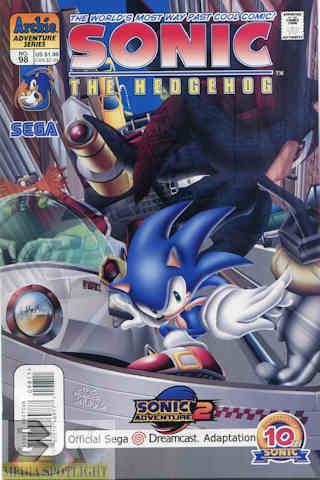
“I thought Sonic Free Riders wasn’t for a few games yet.”
Sonic The Hedgehog #98
Archie Comics Publications (July, 2001)
COVER ART: Patrick Spaziante & Harvey Mercadoocasio
COMPUTER COLOR PAINT: Josh D. Ray
EDITOR: J.F. Gabrie
“Sonic Adventure 2”
WRITER: Karl Bollers
PENCILER: Patrick “Spaz” Spaziante
INKERS: Harvey Mercadoocasio & Nelson Ribeiro
COLORISTS: Patrick Spaziante & Nelson Ribeiro
“When Shadow Awakens”
WRITER: Ken Penders
PENCILER: Ron Lim
INKER: Ram Eklund
COLORIST: Fran Gagliardo
LETTERER: Vickie Williams
Catch more from Cynical Adult Watches Cartoons on YouTube
This wouldn’t be my ranking. You can read my Many, Many Intros Of Superman article series for my favorite live-action and animated takes on Superman. I will say that I completely agree on the Fleischer version, while I would put My Adventures With Superman lower not because I think it’s a bad show but because it’s a very poor Superman adaptation. Superman is the only character they got right. Admittedly, putting Filmation higher is clearly nostalgia on my part. Interesting that one of his criteria is pronouncing Mxyzptlk when one of my mine is how well they separate “Clark” and “Superman”, which would boost the Ruby-Spears version since Beau Weaver is underrated, being almost as good as Bud Coyer without the same years of experience.
Kids, there used to be these things called payphones. Pay phones would be stationed in various areas by the local phone company and if someone was out and needed to reach someone, because cell phones didn’t exist yet, you could put in your coin and make the call home for a ride, or to see if a friend left their house yet, or whatever you needed at the time. If you didn’t have the phone number, probably because someone stole the phone book they kept inside if they had one at all, you could dial the operator and get the number or get help making the call.
It’s this outdated communication method that Jim Croce was thinking of with when he put out “Operator “That’s Not The Way It Feels”, off his 1972 debut album You Don’t Mess Around With Jim, his second single after the title track. I was listening to this while driving with my dad the other day (as I write this) and I noticed there was a story attached to it. So of course I looked it up.
Per usual in this series, we’ll start with a lyric video, to put focus on the words, as he tells the story from the perspective of a man trying to get a call to the woman who broke up with him for his best friend. As with many songs, this was inspired by an actual event Croce witnessed while in the military and elsewhere. This is not a happy song, but it’s not a dark song.

“I didn’t know you had kids, Spectro!”
Captain Atom vol 2 #81
Charlton Comics Group (July, 1966)
Ditko & Mastroserio


 The Clutter Reports (my other site) Atop The Fourth Wall Crisis On Earth Prime Lean Into Artcast Bully Says “Comics Oughta Be Fun” Siskoid’s Blog of Geekery
 Cartoon Hero’s Lair SF Debris Four Million Years Later


 BW Media Spotlight