“This BW site is really cool!” (Hey, how often do I do that?)
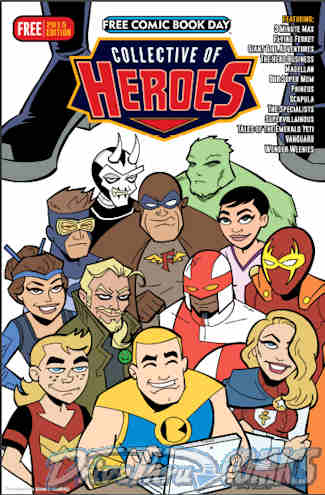
Collective Of Heroes
Free Comic Book Day 2015
From what I can tell this is a digital book promoting an aggregate site for different superhero webcomics. I would link to the comics previewed here, but the list isn’t very well maintained. Some of the links don’t work, one went to a completely different comic, and the lineup in the comic includes things no longer on the site. So this will just be a look at the various comics previewed here.
Police Squad was a short-lived parody of 70s cop shows, with TV Guide specifically calling out the works of Jack Webb (Dragnet and the original Adam-12) and Quinn Martin, and there’s a lot of the later’s intro flavor in the show’s. Wikipedia credits The M Squad, and Felony Squad. You can see the pattern, I guess, but I have not seen either show. I got to see Police Squad on A&E back when it was still standing for Arts & Entertainment, and it’s rather funny. They went on to make the Airplane movie parodies. In 1988 the show was revisited in The Naked Gun: From The Files Of Police Squad, though the two sequels focused more on “Naked Gun” than “Police Squad” for titles. The movies brought Leslie Nielsen, but no Alan North, who was still alive, or Rex Hamilton, who passed in 1985. (No clue if he was at the theater at the time.) The only other returning actors were Ed Williams as forensic scientist Ted Olsen and the so tall his head was never on frame Ronald Taylor as Al.
The movies renewed interest in the show, but after Naked Gun 33 1/3: The Final Insult the series went back to obscurity, though not to the point it had been. (Personally I couldn’t get past the…clinic scene. If you saw the movie, you know what I mean. If not, I envy you.) With Neilsen having passed away we get a new Frank Drebin for a new generation, the son of the original following in his father’s footsteps. And given the world this franchise takes place in, they’re probably clown shoes. Let’s watch the trailer and ask if Liam Neeson is young enough to be Leslie Nielsen’s son or if the similar sounding names was too much to resist.
Said it before and I’ll say it again: The prince is Snow White’s reward for all the crap she goes through, finding a way to maintain a positive and compassionate attitude the whole time.
I recommend a History Channel miniseries if you can access it: How Disney Built America. (I did an article about Walt’s legacy after watching it._ Walt did for animation what George Lucas did for science fiction in creating or embracing new technologies and taking big risks to get his dream to happen. If classic Snow White was “Walt’s Folly”, we can call the live-action demake “Bob’s Folly”. Clearly Walt succeeded where Bob fails. No wonder he wants to get rid of the legacy on top of modern Hollywood’s snobbery against animation.
I’ll be looking at some trailers this week, but we’re starting with a sneak peak.
James Gunn and DC Studios recently dropped a scene from Gunn’s upcoming Superman, formerly Superman: Legacy until someone realized that wasn’t confusing as “Superman” could be a bunch of different shows and movies over the decades. The scene gives us a proper look at Krypto, based on Gunn’s dog rather than the labrador retriever he’s usually depicted as. Gunn’s rescue dog, Ozu, is a terrier mutt, and thus James wanted his dog to be represented. It doesn’t sound like much of a complaint, and if not for the fact that they’ve screwed up so many things from the source material over the years and there’s a reason only G.I. Robot is talked about from Creature Commandos in my circles I probably wouldn’t bring it up. Check Comic Drake’s video from earlier today about Krypto’s history and other breed swaps, but I know what I grew up with, even if I had to look up the names because I know nothing about dogs. I know Gunn’s Krypto isn’t the right breed, so I…think that means I’m not a breedist. Frankly who can tell what the internet crazies are thinking these days. It does mean a smaller dog, but he has the right fur color…which I’m sure I will get called something for bringing up.
Enough pseudo-culture war BS. Thus far the stuff I’ve seen and heard has kept me neutral on this movie, and given that Superman is my favorite superhero that’s almost as bad as being negative towards it. A resounding “meh” is not the reaction I want to have whether or not it’s an improvement over the Snyder incarnation. That’s where we are, and honestly…not really any different here.
Nice of the cover to tell you the backstory…instead of this issue’s story!
Space Adventures #36
Charlton Comics Group (October, 1960)
Four stories, but while we only care about Captain Atom in our pre-DC runthrough we’re going to go and read the other three comics anyway. Thus far they’ve involved space but the “adventures” part has been kind of weak, even with the hero we’re here for. Hopefully this issue will be different, partly because we’re getting two stories with Captain Atom this issue.







 BW Media Spotlight
BW’s Daily Video> You Can’t Subert Forever
Catch more from Comics By Perch on YouTube
So Prime doesn’t have a lot of good villains? Looking forward to that on Malibu Mondays.
Tell others about the Spotlight:
Posted by ShadowWing Tronix on April 10, 2025 in Comic Spotlight and tagged commentary, writing comics.
Leave a comment