
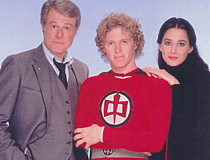
Yes, I know The Greatest American Hero was never a DC series, but we’re talking the nature of heroes, with DC only used as an example because it’s the people in charge of DC we’re discussing.
I have nothing against villain characters. I’m into action sci-fi and superhero stories. Villains are rather important to have, even if the “villain” is just a force of nature or rescuing trapped people or something. I’m not the fanboy that Reviewers Unknown headman Ozzie Arcane is, but I do have my favorite villains to watch. Lately, however, DC Comics is proving to be obsessed with villains to the point that they have an event where the heroes are gone and the villains are in charge, as well as a home video release dedicated to them called Necessary Evil. Geoff Johns, DC’s Creative Director (why do comics need someone to direct creativity all of a sudden?) and big name writer, has gone on record being a fan of villains. This explains why the Red Lanterns and Larfleeze have had their own titles.
I don’t have the above linked-to DVD because with my current budget I have more important things to spend money on. DVDs Worth Watching (sister site to Comics Worth Reading) has seen the DVD (or maybe they got the Blu-ray–I linked to the combo pack so everyone wins) and there’s one line that was pointed out by fellow Friday Night Fighter Brian Snell of Slay Monstrobot of the Deep that shows me that the wrong people are in charge at DC Comics.
From the review:
My favorite part was Mike Carlin talking about the “Death of Superman” story and how the important elements were what came afterwards, reactions and repercussions. Bad guys can’t win too often, he reminds us, in an approach that seems to have been forgotten by the current regime. In contrast, Jim Lee and Dan DiDio don’t think stories are any good unless the hero’s victory comes with a price. “They have to have something sacrificed… every time they win,” says DiDio. “They should be a little more broken because of what they’ve done.” That’s not a good way to shepherd 75-year-old properties, guys.
“Death & Return Of Superman” was a great storyline that showed Superman’s impact in the DC Universe at the time. It saw the rise of three new heroes, two of which stuck until recently and one of which turned out to actually be a villain pretending to be a hero. That’s why the “World WIthout A Superman” portion was interesting but you also knew they weren’t going to keep a flagship character dead (at least I knew it) and seeing his return was inevitable. However, he was willing to sacrifice himself to stop Doomsday, because we didn’t know what he would have done. In a later storyline we would learn that Doomsday specifically targeted Superman for a reason but he had to be strapped to that asteroid for a reason, right?
I’ve often thought that it’s a paradox that makes that “weakness” villains keep talking about a hero’s strength. A hero is willing to die to save others, but if he or she does die nobody will be there to stop the villains from taking over, hurting people, or whatever their dark goal is. This is the sacrifice heroes must make and yet can’t make. If you follow what I mean. But let’s look at that DiDio quote again.
In contrast, Jim Lee and Dan DiDio don’t think stories are any good unless the hero’s victory comes with a price. “They have to have something sacrificed… every time they win,” says DiDio. “They should be a little more broken because of what they’ve done.” That’s not a good way to shepherd 75-year-old properties, guys.
My god, even Spider-Man gets better treatment and there’s a reason I keep depicting him like this:

Not only are we getting the Batman-ficiation of the DC Universe lately (which started all the way back with Kyle and Alex if not sooner) but they don’t even get Batman. Is Warner Brothers or Diane Nelson this unobservant or this misguided? But this is only the view of fictional superheroes, right? Because if this is how DiDio sees real-life heroes, this went from annoying to downright insulting!
I’ve known people in the police (town and state), fire department, and at least three different branches of the military. You also have the FBI, CIA, and “first responders”, plus other organizations that save lives. These men and women put their lives on the line. They also have families that they go home to, provided they weren’t shot, blown up, or killed in some other way. Really, that could happen to any of us, but these people put themselves in harm’s way to protect and rescue us. According to DiDio, they aren’t allowed to have families or have happy times. The people I know, family and friends, would beg to differ.
There’s also the “I’m loving torturing the hero” line I see out of too many writers. There’s a difference between challenging your hero and enjoying torturing them. The former means you want to see how he or she is going to get out of the death trap, defeat the bad guy, and win their true love. The point is wanting to see them win! We want to see them overcome the odds and win the day. A good villain is a key part of that. They are an obstacle and while that sometimes means the villains are entertaining, it’s why they’re entertaining that proves to be yet another obstacle.
Real terrorists aren’t semi-incompetent fools like Cobra, and anybody who survived or lost love ones at the two World Trade Center bombings (people forget the one in the 90’s) or the subway bombings in Spain can attest to that. Real pirates, past and present, are less like Captain Jack Sparrow or the cast of One Piece than they are the Somali pirates that pop up now and then. And I’m pretty sure gang life is nothing like Saint’s Row or Grand Theft Auto. Fictional villains can take a few liberties but in the end they are an obstacle that the hero needs to overcome. Seeing how the hero wins is why we, the people the heroes rescue and protect, want to emulate at least their beliefs and goals. The heroes are supposed to be extensions of our fantasies and aspirations while the villains represent either our darker fantasies, the things in our way, or catharsis for the enemies we can’t stop, which is why the first-person shooter genre in general and games like Call Of Duty are so popular. Heroes speak to our “better natures” and villains to our “worse natures”. Unless you’re running DC, apparently.
If you would rather sympathize with the villains or make them look good, DiDio, Johns, Jim Lee, and the rest of the Bad Fanfic Brigade, that’s up to you, but that makes you the wrong people to put in charge of a franchise that has, until you showed up, been about heroes being heroes and inspiring their readers to be better people.
Related articles
- Necessary Evil: Super-Villains of DC Comics (comicsworthreading.com)
- Why #FireDiDio Won’t #SaveDC


 BW Media Spotlight