
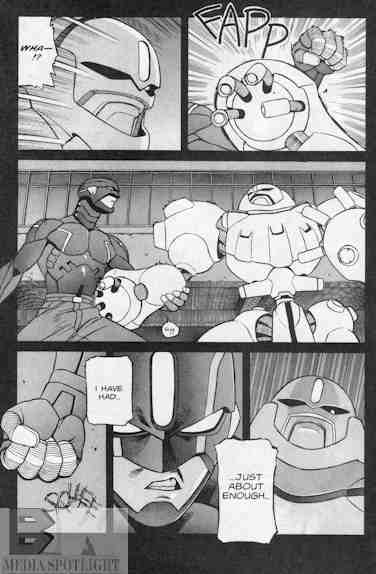
Metal Guardian Faust is a manga I wish continued in the US. I was getting into it.
As American comics and other media continue to lose sales, fans of Japanese media are experiencing a rise in numbers due to one simple thing: most Japanese creators are simply making stories for their target audience. The goal isn’t to preach, or take what was made for one group and give it to the everything for meeeeeeeeeeeeeeeeee crowd. They aren’t using false stereotype “representation” or altering the terminology to fit some personal commentary or message by the translator, and they aren’t bogged down in not-stalgia where something becomes unrecognizable from the original product.
Granted, there are exceptions, but around the Western creators that’s become the rule. Their adaptations are faithful because they care, with most adaptations being minor changes. Sometimes they’re in the wrong spots or ways, like the fallout from the Sexy Tanaka-San‘s adaptation driving the manga creator to suicide. Believe me, I’m not letting them off the hook. I’m talking more often than not you can at least recognize the material, which changes made for the adapted format change more often than “the studio had a ‘better idea'”, like in the Sexy Tanaka-San incident.
At least that’s an internal issue within Japanese media. However, all the comics, cartoons, and games are catching the attention of the “usual suspects”, the same people who scream about “cultural appropriation” but will still immediately tell Japan what they’re doing wrong and how to make it better, which usually means the same mistakes Western media is making. Since they refuse, their franchises are thriving while franchises in the US like DC, Marvel, Star Wars, Doctor Who–basically anything under modern Disney really, and Star Trek continue to slowly drain from pop culture as the fans who maintain the interest increasingly give up (and let’s not pretend that isn’t the snobs’ goal at least given their open opposition to sci-fi, fantasy, and other “geek media”, with the activists, shills, and everything for meeeeeeeeeeeeeee crowd having their heads too far up their backsides to notice they’re failing) as the corporate overlords have let the wrong people become stewards of the things they love.
I come with a duo of interviews by Japanese creators going over how their unwillingness to conform to Western standards, and why should they? They create for Japan. While Hollywood bends over backwards for China, Japan makes stuff for their country, their culture, and their perspective rather than a bunch of white old bitties who have never eaten and a Japanese restaurant. Again, they’ll scream “cultural appropriation” when some non-Japanese woman puts on a kimono and uses random Japanese words, but they’ll happily tell Japan what their culture and history should be.

Oh My Goddess! surprises me with how much I like something usually way outside my wheelhouse.
The first one, and the bulk of this article and responses, comes from German manga fan site Manga Passion. Granted, I’m working with Google Chrome’s translation but I think enough should be accurate for our requirements. After all, the words are different but the grammar is similar. The site conducted an interview with Akira Kanai, editor-in-chief of manga collecting magazine Afternoon, where manga like Vinland Saga and Oh My Goddess! got their starts. While the US no longer maintains magazines where writers send in stories that are later collected into a book, Japanese publishers still do collected manga magazines, like the Sunday comic strip section in the US (do they still do that?).
Have you perhaps already read Skip and Loafer, Wandance, The Darwin Incident or Vinland Saga? All of these manga couldn’t be more different and yet they come from the same manga magazine from Kodansha – Afternoon. The monthly magazine is generally assigned to the seinen target group and therefore focuses on stories for young men. In the past, classics such as Oh My Goddess!, BLAME!, Blade of the Immortal and Knights of Sidonia have also been published in the magazine. The sister magazine good!Afternoon has also produced numerous series that many fans in this country are certainly familiar with. These include Magus of the Library, Ajin: Demi-Human and Drifting Dragons.
We had the pleasure of interviewing Akira Kanai, editor-in-chief of Afternoon magazine, at the end of 2023 to find out more about what he thinks makes Afternoon manga so special, philosophize about what distinguishes Afternoon magazine from fast food and the extent to which illegal pirated copies have an impact on the globalization of manga. Prior to his current position, Kanai-san worked in the editorial departments of Morning magazine and Weekly Shounen Magazine and has several decades of experience in the manga industry. As an editor, he has overseen works such as Vinland Saga, Planetes, Ajin: Demi-Human, Fragile and Maria the Virgin Witch in the past. The full interview can be found at the end of the article.
For our purposes I’m skipping right to the interview and the relevant parts for our discussion.
MP: Hello Kanai-san and thank you very much for taking the time to talk to us today about your work at Kodansha.
Kanai-san: I am delighted to have this opportunity.
MP: Can you start by briefly introducing yourself to our readers? How long have you been at Kodansha and in what position? Which works, among others, have you supervised?
Kanai-san: I joined Kodansha in 1994. I was assigned to the weekly Morning magazine, which still exists today, for about seven to eight years, after which I switched to Weekly Shounen Magazine in 2002. I’ve been on the editorial staff of Afternoon magazine since 2006, and I’ve been in my current position as editor-in-chief of Afternoon magazine since 2015, so I’m in my eighth or ninth year now.
Japan has also tried their hand at US superheroes.
In terms of supervised works, I worked with Makoto Yukimura on Planetes during my time at Morning. Others are Ajin: Demi-Human, Vinland Saga and Fragile, a story about a doctor. But I don’t know if Fragile is available in German. There’s also Maria the Virgin Witch by Masayuki Ishikawa and others. I’ve only ever worked in the manga editorial department, it’s been 30 years now. It’s been 30 years! (laughs)
As a student, I didn’t want to become an office worker and tried to draw manga myself. Back then, Afternoon and Morning were still one editorial team. I actually wanted to submit my manga to Afternoon, but there was no contact person for Afternoon magazine, which had just become independent. So I applied to Morning. I was assigned an editor from the former Morning, who looked very tired from sleepless nights and gave me – sorry for the choice of words – meaningless advice. I myself was totally hungover and thought to myself, if you can make money for such bullshit, then it’s easier to have manga drawn than to draw them myself. That’s why I started at Kodansha. (laughs) But I felt a bit cheated, because when I started I realized it wasn’t that easy. (laughs)

So that’s his resume. This is a man who has been in the industry a long time, and knows what makes a good story in his market. Note how many of those manga are so different from each other. Planetes is about outer space’s clean-up crew in the future while Vinland Saga is a fictional account of vikings.
MP: You have worked for several different Kodansha magazines. Have you noticed any difference in your work for each magazine or would you say that the work as an editor is similar, apart from the target audience?
Kanai-san: There were both differences and similarities. During my time at Weekly Shounen Magazine, I actually felt a big difference. It’s a label aimed at teenagers, so I was very aware of that when creating the works. The way you address teenagers, i.e. minors, was different from Afternoon or Morning, between which there were hardly any differences.
There is a big difference between a magazine aimed at teenagers and one aimed at adults. In Japan, there is a perhaps unique mindset that young people are very pure and righteous. In contrast, adults are the ones who are mistaken, greedy and power-hungry. The idea that teenagers or children are in the right was very dominant and I couldn’t get used to it at all.
I found my time at Weekly Shounen Magazine a bit difficult. I believe that children are pure, but they need education, don’t they? I was very surprised that the adults in the editorial department there thought of themselves as kind of dirty. (laughs) If you look at Japanese history, there have been quite a few cases of teenagers becoming the King of Rebel and declaring war on the country.
The idea that there is justice in childishness – what is that like in Germany? But perhaps there used to be something like that in Germany too. I was a little surprised to see that this way of thinking still exists in Japan. I don’t know if it’s still like that. But back then, when I was there from 2002 to 2006, that was the case. That’s exactly why boys are chosen as the main characters in shounen manga. Of course, the readers are also boys and there is a division between shounen and shoujo. I found that interesting. And at the same time, it was very different. That was probably the biggest difference.
While the usual suspects try to push Western media closer to one group, mainly them, here’s an editor who understands that what works for one group doesn’t work for another. Weekly Shonen Jump (I’m guessing the U is tied to how the name is written in German) has a different mindset than his current crop of stories in Afternoon. There’s a reason Shonen Jump targets boys, and stays true to that gender group, while presumably whatever the girls version is stays true to them. Zooming ahead…
MP: How do you select the manga that are published in Afternoon magazine? What criteria are important to you in the selection process?
Kanai-san: As I mentioned before, I think that the works should preferably be not only interesting but also healthy – for the mind and mentality. Apart from that, I don’t want to publish works that are not needed. What I mean to say is that someone, be it now or in the past, has already come to the same conclusion. It’s true that you should value friends. But why are you now drawing a work about valuing friends? That’s no longer necessary. It would also be better simply not to wage wars. That is true. But I don’t think it’s necessary to draw conclusions that have already been dealt with in manga.
I would like to see works that deal with the problems that exist not only in Japan, but also in other countries where there are probably people struggling with the same problems. No matter how I respond, it feels like a criticism. (laughs) But it’s not really meant that way. I just think that Afternoon has always had works like this and I wish it was a magazine label that stands for “challenge for something”.
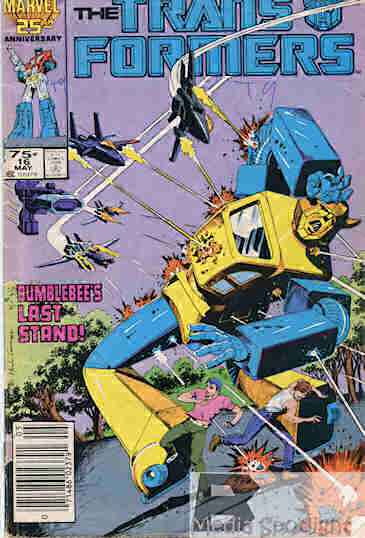
The toys came from Japan originally. That counts, right?
Interesting. Despite targeting Japan, Kanai is looking for stories that anybody can relate to, not just one group who insists “X” is an allegory for their live experience and theirs alone. You could see your own experiences and perspectives in the characters, even if you have never cleaned up space trash and get looked down upon despite it being a life-saving operation so spacecraft aren’t damaged by old satellites or a random floating screw hitting your window. I remember when US stories did that. I’ve never been a shapechanging robot in the middle of an intergalactic civil war, but there’s a reason Bumblebee is my favorite Autobot. I’ve also never been in a suit of armor that someone else made famous, or a black man taking on the role created by a recovering alcoholic white man, but my first Iron Man comic was about that man worried about never measuring up and a villain afraid of being a has-been. It’s one of my favorite Iron Man stories. I never lived their exact situation but it parallelled with what I was going through at the time and sometimes today.
MP: You yourself have overseen several internationally renowned works with titles such as Vinland Saga, Ajin: Demi-Human and Planetes. To what extent do you already think about the (potential) international success of a manga in the feedback you go through with the mangaka and perhaps try to make it more accessible to audiences outside Japan?
Kanai-san: No, not really. For example, there are various codes against the depiction of violence, against the depiction of nudity, whether male or female, or religious codes that I follow. However, I think that there are no fundamental differences in the population in terms of what they perceive as important – be it in Japan, Germany, China or South Korea. Even if it is the case on a political level.
I don’t allow myself to be influenced by so-called political correctness abroad and design the works accordingly. I think that if it’s interesting, it will usually be understood, regardless of whether you come from Africa, Chile or Greenland. I’ve never made a big deal of it so far. But even if a work takes up a very Japanese theme, for example, or a German work a German theme, a Chinese work a Chinese theme – in the end the root is the same, I think.
Too bad not everyone feels that way. Translators have altered things to fit their worldview, or out of some mistaken belief that it would be insulting to “modern audiences” in the Western world. For example, there’s a manga called I Think I Turned My Childhood Friend Into A Girl, about a dude whose best guy friend starts crossdressing, but in the official translations was changed to full on transgender. Anime have been reworked not to represent American culture but one particular form of American culture, namely the far left, referencing things like GamerGate in the negative, which most Japanese people probably don’t even know about, nevermind see as an equivalent insult to what was in the show. Cartoon Cypher mentioned that but right now I can’t find the video that I posed here on it.
Stopping a work because it deals with a problem that is too Japanese, or specifying to do something – that hardly ever happens. More specifically, I wonder if there is a difference in Japanese entertainment content between works that are internationally successful. Is it the works that focus more on the Japanese market or a global market?
I don’t think it’s possible to create works that are exactly in the middle, nor would such works really appeal anywhere. Take Skip and Loafer, for example, which is about a girl who comes from the Japanese countryside and moves to the Japanese city of Tokyo alone to study at a good high school. I think people all over the world will certainly understand her feeling of insecurity in the same way. That’s why such works tend to appeal to an international audience.
In this respect, I really don’t think that works need to be adapted for audiences outside Japan. Although I’m not sure how it is for people from countries where there are no rural areas or no cities. I have no idea what it’s like in Dubai. Maybe I’m biased. (laughs)

Sexy Tanaka-San underwent alterations to live action against the wishes of the comic’s creator, and the fight with the studio was so draining it drove her to suicide.
I don’t know a lot about how US comics are received in Japan, if at all. Manga creators have been influenced by DC and Marvel’s heroes in some of their works, and Marvel actually allowed Spider-Man, Iron Man, and the X-Men to receive adaptations. One is airing right now on Marvel’s YouTube channel I’ve been meaning to get to called Future Avengers and there was one that went the Bayblade/Yu-Gi-Oh route I think. I never really looked into it. However, DC and Marvel’s comics as well as other publishers have had their works translated to numerous languages not usually spoken in the US. They weren’t reworked for the new country, just changed to a language the readers could understand.
Near the end of the interview, the topic changes to things like the lower birth rate in Japan that’s been reported, though Kanai point out it’s not exclusively a Japanese issue. Kodansha, the publisher behind Afternoon and other manga magazines, is getting worried about that, which he refers to. He also makes the rare comment that he understands why pirating occurs, but hopes it will lead people to seek out official works and translations when they can afford to.
The mindset that Japanese publishers will get poorer and poorer if they don’t expand overseas is pathetic and should be abandoned. Now that it is possible to read and draw manga abroad, I hope that the manga fan community itself will grow. No matter where they come from and no matter what religion they belong to. So when it comes to the question of whether I think globalization is important, I can say that it’s much more fun this way.
MP: Finally, is there anything else you would like to share with our readership?
Kanai-san: If you are interested in Japanese manga, I would be happy if you read them. For example, people who want to draw manga, make movies or sing are always inspired by certain manga, movies or bands. They often start because they want to copy something. It would be great if you read Japanese manga first (i.e. works that were first published in Japan, the author doesn’t necessarily have to be Japanese) and then get the desire to draw some yourself.
MP: Thank you very much for your time, Kanai-san.
Encouraging more creators and fans rather than less. What a novel idea, right American creators and publishers?
The “improvers” attack other areas of Japanese media. There’s plenty of videos and websites that go over localization choices in video games and anime that change the meaning of things to suit their ends. The entire “lolicon” art style of what is essentially kewpie doll versions of adult characters, is also immediately treated as kiddie porn because all they see is the surface. Fanservice is also under attack for the same reason, which brought the creator of Kill La Kill, Kazuki Nakashima, out to comment. I’m using the Bounding Into Comics translation because Chrome doesn’t translate Japanese grammar nearly as well and the original article by Febri going over the 10th anniversary of the manga and anime series is in three parts, and there’s only one part we care about.
At one point met with the observation from the outlet’s Shotaro Miya (as machine translated by DeepL) that the production of the over-the-top and bombastic style of the fashion-centric seinen series “was only possible because it was [made] 10 years ago”, Imashi confirmed his host’s assessment and admitted, “Nowadays, we have to think a little more about what we can’t make. For example, the exposure of skin,” to which Nakashima added, ” I think even I would have to restrain myself from doing a full-body depiction of Mako.”
“I don’t think today’s audiences would tolerate a ‘peek into a bathroom’,” he added with a laugh, “I would have to make an excuse for it more carefully. ‘This person’s life is at stake!’ Like that.”
Then pressed by a likewise jovial Miya, “Wouldn’t it be better to just cut the bath scene?”, Nakashima smiled in turn, “if you ask me if the bath peeking scene is interesting after all the logic I put into it, I would say it’s not that interesting. So I think I would cut it.”
I’m not against fanservice, but if you do it just do it, it’s just as bad as some other decisions made just to have this or that in there. Porn exists and you can find it for free on the internet, sometimes when you’re not even trying to. That said, if it works in the story, speaks to the characters, or fits the event (even if the event was created to create fanservice), I’m not going to fight it so long as it’s created for the right age group. The needs of the story comes first. Some US translations try to hard to get rid of any sort of “fanservice”, sometimes in really dumb ways or by annoying the audience. Look at what happened to the Korean game Stellar Blade when the English version censored the skimpier outfits of the games sexy lady protagonist, and that’s not even close to the list of games that were marketed to the same age group in both Japan and the United States but got changed. I’m not talking about anime altered to air on US TV due to the FCC’s regulations. I’m talking about some of the prudest changes you’ve ever heard of. Even the Pierrot Co. Ltd. President and CEO, Michiyuki Honma, weighed in. That’s the studio behind adaptations of the Naruto and Bleach franchises, but this article is running long.
These changes are being demanded by people who don’t read these books, watch these shows, or play these games. They have a surface level view of what’s in it and demand a change without understanding why those decisions were made and are not considered offensive to the target audience. Then again, these are the everything for meeeeeeeeeeeee types. Something that wasn’t made for them already offends them.





[…] Japanese form their own history. Maybe Japanese people are low on the representation list because there is a push by some in the West to alter Japanese media to their tastes and worldview as they have in the […]
LikeLike
[…] to make the black man one of the playable heroes in a game set in feudal Japan would be confusing if I didn’t already chronicle the assault on Japanese media for how it depicts Japanese people, aka themselves, and an intended […]
LikeLike
[…] Japanese Media Under Assault: As Western audiences turn to Japanese manga, anime, and video games for actually trying to tell stories over “sending a message”, the usual suspects have opted to go over Japan. I guess we only care about “Asians” when they’re from China. As proven by taking the ideology out of the Chinese version of the movie and poster. […]
LikeLike