
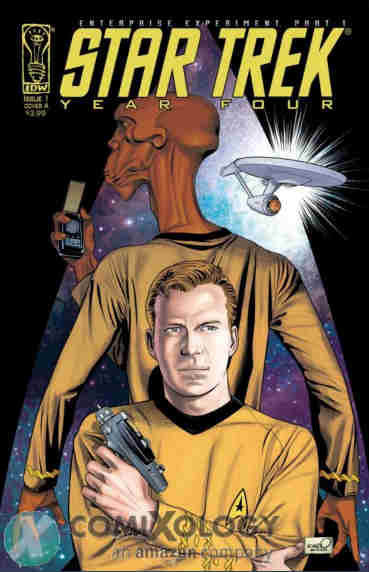
This seems to be my week to put up with the culture war. Well, it was either this, Netflix losing She-Ra being a non-issue but a good time to explain the problems, or the trailer for We Put He-Man On Earth Again Because We’re That Unimaginative. Might save the She-Ra one for a filler, and I’m not interested in live-action He-Man, but since I’ve already gone through Star Wars and Nintendo, I guess we can complete the near-trifecta since this is the only time I have to mention Kathleen Kennedy all article. At least I get to talk about Autobots tomorrow and Godzilla on Saturday. That’s more my wheelhouse.
So let’s talk about “cultural appropriation”. You know, the idea if you’re of the wrong geographic ancestry you aren’t allowed to wear a kimono or get a certain hairstyle…though nobody complains if a Japanese person wears blue jeans. (Especially if they look hot in…oh wait, now we complain about a blond in blue jeans.) It’s stupid, it’s divisive (exactly what the demographic obsessed power mongers want because we’re easier to control if we’re fighting each other and not watching them), and it defeats the whole purpose of “The Great American Melting Pot”, the idea that we can come together, share our cultures, and grow stronger and closer as a species. As I tried to state with the blue jeans reference, however, cultural appropriation is fine if the “right people” do it. You know, like the folks trying to tell Japan how to run their media.
So-called “geek culture” is fair game as well. It’s not bound by any one geographic location. Anybody of any race, creed, color, gender, and species who finds a home here is welcome. At least until it becomes popular, and then the cool kids and activists all want to claim it for themselves because heaven forbid those silly little geeks have anything that’s popular. The everything for meeeeeeeeeeeeeeee crowd won’t stand for it, even if they aren’t interested in it themselves. Dungeons & Dragons isn’t safe, so of course something like Star Trek isn’t. The appropriators also aren’t happy when you aren’t in lockstep with their clearly superior tastes. It’s not enough to see something popular and ask for their version. They need that Brand to be about and for them and them alone, accuse the fans of the same gatekeeping they’re now doing, and just making a mess of something they didn’t care about last Tuesday.
At issue here is a recent op-ed by The Mary Sue going off on YouTube reviewers Gary Buechler of “Nerdrotic” because he started this wave of embarrassing Starfleet Academy with a just-under one hour live stream, half of which was just a Spock action figure sitting on his computer chair, that got more views than the free full episode preview live premier of the first episode on YouTube. (I think he should have played audio clips MST3K Yule Log style with inspirational speeches from the good shows.) The thesis is basically “if you don’t like Starfleet Academy then you don’t like Star Trek and never understood it”. I like Starfleet Academy. Nog’s journey to join Starfleet, the crossover with the Dominion War…oh, the recent TV series, not the 90s Marvel/Paramount Comics thing. That show has problems. Gary’s chair stream was more interesting than the last time we discussed a chair stream because it was shorter and was part of an experiment, which it succeeded at…and that’s why writer and site founder Rachel Leisman was so upset.
For the record, Buechler doesn’t need me to defend him. His website and numerous YouTube channels get more hits than mine. (Would help if I had time to make videos again, but he does beat my articles. You don’t see me complaining.) This is about the current state of geek culture in the hands of people who spent high school ignoring geek stuff and their adulthood taking them over.
Time and time again we’re confronted with “fans” of something who continue to miss the lessons within the media they’re consuming. We’ve seen it with Star Wars, our superhero stories, and it has become an increasing problem with Star Trek “fans.”
More recently, men like The Critical Drinker and Nerdrotic, known for hating anything that seems to be left leaning, have been dogging on the Paramount+ slate of Trek shows. The issue with these Right Wing figure heads talking about Trek is that they miss one important detail about Star Trek: It was never for them.
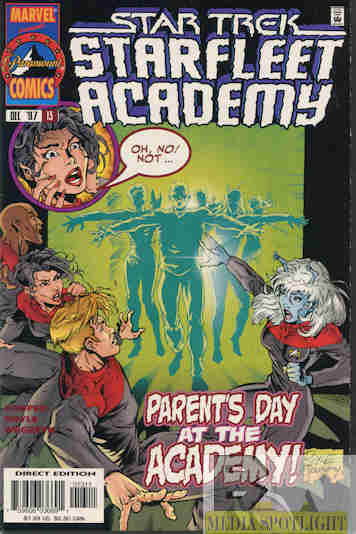
You know why this is funny? It’s the first issue AFTER the Dominion War, which they barely survived. Levity was needed.
And this is why I was complaining about culture war nonsense. That’s exactly how Leisman is framing it: through the culture war. Apparently anyone who hates her new favorite Trek show has to be “evil right-wingers”. One section is even called “You’re a Republican/MAGA personality. Star Trek was never yours.” I’m sure I can find you some mainstream liberal fans who hate the new show. It includes things like a woman eating her combadge (a type of disk usually made of metal and the person who did it is human), a cast straight out of a teen drama, and was created by a man who said that he cares more about using a popular Brand to send a message rather than continue a Brand. Also aliens who shouldn’t be having babies because they’re made in a vat or extinct are proof of that.
Also, nobody decides what was “made for me”. I’m the guy who watches Paw Patrol now and then. If I wanted to talk about if something was “made for me” I would have stuck with the She-Ra plan. Original Star Trek was made for me. So was the animated series and The Next Generation. I’ve read comics, all of which I’ve reviewed on this site, and novels, some of which I’ve reviewed on this site a chapter at a time and I haven’t even scratched the surface of what I own there. I know Star Trek. I look at anything out of Kurtzman and I see the same thing I saw in Enterprise: something that references Star Trek a lot, but isn’t Star Trek.
From the start of Star Trek way back when (60 years ago, to be exact), the series set out to do one thing: Change the world. And that it did. It made history for its inclusivity, including being the first interracial kiss on television in “Plato’s Stepchildren.” The kiss was between William Shatner’s James T. Kirk and Nichelle Nichols’ Lt. Uhura.
You mean the story where Kirk and Uhura were forced to make out by aliens with advanced mental powers and their response was “noooowwww….kiss”? (And those were dudes making slashfic.) It’s only important because it was so rare at that time to see it happen…and it still wasn’t two people attracted to each other.
But since, men like these X personalities think that they are the authority on all things “nerdy.” The reality is, they just speak loudly and incorrectly about these franchises. Look, you can use your money to buy every Star Trek toy out there. Doesn’t mean you understand what this series is saying to you. And now with the new series Star Trek: Starfleet Academy, we’ve seen an uptick in their lack of understanding of what Gene Roddenberry sought out to do with Star Trek.
Yes, things like…
- an episode where Kirk bitch slaps a dignitary they’re taking to an arranged marriage who was treating the crew like garbage…and then she fell for him
- that time Kirk found aliens who recreated the US Constitution and tried to convince them how important the document was
- the often panned TNG episode set on planet Africa, where the woman owns all the property and decides who rules the place because she’s rich but has no other authority
- or the orgy planet where you get put to death by jaywalking on the wrong street on the wrong Tuesday–seriously, season 1, what the hell?
- Kirk again having an exaggerated number of babes he’s hooked up with, but still does it often
- oh, let’s not forget how progressive it was for a woman to take over Kirk’s body with an alien machine because she was convinced she was turned down for captaincy due to being a woman and not that she was mentally unhinged
- or the Orion woman who was also mentally unhinged (and played by Batgirl in green makeup) and insisted that because she and Kirk were now lovers after one kiss that she had to kill him.
Please don’t pretend Gene Roddenberry was any kind of feminist. He most definitely wasn’t. Also, he wrote lyrics to the show just so he could get part of the revenue even though they were never used in the show, so don’t pretend he also didn’t like money.
A lot of the conversation is about how Starfleet Academy isn’t “their” Star Trek. Well, seeing as Roddenberry held democratic and socialist ideals when he was alive, I’d be hard pressed to find a Star Trek episode that even vaguely fit your “ideas.”
What I have come to realize is that there are men in this world who want to pretend like they’re fans of this stuff when they don’t actually care. They’ll buy a Spock doll and pretend like they understand the show itself but the reality is that they just buy nerdy things and make that their personality. That’s fine! Be a collector, dude. But don’t act like you understand these franchises when they argue against everything you stand for.
“Action figure”, and speaking as a collector myself, you don’t usually buy action figures unless you really like the character and the media they’re from. It’s why doing the reverse and making a cartoon based on a toy does so well when the show is well made. Nobody’s running out to collect Galidor but Transformers are still popular all these decades later. The reason Gary has so many action figures is because he loves the characters and wants a representation of them just like anybody collects knicknacks. Meanwhile, a few paragraphs down she writes this:
I come from a family of Trek lovers, myself included. To me, Christmas doesn’t start until I hear Leonard Nimoy say “Shuttle craft to Enterprise, shuttle craft to Enterprise. Spock here. Happy holidays. Live long and prosper” from my brother’s Star Trek Christmas tree. It has been a part of my life for as long as I can remember. Which is probably why the whales, Gracie and George, are my favorites.
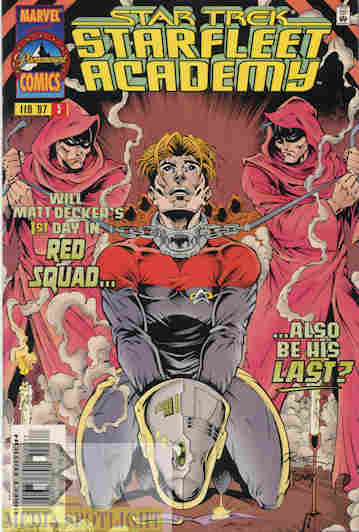
“Feeling quirky now?”
Not sure how the whales from Star Trek IV, which is one of the novels I mentioned, has anything to do with this. It’s not even her tree ornament, it’s her brother’s. We had one that makes obnoxious tweeting sounds. You come from a family of Trek lovers, but that doesn’t mean you are one yourself. My cousin has fond memories of Star Trek as well and was happy to get to see Nana Visitor and Michael Dorn at a local convention. There’s a difference between being a fan of the stories and having fond memories tied to merch.
These people, despite all their parading around as experts on “nerdom” don’t actually know what they’re talking about. They’ll attack and lash out and demand you prove yourself but in reality, those of us who actually love and enjoy these franchises know we know a lot more than some grifters online.
Considering how often I’ve proven wiki research only works when you’re actually trying to learn something rather than “own the chuds” I’m not convinced. I didn’t even need the wiki to remember that stuff earlier. I watched the shows: TOS, TAS (I consider it canon), TNG, and DS9 are all good shows. Voyager and Enterprise had their moments but the latter never really felt like Star Trek while the former messed up the whole Starfleet/Maquis dynamic that was promised by the premise. As for Starfleet Academy, we’re talking about a show that took half it’s premise from a rejected animated series and never read previous Star Trek writer’s guides. I on the other hand have and reviewed them both. Let me share a few segments from the season 2 bible, easily found online or in my “Star Trek: Pitch & Guide” article series:
The scene is the Bridge of the U.S.S. (United States Spaceship) Enterprise. Captain Kirk is at his command position, his lovely but highly efficient female Yeoman at his side. Suddenly and without provocation, our Starship is attacked by an alien space vessel. We try to warn the alien vessel off, but it ignores us and begins loosening bolts of photon energy-plasma at us.
The alien vessel’s attack begins to weaken our deflectors. Mister Spock reports to Captain Kirk that the next enemy bolt will probably break through and destroy the Enterprise. At this point we look up to see that final energy-plasma bolt heading for us. There may be only four or five seconds of life left. Kirk puts his arms around his lovely Yeoman, comforting and embracing her as they wait for what seems to be certain death. FADE OUT (END TEASER)
PLEASE CHECK ONE
- Inaccurate terminology. The Enterprise is more correctly an international vessel, the United Spaceship Enterprise.
- Scientifically incorrect. Energy-plasma bolts could not be photon in nature.
- Unbelievable. The Captain would not hug pretty Yeoman on the Bridge of his vessel.
- Concept weak. This whole story opening reeks of too much of “space pirate” or similar bad science fiction.
NO, WE’RE NOT JOKING. THE PRECEDING PAGE WAS A VERY REAL AND IMPORTANT TEST OF YOUR APPROACH TO SCIENCE FICTION. HERE’S WHY.
Inaccurate terminology. Wrong, if you checked this one. Sure, the term “United States Spaceship” was incorrect, but it could have been fixed with a pencil slash. Although we do want directors, writers, actors and others to use proper terminology, this error was certainly far from being the major STAR TREK format error.
Scientifically inaccurate. Wrong again; beware if you checked this one. Although we do want to be scientifically accurate, we found that selection of this item usually indicates a preoccupation with science and gadgetry over people and story.
Concept weak. Wrong again. It is, in fact, much like the opening of one of our best episodes of last year. “Aliens”, “enemy vessels”, “sudden attack” and such things can range from “Buck Rogers” to classical literature, all depending on how it is handled (witness H.G. Well’s novels, Forrester’s sea stories, and so on.)
UNDERSTANDING THE RIGHT ANSWER TO THIS IS BASIC TO UNDERSTANDING THE STAR TREK FORMAT. THIS WAS THE CORRECT ANSWER:
Unbelievable. Why the correct answer? Simply because we’ve learned during a full season of making visual science fiction that believability of characters, their actions and reaction, is our greatest need and is the most important angle factor.
NOW TRY AGAIN. SAME BASIC STORY SITUATIONS, BUT AGAINST ANOTHER BACKGROUND.
The time is today. We’re in Viet Nam waters aboard the navy cruiser U.S.S. Detroit. Suddenly an enemy gunboat heads for us, our guns unable to stop it, and we realize it’s a suicide attack with an atomic warhead. Total destruction of our vessel and of all aboard appears probable. Would Captain E. L. Henderson, presently commanding the U.S.S. Detroit, turn and hug a comely female WAVE who happened to be on the ship’s bridge.
As simple as that. This is our standard test that has led to STAR TREK believability. (It also suggests much of what has been wrong in filmed sf of the past.) No, Captain Henderson wouldn’t. Not if he’s the kind of captain we hope is commanding any naval vessel of ours. Nor would Captain Kirk hug a female crewman in a moment of danger, not if he’s to remain believable.
(Some might prefer Henderson were somewhere making love rather than shelling Asiatic ports, but that’s a whole different story for a whole different network. Probably BBC.)
I should note that the season two writer’s guide was put together by D.C. Fontana, a woman who even then had a strong writing resume and an even stronger one this many years later. She put the action above t…the space action above the “other action”. The Starfleet Academy comic had young people learning to become proper Starfleet officers. It also had this scene:

Remember when Star Trek actually taught this?
That’s what Star Trek taught us, to respect each other’s differences and find common ground among them, not to force people to join the hivemind. Kurtzman has not realized that or doesn’t care in favor of his preferred message. There was press about the black woman at the switchboard and the Japanese man in the driver’s seat but when the show started nobody cared if they were white, black, Asian, green-blooded, a proto-Thundercat, or a dude with three arms (again, Animated Series is canon to me), or whatever. You had the best person for the job. That’s it. It was based on merit, maybe some nepotism off-screen, not where you came from, though in that same comic storyline Nog got off of the death penalty because killing the first Ferengi cadet seemed like a bad idea, even going to Talos IV, the one planet where just visiting the neighborhood equals the death penalty. It didn’t just bring up references, it used past stories to form new stories. It had characters of differing opinions learning to get along. It didn’t say “this person is wrong”, it created characters and let the audience decide.
It also gave seven rules and I’m pretty sure at one point or another the Bad Robot crew have violated them all.
- Build your episode on an action-adventure framework. We must reach out, hold, and entertain (their emphasis, not mine) a mass audience of some 20,000,000 people or we simply don’t stay on the air.
- Tell your story about people, not science and gadgetry. Joe Friday doesn’t stop to explain the mechanics of his .38 before he uses it; Kildare never did a monologue about the theory of anesthetics; Matt Dillion never identifies and discussed the breed of his horse before he rides off on it.
- Keep in mind that science fiction is not a separate field of literature with rules of its own, but indeed, needs the same ingredients as any story–including a jeopardy of some type to someone we learn to care about, climactic build, sound motivation, you know the list.
- Then, with that firm foundation established, interweave in it any statement to be made about man, society, and so on. Yes, we want you to have something to say, but say it entertainingly as you do on any other show. We don’t need essays, however brilliant.
- Remember that STAR TREK is never fantasy; whatever happens, no matter how unusual or bizarre, must have some basis in either fact or theory and stay true to that premise (don’t give the enemy Starlight capability and then have them engage a vessel with grappling hooks and drawn swords.)
- Don’t try to tell a story about whole civilizations. We’ve never yet been able to get a usable story from a writer who began…”I see the strange civilization which…”.
- Stop worrying about not being a scientist. How many cowboys, police officers and doctors wrote westerns, detective and hospital shows?
They had people to cover the science mistakes and the lore (that one’s really missing) for later drafts, and you had to focus on making a good story while making their jobs easier. Some more random bits, and I know this article is very long compared to the usual but it must be pointed out.
B) Illogical situations. For example, it is swallowing quite a bit to believe a present day naval cruiser would be full of renegades and mutineers. Or that a present day U.S.N. Captain would imperil his vessel and crew over a philosophical disagreement with some foreign country. We want the exotic, the inexplicable, the terrifying–but not in the U.S.S. Enterprise, its organization and mission. The ship and characters are our audience’s tie to reality.
C) Intellectual rather than physical or emotional conflict. It’s hard to get a good story out of philosophical conflicts. We’ve had some interesting analyses of possible alien civilizations, socioeconomic speculation which seemed brilliant to us. But the characters were “sitting and talking” rather than “feeling, moving and doing”. They fail what we call our “GUNSMOKE-KILDARE-NAKED CITY Rule”–would the basic story, stripped of science fiction aspects, make a good episode for one of those shows? Don’t laugh, try it.
Do the science fiction pro’s have any helpful hints for us?
Two: Beware getting too wrapped up in The Wonder Of It all. Keep the story tied to people, their needs, fears and conflicts; remain a story-teller at all times–the quality of an sf tale is always inversely proportional to the pretentions a writer brings to it.
Speaking of the starship U.S.S. Enterprise is it a completely military arrangement?
Semi-military, but without being heavily authoritarian. For example, we will not be aware of “officers” and “enlisted men” categories. And we will avoid saluting and other annoying medieval leftovers. On the other hand, we do keep a flavor of Naval usage and terminology to help encourage believability and identification with the audience. After all, our own Navy today still retains remnants of Nelson and Drake.
You’ll find similar notations in the TNG story bible I also reviewed. I do want to end quick on Gary’s response to the article with a clip from the Nerdrotic Nooner podcast with movie reviewer Chris Gore and Gary’s producer, X-Ray Girl. It starts with that bitch slap I mentioned.
Those of us who used to get picked on for loving science fiction, superheroes, and fantasy stories soon saw the stuff we like go mainstream…so of course the ones who mocked us think the popular things should be about them and tried to remake them into what they like, keeping out the fans who loved what they already had. We never kept you out, which may have been a mistake considering what they did when they got in. The rule should be simple: if you like it the way it is, you’re welcome to enjoy it. If not, you’re welcome to find something you do like. We liked Star Trek the way it was, you didn’t, but because aspects became part of the mainstream or they saw a vehicle to push their ideology.
Then again, I’ve seen the former happen without politics for years. Battlestar Galactica mark 2 suffered for not having the same tone and vision as the original and found an audience who hated the original. I like what I like, I want to continue liking it, but I can’t when everything I liked about it was drained out to make it more palatable to people who didn’t like it or just wanted to use the Brand to push the story they wanted to tell. Kurtzman Trek isn’t the Star Trek I grew up with, Kennedy’s Star Wars isn’t George Lucas’, and in both cases it’s not better. It’s different in all the wrong ways. That’s why we reject it. The political angle is just the reason WHY it’s different because you saw something popular and wanted to make it for you, the more important “cool kids”. That’s the same mentality we used to be able to escape when we left high school and college. Not anymore. Geek culture is popular, and thus must be changed for them. Except this isn’t our lunch money. This is what gave us our morals, brought us together to have fun and discuss things we had in common while debating the stuff we didn’t, but still have a community, a culture of our own.
And I thought cultural appropriation was a bad thing.



 BW Media Spotlight