
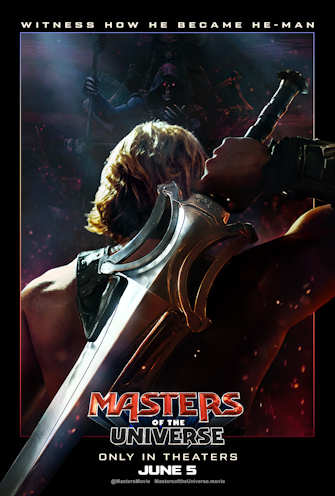
You know, it’s utterly amazing how far Hollywood types will go to ruin any goodwill they pick up, especially with fans of the things they adapt, and that they’re able to do it with just the “right” terminology.
When the latest Masters Of The Universe trailer dropped, it almost seemed like they actually did know what they were doing. Humor has had its place in the franchise even before there was an Orko, but the first trailer focused just on that. The second one added more action to it, letting us know it knew when to be serious…hopefully. It still knew when to have fun with its concept but at least things were looking up in a period where nostalgia was being used by the directors and writers as a way to get their stories past the studio/publisher if not a way to preach for the latest social cause du jour. This might actually work. Then…that term showed up:
Toxic masculinity.
First it was director Travis Knight claiming that Skeletor was the embodiment of toxic masculinity. Now it’s Camila Mendes, who plays the new live-action Teela, making a similar statement when describing the movie. The term just involkes hatred of men, especially masculine ones, because that’s how it’s usually used, the idea that the male power fantasy encourages toxic masculinity. Except for those who use the term ALL masculinity is toxic, except when those traits end up on the girlboss feminist of course. Those same people are also anti-femininity when it comes to women.
So what we have to ask is how the term is used in context. Those who trash He-Man and company do a surface level view of these characters, follow their own warped stereotypes, and decide that way what something is and how “toxic” it clearly must be. The comments come from an on-set interview with Entertainment Weekly as Mendes took a break during filming.
First we should check out this comment by Travis Knight. In his portion of the interview, Knight discussed how much he loved the Filmation series growing up, a line I’ve heard so often in productions that proved otherwise I stopped believing it. He also discussed his take on things, that Adam was sent to Earth and thus there was no He-Man to stop Skeletor. I’ll come back to him later, but to understand one of Mendes’ statements we need read this line. I’ll point out the parts I find important.
“She is a warrior. She’s trained. She’s much more physically adept than Adam is. Certainly, at the beginning of the movie, she’s a better fighter, she’s more acrobatic, she’s smart, she’s strategic in ways that Adam isn’t,” Knight says of Teela. “But also, there is a deep empathy underneath her, like Adam. And I think that’s the thing that binds them together, that they just see the world slightly differently. We see that in minor ways, and how she cares for her father, and how she believes in her father even after he spirals, and how she believes in Adam, who is showing no outward signs of being able to be the champion of Grayskull. She believes in him.”

Teela, having been trained while this version of Adam hasn’t, should be a better fighter. I don’t even know if Adam took a martial arts or boxing class. He-Man is good with a sword as the normal version of Adam gets to train with Man-At-Arms in secret and in the 2003 series Teela would even force him to train now and then. I do like the “empathy” part, something Teela’s been lacking the past few incarnations ever since Rob David came into the picture. In the New 52-ish DC comics Teela tells Adam they were never friends, is constantly mad at Adam and her father, and goes out of her way to make nasty comments about Mekaneck’s mechanical neck, which is worse when you know the reason why he has it originally involved being hurt while failing to find his son after a bad storm. The Netflix series didn’t make her out to be any nicer, but that’s a full discussion on its own. Knight seems to be getting back to a Teela who is strong in spirit but also kind.
While Adam has been on Earth, Eternos — no longer ruled by Randor and Marlena — has fallen into ruin after being destroyed by Skeletor. Teela’s father, Duncan, blames himself for not being able to protect the royals and save the Eternians.
I’m still not happy with this movie’s backstory, and there is an annoying trend of formerly great male heroes being broken throughout the entertainment landscape, usually to put a stronger woman in their position and put men in their place. At least it’s a good reason for self-doubt, but like the “toxic masculinity” term, the history of its use in modern Hollywood brings serious concerns.
(Idris) Elba admits he wasn’t familiar with Duncan from the cartoons, outside of him being “strong, and he had that incredible mustache,” he says. So his focus was on the script and what it was honoring, which is the “family history and his job as the Man-at-Arms. I wanted to bring a human story to Duncan, because he has a really lovely father-daughter story that I really wanted to bring some color to.”
Resisting the obvious response to that last sentence, I’m not against this if it’s done right. Again, that’s not what Hollywood has done recently. They are noting that Teela loves and believes in her father, and in Adam/He-Man, which is something you see so little of these days, as writers seems unwilling or scared to have a woman look up to a man. And then we get to the reason we’re all here tonight:
That storyline was also a big touchstone for Mendes.
“It’s hard to talk about Teela without talking about her relationship to her father, because I feel like so much of who she is has to do with how she was, I guess, let down as a kid,” she explains. “And I feel like that really built this outer wall around her that’s sort of like shielding this inner sensitivity. She’s affected by toxic masculinity just as much as the men in the film. And I think she’s sort of adopted masculinity to protect herself in this very masculine world. It’s how she survives. She’s in survival mode, and has been for a very long time.”
Maybe the altered situation changes things but that’s not Teela. 2003 Teela could be considered a tomboy and Filmation Teela a good warrior, while the original minicomic version was closer to Red Sonja, but she was still very much a woman. She falls in love, she enjoys beauty, in the minicomic she had a crush on Man-E-Faces that didn’t translate to further appearances anywhere in the franchise. Having her adopt “masculinity” when even tomboy Teela could be feminine at rare occasions (very rare, but still there if memory serves) feels somewhat off. It might work in practice because so far the worrying stuff has been fueled more by Hollywood’s current history. This is the same director who made the GOOD live-action Transformers movie.
At least all of the toxic masculinity nonsense is being placed on Skeletor, but you can just say “evil” and not have fans worried about a term usually used on He-Man by surface viewers who look at “man with big muscles and sword” and write him off. He-Man was a bit closer to his Conan inspiration in the early minicomics but even then he was driven not by selfish desires of revenge and conquest but to protect Eternia and Castle Grayskull. In the first illustrated booklet that predated the minicomics he left his home (there was no Prince Adam until DC Comics’ store shelf comics and Filmation’s TV show) just to defend Castle Grayskull, with no reason given. In later stories like one of my favorites, “The Magic Stealer“, He-Man fights overwhelming odds to stop Skeletor from controlling all of the planet’s magical energy because of his love of Eternia. That link there is one of my favorite battles in the comic and I can’t wait to finally get there in Free Comic Inside. It’s one of the reasons series 2 has some of my favorite pre-Adam stories and some of my fav He-Man stories period.

Filmation toned it down a bit but He-Man still fought with all his might to protect the innocent and the planet he loved from becoming the conquest of Skeletor and various other villains. I call the place Planet Deathtrap for a reason. Even the women have to be strong, and in this series they were. Teela wasn’t the strongest physically but she was tough, determined, good with a sword or a blaster, and despite her young age earned her role as Captain of the Royal Guard, which continued in the 2003 remake. Even in the minicomics demons feared her might. When the Sorceress wanted to help Adam with his homesickness while being stuck on Primus, she took advantage of a temporary flux in space/time to send Teela to visit and she helped fight the mutants. Yes, there were times when He-Man needed her help and didn’t have to look like a chump to the “superior girlboss” to do so, Kevin Smith. He-Man was always masculine, but also always kind, helpful, desiring nothing more than to protect the world he loved and its people, and be there for his friends even when he wasn’t in his magical muscular mode.
Meanwhile, Teela wasn’t the only strong woman in the show, but there were different degrees of strength. The Sorceress, and the Goddess before her in the minicomics, were strong in magic but also wise and compassionate. Marlena was a former astronaut and skilled pilot and marksman. Evil-Lyn was Skeletor’s most competent underling. Guest characters also so such fortitude that the only time we seek a weak woman who wasn’t just there to be rescued and disappear from the story, her whole character arc was finding inner strength without a magic potion that totally wasn’t drugs or alcohol or steroids. Why would you think that? The reason She-Ra even exists is because of the strong women of Eternia leading to Etheria and the rebel forces.
I also have to give credit to Nicholas Galitzine, not only for actually being good natured about wearing the accurate costume while joking about “being in a miniskirt and harness while everyone’s fully dressed in puffer jackets and whatnot”, but because according to the article both he and Mendes put in the effort to have the right physique for their roles. Teela looks like a woman who is also a mighty warrior. Galitzine is as close to He-Man’s physique as he can be and it’s just being used to the toys and art models having a body closer to fellow live-action He-Man Dolph Lundgren that makes it look off. No padding, no CG, both performers wanted the natural look and it paid off. Good on them!
So someone needs to let these performers and film crew know to choose their words. When I saw this come up in a different article I was sure that the deep dive would give me cause for concern. As it stands it’s only the use of those two words due to what they usually stand for that are troublesome, which the article does acknowledge.
“Toxic masculinity” has become one of those loaded phrases that instantly signals something broader than just character development. For a large portion of the audience, it reads less like storytelling and more like commentary—sometimes even accusation. It’s become an attack phrase used by DEI advocates to demonize men as a whole, and many associate the term with a very specific side of the ongoing culture war.
And whether that’s the intent or not, perception is what matters.
So if that’s not what Knight is going for, maybe he needs to find a better term. Just say “evil”. Skeletor has always liked being called evil. I’m not ready to immediately hate this movie, but recent history is making it hard for me to be as excited as I want, and throwing around one of the big fan base trigger terms isn’t helping.





[…] brought up with Skeletor by Knight, when Skeletor just needs to be the master of evil in general, and Teela’s actress mentioned it but according to this article by Geeks & Gamers there doesn’t seem to be a lot of it in […]
LikeLike