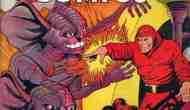


Sarge Steel #3
Charlton Comics Group (April-May, 1965)
“Heritage Of Hate”
CREATOR: Pat Masulli
WRITER: Joe Gill
ARTIST: Dick Giordano
LETTERER: Jon D’Agostino
Sarge Steel #3
Charlton Comics Group (April-May, 1965)
“Heritage Of Hate”
CREATOR: Pat Masulli
WRITER: Joe Gill
ARTIST: Dick Giordano
LETTERER: Jon D’Agostino

Well, last time we checked in with the good guys as they formulated a plan to deal with the bombings. This chapter is back to Russia and the bad guys. I did skim ahead to see how long this pattern lasts, and it isn’t a permanent situation.
I will say that so long as it didn’t hurt the overall narrative flow, it wouldn’t be a bad idea to go back and forth, act and react between Op-Center and Commie Op-Center. The previous book was more thought than action, which I was okay with. It was the regular characters I had issues with. It may be the same here, but I do wonder if the next book, the last one I have, also starts with a bombing. I would like more variety than that. Book 1 had a bombing in Korea to protest unification. Book 2 has a bombing to attempt reunification of the Soviet Union. Book 3 needs to break that trend.
We’ll see when we get there. For now, it’s time to check in on Commie Op-Center.
Hardcase #7
Malibu Comics/Ultraverse (December, 1993)
“Break-Thru: Sudden Surprises”
WRITER: James Hudnall
PENCILER: Scott Benefiel
INKER: Mike Christian
COLOR DESIGNER: Moose Baumann
LETTERER: Tim Eldred
EDITOR: Hank Kanalz
Catch more from Lemmy Audit You on YouTube
For my fellow Americans, if you see a Veteran, thank them for their service. Thank their family for standing by them, as they suffer along with a deployed soldier. Take some time today to remember those who risked all for the protection of all. Even if they came home, they may not be the same person that left. Have a happy and safe Veteran’s Day, but don’t forget why we celebrate it.
I hope I never have to see another one of these BS election ads again. At least now I can waste time dodging ads for Hero Wars. @#$% that game.
Over at The Clutter Reports this week I did some stuff for my dad and got a bit closer to finally doing that long overdue let’s play series. Fingers crossed.
With no appointments for this week, maybe I can get back to doing stuff! There’s the next installment of our Chapter By Chapter review of Tom Clancy’s Op-Center: Mirror Image and the writer’s guide for the original Star Trek to go over, plus whatever comes up this week. I’m hopeful (because that’s never gone wrong) that there will be feature articles, daily videos, and comic reviews all week, but we’ll see what happens. Have a happy Veteran’s Day, everyone! Thank a vet for their service.

Last week’s article link featured author Brian Neumeier making the case that Christian fiction shouldn’t be overly preachy, shouldn’t be just a Christian version of something else. (Kind of hard with porn. Heh.) While I linked to his website I first saw the article on Bleeding Fool, where it was crossposted.
That leads to this week’s article link, from fellow Bleeding Fool contributor A.H. Lloyd, in an article titled “Counterpoint: Christian Writers Should Write Whatever They Want”, where he shares Neumeier’s sentiment, but makes the case that Christian fiction can indeed be good. Neumeier himself offered a response before this post went live.
For my two cents, Proverbs & Parables up there is a collection of adaptations of tales from the Book Of Proverbs as well as the Parables used by Jesus to preach to the masses. In my review I stated that even if you aren’t a Christian it’s worth checking out for the different art styles used in the book, some of which are really good or at least really fun and still comes with a high recommendation from me. I guess the point is knowing what your target audience is and what you want to do. If you want to write something for Christians that boosts their faith, or something that reaches out to others, go for it. You may reach some people that way. Other people would have to be drawn in with something more broad, like Neumeier suggests, or at least would entertain without coming off as the same preachiness of so many “SJW/woke” stories.
Basically, both are an option, so long as story comes first and any message is properly worked into the themes of the story. Create believable people and have them act like believable people, or at least people believable in that world, in that situation, whether they would exist in the real world or not. Lloyd is right in that you should write the story you want, but Neumeier is right in that you have to put some thought into it.