

Welcome to a special print edition of BW Chats because I haven’t had access to online visual communication since Google Hangouts went down. All I have is a Skype account I can’t remember the last time I used. So I actually did this through the Twitter instant message system.
The original Tron may or may not be a successful franchise depending on your point of view. The 1982 movie was a splash of computer graphics, and even if some started out as regular animation as I’ve heard the end result showed what computers could do at the time. Not as advanced as you see now, but my Atari 800 couldn’t pull that stuff off. This led to two arcade games, more at home games than I realized if Wikipedia is to be believed, a sequel movie, an animated series, and even a few comic book adaptations.
Among those video games was Tron 2.0, an unofficial sequel rendered non-canon by Tron: Legacy, which I’ve reviewed before. The PC game and it’s tie-in for Game Boy Advance, Killer App, tells the story of Jet Bradley, son of Alan Bradley (Bruce Boxleitner even returns to voice Alan in the game) and the late Lora Bradley, killed in a lab accident even though her actor, Cindy Morgan, returns as Ma3a and there’s speculation she contains computerized bits of Lora. Why even do that? Anyway, Jet makes “friends” with a girl program (don’t look at me, the original movie did it as well) named Mercury and together they try to purge Encom’s systems of a virus from a rival company or something. I didn’t get very far before my sucking at first-person shooters held me back. Someday I want to play it.
Among those comics was a tie-in to Tron 2.0, published by SLG Publishing, formerly Slave Labor Graphics. “The Ghost In The Machine” was a six issue comic in which Jet is called back to the computer world for…well, that’s where things get confusing. Here are links to my reviews.
[ISSUE #1|ISSUE #2|ISSUE #3|ISSUE #4|ISSUE #5|ISSUE #6]
The co-writers of this issue is no stranger to BW readers who have been here long enough to see my review of Supergirl: Cosmic Adventures In The Eight Grade. Landry Q Walker and Eric Jones were a great writing and art comic making team, including their own series also published by SLG Publishing, Little Gloomy. Perhaps you’ve seen the cartoon Scary Larry, which has the same cast but for whatever reason the goth girl got pulled from the spotlight in favor of the werewolf. In addition to Cosmic Adventures, currently my favorite comic miniseries, they also worked on the tie-in comic for Batman: The Brave & The Bold and Danger Club, all comics I’ve also reviewed. Sadly, Jones passed away in 2022 at 51 years old. I don’t know from what and I’m not going to pry.
I didn’t know Eric Jones, but I do know Landry. He found my reviews of Cosmic Adventures In The Eight Grade and we struck up an acquittance. He even wrote me to make sure I was okay in 2016 when the site and Twitter went dark because I was…experiencing 2016, which was appreciated on my part. Nice to know people care. Somehow he didn’t change his mind after my reviews of Danger Club, which I liked and there were some great characters and ideas but I felt too dropped in to connect with everyone. Great concept though: how do the sidekicks take over when all the heroes vanish? I did enjoy their whole run on Batman: The Brave And The Bold though. So when Tron: The Ghost In The Machine came into my schedule for “Yesterday’s” Comic I decided to warn him the reviews were coming. When I originally read the comic before starting this site I was rather confused by everything. Re-reading them for the reviews…only slightly less confused.
To my surprise, Landry was not only okay with the reviews but rather amused. Apparently stuff went down behind the scenes and he offered to do an interview after I was done reviewing the miniseries. That happened in the previous post so here’s that interview.
BW: Let’s start with the obligatory opening stuff: What brought you into the world of comic creation and your partnership with the comic’s co-writer, Eric Jones? (My condolences, by the way. I never communicated with him, but based on your old livejournal entries I get the sense you were close friends and he loved his work.)
Landry: Eric was the best human being I’ve ever known. We were very close friends as teenagers. And during that time (1988/1989?), we were both independently trying to make comics – and I can’t draw. He could, so it was a good fit. We were first published back in 1993, which lead to a Disney Adventures gig starting in 1998.
I’m fine explaining what happened by the way. He died abruptly and unexpectedly. His death is believed to have been from a sleep apnea related seizure. He had been struggling a bit for a few months, but neither he, or the doctors, or any of us that were close to him thought it was going to lead to anything serious. It was a shock. Still is.
BW: Sorry to hear it. I only know his work and it was quite good. I remember you saying on livejournal how he used to use post-it notes to assemble the comic pages, which is an interesting method.
Landry: He was always reinventing his approach. He penciled all of Supergirl – each panel separately – on typing paper. That means each panel was penciled at full paper size. That leads ot a lot of art. I inherited all his it – he never sold any. Not much anyway. So I have giant stacks of it now.
BW: Not the first comic artist to hold on to all his old pages..not that I know anything about that…now that I’m working digitally.
Landry: He had transitioned to digital after Danger Club. So all his Star Wars and his Pepper Page saves the Universe art – none of that exists in physical space.
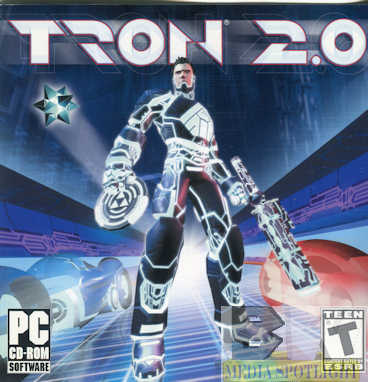
I need to finish this game…and to stop sucking at first-person shooters. Or games in general.
BW: SLG published Little Gloomy prior to this so you already had a working relationship when it came to the Tron 2.0 comic. Who pitched to whom and had either of you played the games prior to the comic job?
Landry: Eric and I pursued the rights before SLG got involved. We were already working with Disney Publishing so the dialog was there to be had. We had envisioned something very different – a prequel to the film called Rise of the MCP.
In the film, we kind of come into the cyberspace aspect at the end of a previous chapter. Tron is imprisoned and a legend for his rebellious actions, The MCP has already choked the life out of the digital world. Clu is almost to a goal he had been pursuing (on behalf of his User) for some time. Yori is half-brainwashed, Dumont powerless and pining for the old days before the MCP. So… What happened before?
SLG sought the license on our behalf (along with others that made sense for them). But then Disney pushed us away from anything involving the film. Our story HAD to be a sequel to the game. I played it, and quickly determined that it really didn’t need a follow-up. But we had to have one.
BW: And now the game is non-canon after Tron: Legacy.
Landry: That was a funny twist of events for me. They (Disney) actually started moving away from the game while we were working on the comic.
BW: Did that give you more freedom or less?
Landry: Less, I think? It has been awhile, but we some things that came in during the process that forced us to try and rewrite on the fly – after art was already completed. It’s not the first or last job I have had that operated like this, but certainly the messiest.
BW: Why was Eric a co-writer instead of the artist? Usually you wrote the words and he made the pictures.
Landry: Well, our creative partnership was never really that simple. He had a hand in story always from the very start. And I worked on the art aspect more than people expect. But comics credits kind of work a certain way, which creates certain boxes you get placed into.
In the case of this book… he just really didn’t want to draw all the circuitry. That was really it. He also was very much locked into his Super Scary Monster Show” art style at the time – we’re talking years before Danger Club. So I don’t think he felt like it would be fun for him.
BW: What did you think of the art in the book…or is that telling on your peers. You’re not doing a review site like some two-bit hack comic creators who shall go nameless.
Landry: The first artist (Louie De Martinis) was a bad fit. He didn’t follow the script and made dramatic changes that left several key pages unaccounted for in both issues. That left us scrambling. Eric actually did go in on those issues and make a few panels of matching art just so scenes could be bridged properly. That – combined with shifting notes from the studio – caused us to have to pivot very abruptly.
The second artist {Michael Shoyket) was 100% a great guy. We actually landed a Superman book together right after, but the series – I think it was a run on Superman Confidential – got cancelled before we were announced. The three of us were going to do a story where Clark and Lois go to investigate some small town murders that end up having a Lovecraftian theme. It would have been Superman’s first encounter with magic. I’ve posted some of the art before. Fun stuff.
NOTE: I wasn’t able to find the images online. My search skills are slightly above mediocre, just enough for my usual posts.
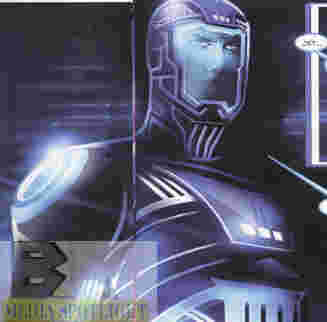
Why does Jet look like he’s wearing underwater gear?
BW: Okay, now that you’ve laughed at my reviews, which is totally not the response I was expecting to “your work is a confusing mess and I have no idea what’s going on”, perhaps you can explain what was going on. There was a lot of contradictory stuff in the story. Is Flynn gone, which actually would have fit with Tron: Legacy and the prequel comic, or still around? Is Lora dead or alive or part of Ma3a? Is Jet a byte believing he’s a man or a man believing he’s a byte? Let’s start with did anything in the real world scene of issue #1 happen? Was Alan intended to be killed? Did Jet see a therapist after his time in the computer world?
Landry: As I recall now – because it has been a while – Originally, the real world stuff was happening. But because of the aforementioned complications, we had to pivot to where all of it was transpiring in cyberspace. Jet absolutely would need a therapist – who wouldn’t? As mentioned in the comic, he anthropomorphized programs. Wipe the hard drive? You just murdered how many beings? Destroyed an entire civilization? That’s happening every day everywhere. That’s going to mess you up. But…
…This was always a sticking point for me with Tron – the film that is – none of it really happens. Not literally. Flynn is digitized – yes. That is true. The program that constitutes his consciousness is encoded in some way to become a game. Something the MCP does with the code leftover from programs it absorbs.
So is Flynn running around as a super tiny person in a microscopic data-world having adventures with actual beings? I would argue – emphatically – no. What happens is that Flynn – who is more than a program – has to make sense of what his consciousness has become. So he anthropomorphizes it. He makes it familiar. the alternative is to go mad.
BW: So where do the “user powers” come from?
Landry: You are a programmer turned into raw data, surrounded by streams of code? And you – even if subconsciously – have the knowledge on how to reprogram that code? Boom. You got superpowers now.
BW: This is all probably tapping into some fan debate on the movie so I’m just going to do a pivot of my own. 🙂
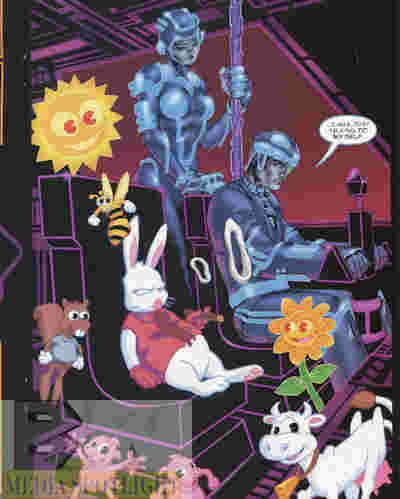
“Mercury, I think we ended up in Cuphead by mistake.”
In the story, Jet.EXE, the experiment I think, was split into three personas that I called Blue Jet, Red Jet, and Green Jet (called Clarence later in the story). Blue were the good programs in the original movie and the 2.0 games, Red the ones under the influence of the Master Control Program in the original movie, while a brighter, almost green-yellow version were used for the corrupted programs in the game, lighter than what “Clarence” was shown as. What were your intentions with the three programs, and was the MCP actually tied in to this story?
Landry: The MCP wasn’t actually in the story. I am trying to dredge up some old thoughts on this. Blue Jet had the least idea of what he was. His mind had fabricated a reality for himself as a place to hide. Red Jet was mad. The truth of what he was had driven him mad, and he resented Blue Jet’s existence. Green Jet was the sanest of them really. He recognized what he was, where he was, and the ramifications of their synthesis. It would mean an end of his own Self, and he was trying to protect that by keeping Blue and Red at odds. As long as Blue and Red were apart, Green could remain an independent being in a world he could manipulate and enjoy. Alternately, he could become a lesser part of a whole.
BW: Was Jet.EXE actually Jet or a program version of him, like Clu and Flynn only not evil…well not Blue Jet anyway.
Landry: Originally, it was going to be Jet.EXE (Red Jet) trying to take real Jet’s place in the real world. Not a program – a backup copy.
BW: So actually closer to Clu (in Tron: Legacy)?
Landry: I don’t really know Legacy. Is that what Clu was? Interesting.
BW: I think he just made another program named Clu for the Grid since the Clu of the original movie was derezzed.
Landry: Weird. Well, digital Jet was a backup copy of the real Jet, left after Jet exited the system. So a program, but not really. I mean, basically he’s a clone of the real Jet.
BW: Originally this question was “If I understand the characters the war seen in the story was tied in to the system issues with the Legacy program or the experiment. Was there an actual war between Ma3a and a new MCP or is that all part of the confusion in the system?” However, you stated the intent was for “Clarence” to keep Blue and Red at bay. (I hear you snickering, Halo fans.) Am I understanding that right?
Landry: In our original draft, the war was real. The backup copy of Jet was the new MCP and he was trying to conquer the system so he would have the resources need to make himself appear in the real world. There was only originally going to be one digital version of Jet. There being three of them was a retcon of sorts. One of the modifications we ended up making was to turn the war into the “confusion”.
BW: So what was the goal of the experiment? What would MCP-Jet do in the real world?
Landry: So if we had been able to tell our original story – Jet leaves the system at the end of the game, and an autosave copy of him is activated. That version wants to become real, and uses the resources it has to drive Jet into the computer world.
What would he do? First and foremost he just wanted to be real. He was real – basically. But he had also been driven mad -a form of data corruption really. Once in the real world he probably would have become monstrous – at least eventually. He would have learned how to manifest digital creations of his own imagination into the real world. He would have continued his war, in all likelihood.
But that wasn’t an experiment. The experiment was a retcon. The original story – Digital Jet wasn’t meant to exist. He was born out of a basic quirk of computers – autosave.
BW: In Legacy, Clu wanted to lead an army into the real world and conquer it for being illogical and “imperfect”. Jet-MCP sounds more like the makings of a horror character.
Landry: I think he would have seen his own plans similarly. Disney had all the pitches for all of this. The filmmakers had our book.
BW: Was Alan going to turn out to be alive, or was there something else planned with the reveal of the video footage of his murder?
Landry: I think… it’s been awhile… I think he was going to be alive, but the way the initial art came in we lost our clear window for this. And then we had to retcon it for the studio that would make sense because we wouldn’t be allowed to kill him, but now he was dead and we had to fix it. So suddenly it had to be faked. It was a mess.

Wait, if Clarence is an aspect of Jet…is Jet a furry? And how did he compact into that little rabbit with the head on?
BW: What was the original intended ending of the story (either or both versions if you can remember) and why was the comic cut off so soon?
Landry: It was always planned as a six issue series. But we lost a lot of ground with the way the first two issues were played out. The original ending – the one where it’s real Jet versus Digital Jet – had Jet escape the computer. But he discovers he failed to stop Digital Jet from uploading themselves first, and he isn’t revived for a century. By then the machines run everything and most of humanity is living in an artificial world and being kept alive as a power source – I hadn’t seen the Matrix yet, so…
Truth be told, I still haven’t seen it.
BW: I saw the first one. I’m not on the hype train but it was good. (At least I thought I did. You’d think it would get a Finally Watched article but I can’t find one.)
You actually suggested this interview to discuss the book or whatever your intention was. So what haven’t I asked about the creation of the comic and intentions that you feel readers should know about “The Ghost In The Machine”?
Landry: There’s a lot I am happy with about the book. Though I understand why it doesn’t click for people. The ramifications of being able to turn people into programs, and then bring them back out… that’s insane stuff. It would be world ending. The world as we know it anyway. And the concept being played out in terms of our consciousness, being reduced to data? Which means it can be edited, modified, copied, deleted… Our perceptions of reality would have little meaning. We got to play with these concepts. It’s a very broken story, and it has so many storytelling flaws – I’m well aware of that. But the fundamental concepts behind the work – those i am proud of.
Earlier you mentioned that you were surprised I was enjoying the reviews. It reminds me about a friend I have. She got a bad haircut back in the early 90’s. I told her was bad. I was clear that it was really, really bad. I think she was hurt? Maybe offended? Ten years later she got a really nice haircut. i told her it was nice. She was pleased. I pointed out that if I didn’t like it, she knew I would tell her. That made my praise mean more, because she knew it was going to be honest.
So a negative review – when done from an honest place – is a joy. because it means a positive review from the same person has more weight.
BW: I do try to be honest about the reviews because I’m also trying to teach myself by finding the good and bad of stories I know. The bad parts of good stories and the good parts of bad stories only teach me further. Plus creators like yourself sometimes find my reviews and just because I’m blunt at times doesn’t mean I have to be a jerk about it. 😀
Finally, what can you tell us about any current projects you’re on, and where my readers can best follow you?
Landry: Well, the last book I had come out was a bit over a year ago. Pepper Page saves the Universe. Art by Eric. I have another book coming out from a major publisher in early 2024, but it’s not announced yet. I’m doing a bunch of work for Disney on some stuff… hopefully I will be able to announce that soon as well.
BW: With that I thank you for taking time out of your schedule to defend yoursel…I mean discuss the work put into this comic. I’m not used to this and hopefully I’ve done well by you and my readers.
Landry: Thank you! I enjoy getting the opportunity to talk about the book. It’s also my first interview of any kind since Eric died, so thanks for giving me a chance to talk about that. I really appreciate it.
Tron 2.0, which I need to finish, is available on Steam and GOG. I’m afraid you’ll have to go the back issue route to find any of the comics mentioned in this interview.



 BW Media Spotlight
[…] in favor of the “more important” medium of live-action theatrical films, and getting to interview that comic’s co-writer, the Tron franchise is on my mind…and no, it doesn’t have […]
LikeLike
[…] Landry Walker Responds To My Tron 2.0 Review: When I was out of action for a good portion of 2016, Landry Walker did a check to see if I was okay because I wasn’t posting. I think that makes us friends, ever since my positive reviews of Supergirl: Cosmic Adventures In The Eighth Grade. So I warned him that I was reviewing SLG’s Tron comic, a sequel to the video game sequel to the 1980s movie long before Tron: Legacy, Tron 2.0. (I need to finish that game.) He told me there were some fascinating stories behind what went wrong with that comic, which he did with his late creative partner, Eric Jones, and since I still have online streaming issues we conducted the interview over Twitter. I wouldn’t mind getting to actually talk to the man someday. So this was the first written version of BW Chats. Includes links to the reviews so you know what we’re talking about. […]
LikeLike
[…] gotten to interview relatively famous people from Billy Tucci and Landry Walker to Frank McLaughlin and Larry Kenney. I’ve always been fair to them (though I was unprepared […]
LikeLike