
The following video, which being from The Critical Drinker obviously has quite a bit of swearing and drinking, is not posted to be the article, but something he said here did lead to the article. You can watch it if you want but my point will be clear with or without it. I just like being thorough.
One of the modern issues with Hollywood’s overblown budget that Drinker touches upon is how big and epic every superhero movie has to be, with the effects to match–which is a problem considering that the situation at Marvel Studios has gotten so bad for the VFX artists that they decided to unionize just to keep their sanity with all the last-minute changes that take time to implement. Script changes, someone in the upper levels or money people demanding a change so they feel better about themselves because “they’re helping” (spoilers: they’re really not) or making their kid happy or something, and all the work and money that goes into it is definitely a problem.
You know what would keep all those effects a bit less obtrusive? Maybe don’t put all your stakes in the first movie. You know you’re making a series, so does the origin need to be that important? If it’s an origin story does it need to be for all the marbles if you already want a second movie and beyond? It’s a symptom of a larger issue I’ve mentioned before, that every story needs to be the most epic thing ever, a problem that’s afflicted comics as well as Hollywood recently so of course the comic-inspired (not really adapted) movies would suffer the same mistake, but they do it right out of the box.
So that’s what I’m here to answer: does the first movie need to be as huge as it is? Short answer: No. Long answer: read on.
When the original Iron Man hit theaters, some fans were upset that the enemy he faced wasn’t the Mandarin. Instead it was Obadiah Stane, which they felt was a weaker opening. I thought he was a perfect opening villain. Stane in the comics took over Stark Enterprises while Tony battled alcoholism. Eventually Tony gained his company back, but not before starting a smaller company and issues happened. Circuit Maximus had a short history. Stane was tied to Tony’s character, and was even the primary antagonist on one of the cartoons that was also an origin story, Iron Man: Armored Adventures.
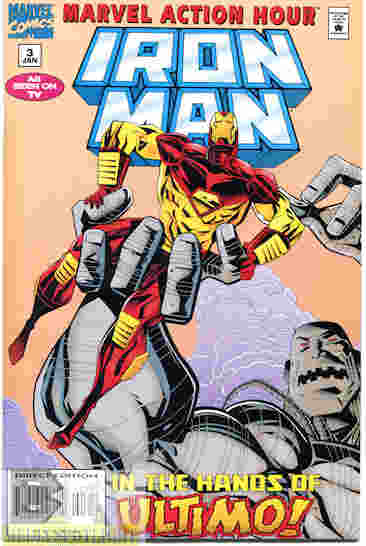
“Where is Ultimo’s movie?”
While the movie didn’t skip out on the armored action from the terrorists to the Iron Monger the focus was on Tony’s personal journey. It focused as much on the man as it did the armor, and the movie was better for how it used both to follow Tony’s character arc. He didn’t necessarily learn humility but he did grow a conscience. The only big action was the final battle with Iron Monger serving as a physical representation of Tony and Obadiah battling for the soul of the company. That was the stakes involved, not the fate of the world.
Had the Mandarin been there, ignoring the sham of Iron Man 3, then it would have been larger than life because he’s one of Iron Man’s most powerful enemies, maybe his most powerful since Doctor Doom is primarily a Fantastic Four villain who eventually battles other Marvel heroes when he gets bored. He even fought obscure heroes like Solarman…kind of. Where would Tony have gone from there? Ultimo? As it turns out the second movie had Justin Hammer, which would have been a huge drop from Mandarin and his 10 rings of power (which in the comics aren’t the kung-fu wrist rings but finger rings, each with a different power) but is a step up from, or at least parallel to, Obadiah Stane as he’s from a rival company and caused more trouble long-term for Tony than Stane did in the comics.
Then you have Man Of Steel, a movie that was also an origin story, this time for Superman. It is the total opposite. While Tony’s first outing was for small stakes that were still important enough and was able to climb up the ranks, Superman gets General Zod and a whole army of Kryptonians! Even the Donner films waited for the second movie and only had two underlings. Lester followed that up with a step down until the computer decided to become Brainiac, and Nuclear Man had…wasted potential, while Supergirl got a crazed witch with a cougar fixation on Kara’s overage boyfriend…look, just because I actually like the movie doesn’t mean I don’t see flaws!
The first movie in the Salkind era Superfilms was Lex Luthor, who is often Clark’s first enemy in new incarnations. While I’m rather over his being the first almost every time, first appearing outside of comics in the SECOND serial and not again until The New Adventures Of Superman, there’s a reason he’s the go-to. Whether he’s the pre-Crisis mad scientist out to prove his mental superiority or the post-Crisis evil businessman who can’t relate to someone with power being a good person acting in service of others, he’s a good starting point for Superman, and there’s a chance to go above or at least parallel in the next movie. Each movie should raise the stakes a bit. Heck, start Superman: Legacy with Toyman (I triple dog dare him to use The Prankster but not holding my breath) and James Gunn will have a long way to go before he has to break out someone on Doomsday’s level, which was the only step up the next Snyderverse movie had from a Kryptonian army. Even in the Salkinds’ take on Superboy or Bruce Timm’s DCAU debut of Superman, Luthor was first, and while still a major threat you could have more dangerous opponents like Metallo and Brainiac. You didn’t have to put the whole world at stake. Superman’s stakes in previous debuts was stop the villain and establish himself as the protector of Metropolis while having room for the audience to get to know this incarnation of Clark Kent.
Compare to what Christopher Nolan was doing with Batman. First up was Ra’s Al Ghul, who was a good introductory villain, but the stake was the whole of Gotham City. He saved Joker for the next movie but Tim Burton used him first because Batman’s villains are mostly parallel, each criminal in his or her own way from the crazies to the corrupt to the mob. Joker just has the higher personal body count. They could have done a good Riddler story for the second appearance and not feel like a step down. Instead we have freak-of-nature remake Penguin and sexpot Catwoman because Tim Burton likes making movies where everyone is messed up in the head. The effects requirements weren’t that high because city wide destruction wasn’t required, just a building or two. You have breathing room to raise the stakes in the next film. By the third movie under a new director, Joel Schumacher was still only dealing with mind reading criminals and it wasn’t until the fourth film of that continuity until we got Mr. Freeze flash-freezing the city. The ongoing narrative had room to grow while the current narrative had time to tell a complete story on its own.
“That’s no moon, it’s a plot device!”
Getting off superheroes, the original Star Wars Trilogy found a great way around this. How do you come up with a greater threat than a moon-sized space station with a cannon that can bust a planet like a fortune cookie? Well, the enemy is still out there and still running the galaxy, but you can make the stakes more personal. The middle point of the story focuses on Luke’s journey to becoming a Jedi, Han and Leia growing closer together, and Vader wanting to connect with the son he just found out about…and turn him evil. Never said he was father of a year. Turns out he also wasn’t a great husband and not very good with kids. What I’m saying is that Star Wars found a way to make the big threat not the most important threat. Even Death Star II: The Quickening was really just a trick to lead to the final battle between the remnants of the Old Republic looking to form a New Republic and the people responsible for the Old Republic collapsing. It didn’t raise the stakes so much as find a way around them. However, in modern stories the stakes are already at the highest both personally and the fate of everything during the origin story itself so you can’t go up in the next one.
And because the stakes in a science fantasy setting (half science fiction, half fantasy, which is what a superhero story is) are the fate of everything it costs more to showcase all the destruction, armies, superpowers, machines, and whatever else is needed. They don’t take time to really focus on the characters. Hollywood is a surface level culture, especially in present day 2023 AD. So all they see is a surface level view of anything. That includes the audience. So they see the audience likes explosions and assume the answer is more explosions, louder explosions, and stakes large enough to include those explosions. Even they know a lot of explosions would fit a story about Coke versus Pepsi so the city or the planet or the galaxy has to be in danger. There’s nothing personal about the stakes involved because it’s the larger threat that yields the most action. The Avengers movies worked because they were built up to in previous MCU movies and were events alongside those movies. We were given a reason for the stakes to matter, but the first movie still put enough emphasis on the chosen heroes before Loki and his space friends invaded. Ultron was the next threat and they built up to Thanos, which ended up needing two films to fully deal with, and there’s still some bigger potential threats before you have to go to Ultimo…or would be if they hadn’t screwed up the Kree and Skrull uses in the MCU.
If Marvel Studios finally gets its mutant movie and start with the Shi’Ar I’m not sure where they could go. Starting with Magneto, the first villain of the first comic, worked for the first batch of movies, while the Fox Kids and X-Men: Evolution versions worked their way up to Magneto and his Brotherhood Of (Evil) Mutants. Yes, somehow the giant robots was working up to the overpowered mutant supremacist. Using smaller stakes to introduce the characters allows you to focus on the origin better and introduce us to these characters you want us to cheer for in the next one, leaving the higher stakes for the later films. If they want the Marvel Cinematic Universe to continue…they just did a whole thing with the multiverse. Where do you go from there? This also gives your VFX team a chance to play with new techniques and have models ready while still making deadlines so when the situation does get worse and needs larger effects they already have a starting point. The bigger the battle the more time it’s going to take to make it look good enough for people not to make fun of (She-Hulk, anybody?) though not changing your mind every few minutes to make yourself look better isn’t helping. Even George Lucas waited before going back and adding things in the Special Editions…and fans didn’t like a lot of what the Special Editions have. There’s a reason my copy of the movies are still only on VHS with the enhanced THX audio system.
Everyone has to do the origin story because that gives them all the power even if they don’t work on future stories until someone finds a way to retcon your hard work away (which is sometimes a good thing and sometimes ruins fan enjoyment–retcon responsibly, kids). However, you need to know where to start off. Your focus should be on the origin, not having the most important stakes ever, or your origin will also be your finale. If your goal is one movie, fine. If your goal is a series of stories with these character in this continuity you better have somewhere to go with the next installment.



 BW Media Spotlight
[…] Does The Origin Story Need ALL The Stakes?: You’d think being the origin of the hero should be enough, but if you’re Hollywood it also needs to happen for the biggest, world-shattering reason possible, instead of just one villain’s mad scheme. […]
LikeLike