
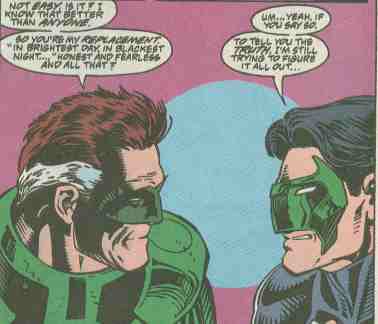
Adaptation (noun): a written work (as a novel) that has been recast in a new form (vocabulary.com)
Here’s a question: why adapt something if you don’t care about it or the fans? Alternately, what is it about the source material that you do like and how much can you toss out before it’s no longer the same thing. Surface level people will say “this is his name, these are his powers, this is the costume” and slap it onto whatever they want to be pushing. Hollywood has a lot of surface level people, like showrunners who only want to make the story they want to tell and trick the studios into doing it because all they want are the popular IP. It’s gimmick as lazy promotion.
So for them Hal Jordan and John Stewart are just a space cop with a magic ring. Hence everything I’ve seen about HBO Max’s Lanterns In Name Only, a show that decided the best thing to do with superhero space cops with decades worth of lore, backstory, and multiversal continuity (even when DC does a minor or full reboot of the universe every few years) is to toss them and do something inspired by True Detective. I was never interested in True Detective, nor any of the other inspirations that weren’t the comics or even later animated movies and shows, so I’m holding firm to not watching this show. Nothing I’ve seen, and nothing I’ve heard from reviewers who deep dive these shows that I find trustworthy in their summaries if not their opinion, tells me this is a proper adaptation within the limits of a change of media format.
Damon Lindelof, and this shouldn’t surprise you from someone part of the SEECA crowd, thinks he knows better than the fans how to properly adapt Green Lanterns, even stating that fans don’t actually want it adapted right. Clearly this is BS on his part, but that’s what he said as part of a joint interview with Tom King, the comic writer who loves psychologically damaging DC’s heroes and is one of James Gunn’s favorite writers to the point of making him “essential” to his vision for the DC Universe. We’re going with an interview in The Hollywood Reporter that opens by discussing other adaptations, meaning contributor Brian Davids doesn’t understand adapting the comics to a TV style series, either. When you hate superhero comics, it’s easy to not care about them.
If you’re terminally online, you’ve probably found yourself swept up in this year’s exhausting discourse over creative license and beloved IP.
When the now well-received Lanterns premiered its official trailer earlier this year, a vocal subset of fans objected to the premise of taking the ring-powered space cops of the Green Lantern Corps and grounding these colorful, cosmic superheroes in small-town Nebraska for a desaturated, Taylor Sheridan-esque riff on True Detective. Earth’s first Green Lantern, Hal Jordan, played by Kyle Chandler, also drew criticism for being portrayed as an older, messier iteration of the most famous intergalactic peacekeeper rather than the more idealized version in his prime.
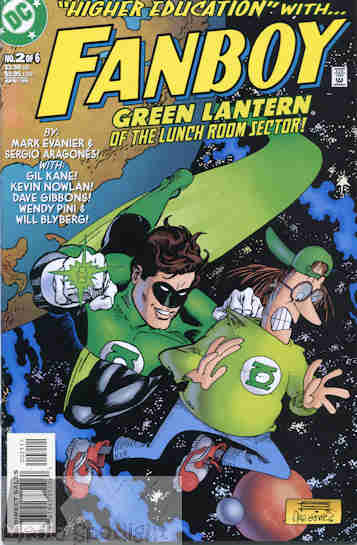
This looks a lot more fun that Lindelof’s nonsense.
“Well received”? I have yet to see any clear evidence of that. IMDB has it at an 8 but the four reviews I can read without becoming a member tell you nothing, outside of the one guy who admits to not being a Green Lantern fan. I’ve noticed that people who don’t like the source material love the takes that stray from that material. Yeah, I could enjoy a zombie movie if it didn’t have zombies in it or they were all cured at the end and didn’t actually eat people. That would still make it a rather terrible zombie movie, wouldn’t it? Meanwhile, Criticless (as of this writing) as it at 43%, while every comic fan I follow hates the way it resembles little to nothing about the comics, gets even recent lore wrong alongside the long time lore that didn’t get retconned away and even question story elements that make the heroes look stupid.
Davids continues his intro going over The Odyssey, a movie praised for cinematography and condemned for being careless with the historical accuracy Christopher Nolan was claiming he was going for. All he wanted to do was strip the myth from the mythology and according to reviews I’ve seen make it about Odysseus’ PTSD and guilt over violating Zeus’s law despite Zeus not existing in that reality. Speaking of zombies, he also goes over the recent Resident Evil movie that I don’t care about (again, don’t like zombie movies) but one reviewer I follow who is a fan of the franchise called it a generic zombie movie with little to no connection to the video game franchise outside of some name usage. Kind of like everything I hear about Lanterns.
If anyone understands fan backlash and demands for adaptational fidelity, it’s Lanterns‘ Emmy-winning co-creator Damon Lindelof. He’s worked across a wide range of existing IP, including Watchmen, Star Trek, Star Wars, Alien, World War Z and The Leftovers. He also co-created Lost, a series that is bound to be revisited or reinterpreted by someone else down the road. Having lived on both sides of the equation, he has heard every possible reaction to his work, from effusive praise to deep-seated contempt
Again, going by the reviewers I know and trust, that doesn’t help. His version of Watchmen doesn’t sound like a continuation of the comic I’m currently reading or the movie that was a more faithful adaptation outside of replacing the giant squid monster with Doctor Manhattan for some reason. (Yes, give humanity another reason to hate heroes. Given it’s Zack Snyder adapting Alan Moore, that probably was the goal.) Lost is also not a favorite even among former fans who were put off by the lackluster ending and the forced continuation because the “mystery box” style of storytelling is not about the answer because usually there isn’t one. They just hope the viewers will forget about it due to all the great characters they totally made.
“We all just have to acknowledge that there’s a level of hubris involved in taking on any of this preexisting IP. But it is called adaptation. Source material is supposed to change and evolve [by definition],” Lindelof tells The Hollywood Reporter. “As a consumer and as someone who’s making this stuff, there’s almost a responsibility to take risks. I don’t think anybody wants to see you be completely and totally vigilant to the source material because then it isn’t an adaptation at all. Shouldn’t we be beyond this conversation by now?”
Then what is it, Dave? A retelling? People are pretty excited for the upcoming Batman: Knightfall animated adaptation. There have been Green Lantern adaptations long before yours, going as far back as 1967 and the Filmation cartoons through pretty much all the DC team-up cartoons, three direct-to-video movies, and a more recent animated CG series. Nobody said the things about those shows that they have about yours. In fact, there are people who aren’t me and hated the Ryan Reynolds live-action movie who look more favorably on that. Those were adaptations as well, changing things to follow a different media and include viewers who aren’t into comics, but still pleasing fans who saw a new take on characters they like that still felt like those characters in tone, attitude, and the essential lore elements of multiversal continuity.
Thus, until the audience behavior truly shifts away from franchise stories, barring a few outliers each year, creators like Lindelof will keep utilizing creative license to reimagine the familiar in the most compelling ways possible.
Shifting the audience away almost feels like the goal. The studios only want to remake the old stuff, believing they’re safe, and the new creators who are only interested in themselves only want to make their stuff. Since the studios only care about the Brand and the creators couldn’t care less we end up with adaptations that are really new stuff with some brand names slapped on and the cliff notes summary of the franchise. It might as well be something else…which is what the creators really want.
“Nobody who does what we do goes to bed at night, saying, ‘All that I care about is whether or not I pissed off the fans.’
Except for the people who forced She-Hulk: Attorney At Law on us.
They go to bed at night, going, ‘Did I do anything worthwhile creatively? Did I put anything authentically emotional into this story that people can relate to?’” Lindelof says. “And the fact that we have to do it inside familiar IP most of the time is the cost of doing business.”

Artist depiction of David Lindelof’s treatment of Hal Jordan.
So you don’t hate the fans. Congrats. You still don’t care about the fans, and yet somehow expect them to care about your “superior” takes on the stuff they love that resembles as little of WHY they love it as you can possibly get away with. For some reason this article also has a transcript of the interview with Lindelof and Tom King. An odd writing choice, but look who he’s interviewing.
It’s nothing new, but the discourse this year surrounding adaptations and source material has been as insufferable as it’s ever been. Whether it’s Lanterns or The Odyssey or Resident Evil, there’s been so much bellyaching over creative license. Some of it is manufactured and disingenuous, but why do you think there’s so much resistance to change when it’s been proven that people rarely want more of the same?
So we’re not even depending to be unbiased, are we? I show my biases but I run a commentary site, not a newssite like The Hollywood Reporter pretends it is. I love how they keep trying to frame disagreements with the creators as “manufactured and disingenuous”. The “some” acts as a disclaimer. “I don’t mean all.” That’s how you want to frame it. I say everyone I follow who has seen the show enjoyed it, acknowledged that IMDB gave it a high score while questioning some of the reviews not because I think they were “disingenuous” but because I don’t think they’re fans of the comics who totally embrace the “True Detective” vibe and don’t care about sci-fi superheroes. There’s a different. I don’t question their honesty, I question if they’re part of the everything for meeeeeeeeeeeeeeeeeeee crowd.
DAMON LINDELOF I love the frame on the question.
I’m sure you do. It allows you to take a shot at people who have engaged with these characters longer than you have, and push back against taking everything they liked out of the property to replace it with what you really wanted to make. Clearly your tastes are more important than the people who made the brand popular enough that Warner Brothers thought this would be a moneymaker for them.
I love how insufferable [the discourse] is, and at the same time, it feels like it’s such a vital conversation. In the case of The Odyssey, which is millennia-old, or Green Lantern [comic series], which is on the right side of the century mark, our engagement in these works generates a high level of passion. But the other level of it is this weird conceptual framework of ownership, and that’s where it becomes insufferable. There’s a direct corollary to the amount of time that you spend ingesting something or thinking about something or talking about it with your friends or communities. You begin to feel like a proprietary interest in protecting it.
You don’t own it either, Dave. You were hired to make a show based on the comics and you failed. You made the show you wanted to make, slapped character names on it, and insisted it was the same thing, like pouring Dr. Pepper into a Fanta bottle and claiming it’s still soda. Yeah, but it’s not orange soda. I also happen to like both on occasion but if I wanna Fanta that’s not the day I want to be a Pepper.
So I think we all just have to acknowledge that there’s a level of hubris involved in taking on any of this preexisting IP. But to your point, it is called adaptation. I don’t have my dictionary handy, and while I’m sure there are multiple definitions of adaptation, the one that resonates the most for me is that source material is supposed to change and evolve. [Writer’s Note: To his point, here’s another definition: Something that is changed or modified to suit new conditions or needs.]
The new condition is supposed to be a different format, not a different genre. Oddly, there’s a comparison from King that’s somehow worse than my soda analogy.
TOM KING To me, at the end of the day, it’s quality. And that’s such a stupid answer. Clueless, which is an adaptation of Jane Austen’s Emma, is completely different. It almost has nothing to do with it, but it’s such a good movie on its own. When you look into it and you see the Jane Austen of it all, you’re like, Oh my God, that’s an amazing adaptation. So adaptations have to do two things at once: they have to stand on their own and they have to talk to the old material. If they can’t stand on their own, then what you’re going to see is how you misinterpreted the old material. So quality, quality, quality is always just the apex of everything.

Too bad the showrunners can’t.
Clueless never claimed to be Emma. I haven’t read it because I’m absolutely not the target audience, but I’m going out on a limb and saying that Austen didn’t use valley girl lingo or set the story in Beverly Hills. Clueless might have been inspired by Austen but it didn’t claim to be a translation of the book, nor did the TV series claim to be Emma’s further life story. It was Cher’s, and I don’t mean the singer. I don’t think Austen’s actual fanbase looked at it and said “this is my Jane Austen”, because it wasn’t. It wasn’t even a namesake.
Lanterns, however, is claiming to be an adaptation of the comic characters, lore, and concept. It is none of those things from everything I can tell. Frankly, the interviewer has just as dumb an analogy.
When artists or bands cover well-known songs, the whole point is to hear their twist on the material. Nobody expected Johnny Cash’s “Hurt” to be a carbon copy of Nine Inch Nails’ original, so it’s puzzling to me why movie and TV adaptations are held to a different standard.
I also don’t expect “Hurt” to sound more like “Ring Of Fire” and use that song’s lyrics but drop the chorus from “Hurt” in the background somewhere. This isn’t even “Pass The Dutchie”, where they altered lyrics that turned the druggie song into a song about poverty, then added in lines from a completely different song at one point. You guys, to continue the analogy, used your own song and stuck a few lines to pretend it’s the same song being “adapted”.
LINDELOF But I do find the conversation much more exhilarating on the outside than from the inside. Also, look at the movies and television shows that are generating the most interest and the most eyeballs. It’s disproportionately a retelling versus a telling. So when something fresh and original like Backrooms or Obsession comes along, it’s the exception to the rule versus the rule. All of us are completely and totally overwhelmed by the familiar.
See, that’s what he wants to do. Something original and uniquely his. Notice his choices, two movies made by YouTubers, one being a continuation of his YouTube series. Not mentioned: Markiplier’s Iron Lung, a video game adaptation because he was a fan, self-funded or crowdfunded at every level, which satisfied his fans. It did amazingly well under the circumstances and not having a major studio behind it, or even a minor one like the movies he listed.
KING I’m working on Mister Miracle now, this animated series within the DC Universe. It’s me adapting myself, but it’s myself from ten years ago.
LINDELOF The fans will get to say, “You ruined it!”
He already did that when he wrote it, turning the guy who broke out of Apokalypse and ran to Earth to become a superhero and performing escape artist alongside his reformed wife and his bestie into someone suicidal. Because someone who wants to cut himself and die is exactly the inspirational hero we need to fight Darkseid. If you’re Tom “Psychologically Break All The Toys” King.
Geeks & Gamers contributor Martin Martinero had a great response in his own article about this interview:
Lindelof’s argument appears to construct a false choice between slavishly reproducing every panel of a comic book and substantially reinventing the characters being adapted.
Virtually nobody arguing for faithful adaptations is demanding that Hollywood reproduce comic books panel-for-panel.
Some of the most celebrated adaptations ever made changed their source material.
Peter Jackson’s The Lord of the Rings trilogy made significant changes to J.R.R. Tolkien’s novels. The Harry Potter films condensed and altered material from J.K. Rowling’s books. Sam Raimi’s Spider-Man changed elements of Peter Parker’s origin and supporting cast.
Adaptation inherently requires decisions about what works in another medium. But fidelity isn’t simply about reproducing every event exactly as it appeared on the page.
It’s about preserving the characters, themes, mythology, tone, and fundamental appeal that made audiences care about the property in the first place.
He and others make the case that Lanterns doesn’t do that, and you can tell from the interviews, promotional material, and reviews of people who actually care about the characters that inspired or at least entertained them. Read the full article. He makes some great points. Lanterns is not an adaptation. It’s a new story with old names on original characters. Lindelof didn’t want to make a sci-fi superhero story. He wanted to make a gritty crime story about a trainee anxious to take his mentor’s spot and believing its his right because the mentor is another grizzled old hero out of touch with those he protects, so the trainee feels its his birthright to take over. It shows little understanding and in some cases outright ignorance of the lore it claims to be based on, if not full on contempt. Not hating fans means little if you still can’t figure out how to give them what they want without losing the casual audience and pursuing the “cool kids” instead of what you really want to be making.
Go make the thing you want to be making. You pointed out two people that did and they’re quite successful. Leave the existing properties to creators who at least care about getting it right if not the property itself, and can win over both fans and casuals. THAT is how you make a good adaptation. This is how you ruin the possibility of having a good adaptation by insuring the audience doesn’t get what they want and aren’t there to see another beloved franchise die in the hands of people who don’t care and want to replace everything with themselves.
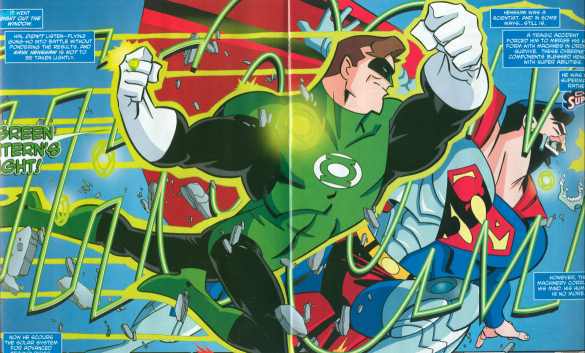
That’s the Hal Jordan we wanted to see. Beating up evil not-Superman specifically? No. Beating up bad guys while looking cool and being a bright light to the galaxy? Hell, yes!




Nice riff on the oath.
LikeLiked by 1 person
Thank you kindly. For the rest of the audience it’s what I used to promote the article in update subscriptions through e-mail & WordPress reader:
“In darkest day, in darker night, what evil is in my sight? Let those who enjoy Hal Jordan’s fight beware the suckage, Lantern’s lack of light.”
LikeLiked by 1 person
[…] of DC lately, though. Given how badly DC Studios is botching adaptations (including hiring people who don’t know what that means), seeing people who at least appear to want to get it right is a step […]
LikeLike
[…] have fan interests in mind. Damon Lindelof, who just wants to use a Brand to tell his stories and has a surface level view of what an adaptation is doesn’t have fan interest in mind. I’m not sure they have anyone’s interest in […]
LikeLike