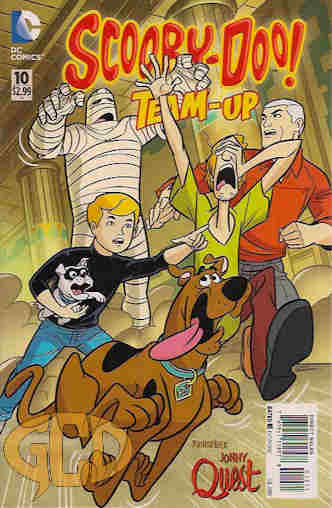
Scooby-Doo Team-Up #10
DC Comics (July, 2015; as featured in trade collection volume 2, posted to comiXology)
“Quest For Mystery”
WRITER: Sholly Fisch
ARTIST: Dario Brizuela
COLORIST: Franco Riesco
LETTERER: Saida Temofonte
Scooby-Doo Team-Up #10
DC Comics (July, 2015; as featured in trade collection volume 2, posted to comiXology)
“Quest For Mystery”
WRITER: Sholly Fisch
ARTIST: Dario Brizuela
COLORIST: Franco Riesco
LETTERER: Saida Temofonte

In the Clutter Report overview of The Merry Adventures Of Robin Hood a commentor explained why the author’s art was replaced by a high school artist. It was what I expected, and while I preferred the author’s art because it was the author Laura Winter’s art wasn’t too bad. The commentor also pointed me to this article that goes over the history of the Student Classics and the student artists who illustrated them. Apparently there isn’t much information out there about them.
Sadly I still don’t know why that one section was removed and I had to look it up online.

The year was 1938, which would see the debut of two influences from fake aliens. The first was Action Comics #1, which debuted among other characters the hero known as Superman. Unlike the Superman we know today his powers didn’t come from the Sun but because Earth’s gravity is lighter than Krypton’s. He couldn’t fly or had any special vision powers but he was superstrong, could leap an 8th of a mile and outrun a train, and while he was still bulletproof he wasn’t as invulnerable as he is today. The force of a bursting shell was the minimum to pierce his skin, and that was by 1938 levels. That wasn’t the only difference between the Superman of history and the later known iconic take on Superman.
1938 was also the debut of the Mercury Theater’s Halloween radio broadcast The War Of The Worlds. Loosely inspired by the H.G. Wells novel the setting was moved to then present day, with the framing device of a music broadcast constantly interrupted by a mysterious threat from the planet Mars. While the public reaction has been greatly exaggerated (one source suggesting it was the newspapers taking a shot at radio because radio news came faster than the twice-daily newspaper–and given modern reactions to new media I’m willing to believe it), the story still earned a place in our culture, and TV specials have used the same framing device.
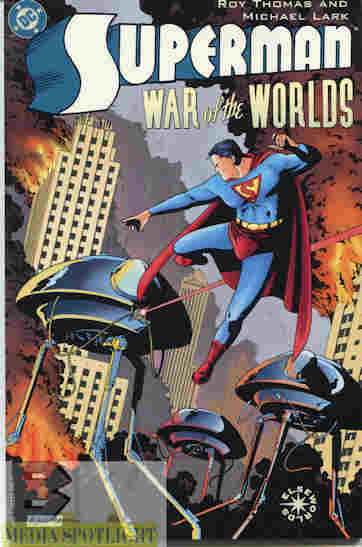
1999 may be a year late for the two stories to have an anniversary, but it’s the reason 1938 was chosen as the setting for one of my favorite Superman Elseworlds stories. Superman: War Of The Worlds uses the original incarnation of Superman while mixing elements of the original Wells novel and the Orson Wells radio drama and tells a story of what could have happened had this relatively weaker Man Of Steel had to protect the world from the other Red Menace.
Superman: War Of The Worlds
DC Comics (1999)
WRITER: Roy Thomas
ARTIST: Michael Lark
COLORIST: Noelle Giddings
SEPARATIONS: Heroic Age
LETTERER: Willie Schubert
Robotech Masters #8
Comico The Comic Company (May, 1986)
“Metal Fire”
ADAPTATION: Mik eBaron
LAYOUTS: Neil D. Vokes
FINISHED PENCILS: Reggie Byers
INKER: Keith Wilson
COLORIST: Tom Vincent
LETTERER: David Cody Weiss
EDITOR: Diana Schutz
Catch more Professor Geek on his YouTube channel.
Last night the CW brought their version of Superman to his own show. Debuting in Supergirl, Tyler Hoechlin has already been Superman for a while in the CW DC Universe, usually referred to as the “Arrowverse” due to the Green Arrow series Arrow being the start, like how Batman: The Animated Series started the DC Animated Universe. This also brings in Elizabeth Tulloch as Lois, who has also played the character in prior shows in this continuity. That’s kind of where the problem starts however. The Arrowverse is a darker take on the DC Universe, something closer to what DiDio was doing with DC when Arrow began. It’s like building a TV universe around the 60’s Batman or the old Adventures Of Superman series. Any further show that might have come out of that would reflect those shows. Look what Batman‘s producers wanted to do with Wonder Woman.
To give the Kents the CW treatment they created a second kid, decided to move the family to Smallville, and give everything the same overcast day except when they want to emphasize something. While I can’t say the show is all bad I do have a lot of issues with it that I’ll be going more into. Suffice it to say that if the show wants to win me over they have some work to do and they’re not off to the best start. There’s a difference between being a good show and a good adaptation. One episode isn’t enough to gauge the former but you can tell the latter is all kinds of wrong. Spoilers to follow.
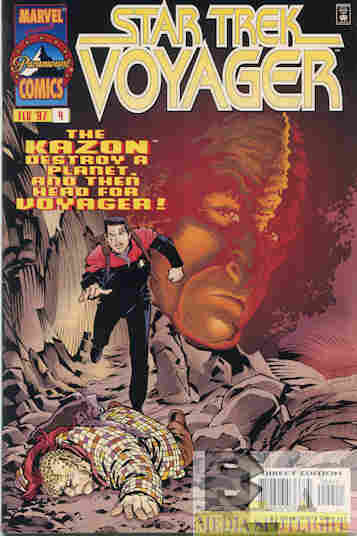
Star Trek: Voyager #4
Marvel/Paramount Comics (February, 1997)
“Homeostasis” part 1
WRITER: Howard Weinstein
PENCILER: Jesus Redondo
INKER: Sergio Melia
COLORIST: John Kalisz
LETTERER: Chris Eliopoulos
EDITOR: Bobbie Chase