

The story so far…
The Comedian is dead and nobody cares…because he was a scumbag who tried to rape one of his own team, treated the closeted gay man like dirt, killed his baby mama after she sliced him for abandoning her and their unborn child after winning the Vietnam War (alternate history), and treated everyone else like dirt as well. And yet he learned something and only Rorschach, one of the few remaining active superheroes, is curious what it is. In our last chapter the former Silk Spectre, tired of her boyfriend Doctor Manhattan seeming to lose his humanity, left him and spent time with the former Nite Owl II (not like that…yet), but returned to learn that during a talk show appearance, Doc Man was accused of giving his previous lover cancer just by existing (he did not, however, turn into a car…Harry Partridge lied to me!) and teleported the paparazzi away. Based, but then he ran off to Mars.
Skimming the omnibus I’m reading from we seem to have reached a part of the story that will focus on each of the heroes that make up the Watchmen, which I know is not a team name but it’s an easy way to group our main cast. Just letting you know I’m not stupid. (I’m only an idiot.) This gives us not only a chance to look at each of the heroes individually, but compare them to the hero that Alan Moore intended to use versus how they appear in the comic. Now it’s possible that the change in character from messing up newly bought licenses to do whatever you want original characters altered the plan. Still, it’s fun to think about what might have been, so let’s start here.

The Captain Atom DC inherited was Captain Nathaniel Adam, an Air Force expert in nuclear energy and weapons who got caught in his own rocket, blewed up real good, but because Charlton Comics was a Bronze Age universe operating under Silver Age rules (which might have been what hurt them having read and reviewed his various Charlton appearances), he not only survived but gained superpowers. He could alter his molecular structure, fire nuclear blasts, and he developed a special armor that could hide under his skin when he didn’t have his powers active while still protecting the outside world from his radioactive body. If none of that makes sense, welcome to Charlton. I found that happening a lot.
Doctor Manhattan, the only character in the book with actual superpowers because Alan Moore, has far more powers. We already saw him teleport an entire studio of people away and the Comedian noted there were a ton of ways Doctor Manhattan could have stopped him from killing the pregnant woman but didn’t. We’ll discuss the Captain Atom we did get but for now we can speculate what Captain Atom would have done. As far as going to Mars, Cap A once flew into space to fight a dragon that a kid could project himself into playing with Puff The Magic Dragon style when he slept, and fought numerous alien invaders, even going to their planet to beat them up. Let’s not pretend hanging out on Mars would have been impossible.
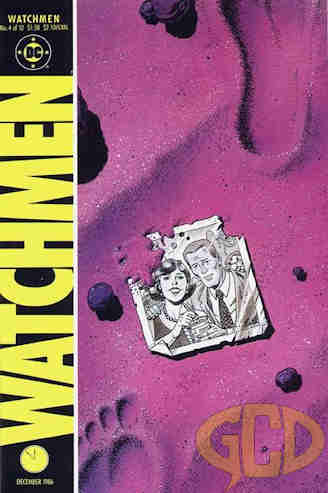
Doctor Manhattan is such a litterbug.
Watchmen #4
DC Comics (December, 1986)
“Watchmaker”
WRITER: Alan Moore
ARTIST/LETTERER: Dave Gibbons
COLORIST: John Higgins
EDITOR: Len Wein
The whole issue is told from Doctor Manhattan’s perspective with him providing the narration. I’m not going to necessarily blame this on Watchmen when there’s so many other things to pin on this book, but nowadays there’s always that question of who the characters are telling this story to because traditional narration is sadly left like Doctor Manhattan leaves the photograph. In this case it kind of makes sense. He’s not only contemplating recent events but his own past. The first segment is him reliving parts of time, showcasing the way he perceives time now, going back and forth between finding the photo, coming to Mars, dropping the photo out of boredom, and then going to watch the stars and contemplate what keeps them going and how long light travels to where he is. I kind of wonder why he bothered getting the photograph from an old bar, but from here we get a more linear sequence of events that led to Jon Osterman becoming Doctor Manhattan. Thank goodness. Instead we get time jumps to the present and future only as seques between the events of Jon’s life.
For example, in 1945 Jon is working on his dad’s old watch. His father is a watchmaker, but after the bomb drops on Hiroshima, Jon’s dad is convinced his son’s future should be in atomic energy, not realizing he just long term signed his son’s almost death warrant. I don’t know why he drops the pieces off the apartment fire escape. You’d think he’d still want his watch, and he’s still a watchmaker. The falling cogs help segway by showing the cogs of his own life falling into place. It’s a nice visual. Whatever issue I have with Moore’s content, don’t forget I still admire his skill as a writer. Yes, even when making porn…I assume he hasn’t fallen in every area as he’s gone slowly insane.
We jump ahead to Jon’s first day at Salt Flats. He meets his new pal Wally, who shows him around and takes him to a bar in the complex, the same one Manhattan got the picture from. That becomes foreshadowing as we learn his predecessor has his picture there after dying from a tumor. He also meets Janey, and we learn that his whole life someone else has made his decisions for him, including his father. This may explain why the guy with godlike powers doesn’t decide to do things like stop the Comedian from killing his Vietnamese “playtoy”. She buys him a drink and we fast forward through Jon and Janey’s romance, including the moment they took the photo.
At the park where the picture was taken, Janey’s watch is broken. Jon volunteers to fix it for her. They start hooking up after that, despite trying to tell the photographer they weren’t a couple. Time passes again and the watch is fixed but he left it behind in the test chamber with his coat. Nobody told him they were setting up another test and apparently nobody was paying attention that he was going into a chamber with a time lock safety feature before starting the next test. You can guess what happens to him and it isn’t pretty. Watchmen wasn’t released under the Comics Code Authority. Comic stores were already around and nobody was paying attention anymore like they when Wertham was rallying the country against those dirty not-books, so that’s not the only thing this issue gets away with.
Over the next few months Jon isn’t dead. Instead he’s trying to pull himself together, form a new body, giving the staff worries that the place is haunted. Nathaniel, in contrast, was in deep space and reformed himself rather quickly. It takes months of restoring his nervous system, then his muscles (no sign of his bones, the last thing to get vaporized should have been the first thing he built), and then finally appears in the bar section with blue skin and nothing else. Dave Gibbons could have put something in front of our view of Doc’s Manhattan, but this is written by Alan Moore and he probably insisted on him going the full monty. (Osterman, not Gibbons.) Janey instantly recognizes the naked bald blue man. I’ll let you make the joke.
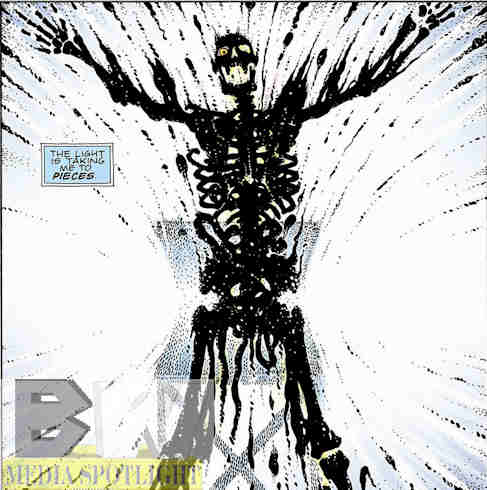
Yes, I’m more comfortable showing this than the naked blue man in the middle of a cafeteria. Call me a prude if you want.
Later, after present day Doc does more stargazing, we see Janey concerned about what might have changed, but we still see emotions from Jon. He says he’ll always want her. I don’t know if he had his time perception back then or not but now we can ask if that’s a lie given what we know happened now, but we also see how the government is deciding his future like his dad did. We saw how well that went. I wonder if he realized his son got barbecued because he talked him out of watchmaking? Jon never tells him he was alive and doesn’t reveal his name until later after his father’s death. Even in 2026 analog timepieces are still made and worn, so looking down on your own present was the wrong move, dad. They give him a costume, but he refuses to wear the helmet. They say it’s the only place to put his symbol, but Captain Atom had his symbol on his chest in both versions of his radiation shielding armor, which is where most superheroes have their symbols. Instead he opts for a hydrogen atom on his forehead, which the PR guy seems to approve of. The name Doctor Manhattan is created to put fear in America’s enemies in the 1960s, a clear reference to the “Manhattan Project” that led to the atomic bomb.
We fast forward to responses by heroes, Doctor Manhattan fighting crime by blowing a dude’s head off, something even Captain Atom wouldn’t have done, and then he’s talking to Hollis before Kennedy’s shooting. He’s aware of electric cars coming sometime later (earlier than in our universe, maybe), and later admits to Janey that he did know Kennedy was going to be shot. Time does bounce around a bit as present day Jon is remembering his growing connection to Laurie after meeting at the failed Crimebusters gathering, now shown from his point of view as more of his time perception is going off. This might actually be the ability that is robbing him of his humanity. Not the atomic restructuring or being able to see how molecules work. Time hold less and less meaning for him, but Janey assumes it’s because she’s gotten old and leaves him. Wally also dies of cancer, which we already know the paparazzo was also blaming on him and not working at an atomic testing facility even before the updated safety devices that led to Jon’s frying.
Our next visit is Vietnam during this alternate version of the war. We get the Comedian from his perspective and nothing new is learned about either man outside of the Vietcong surrendering because they have an, as he puts it, almost religious awe about the near naked blue man (he’s been ditching more and more of his costume as time goes on) that can grow giant size and blow them all up. Earlier he was telling Janey that he didn’t believe in God, but if there was one it wasn’t him. During the war flashback he also remembers that there was similar awe from the Japanese after Hiroshima and Nagasaki. I’ve not heard that before but I don’t know what research Moore did or didn’t do on that.
After present day Manhattan gets tired of looking at dead stars he decides to build something. We jump back to 1975 and Nixon wanting a constitutional amendment to allow him to run for office for a third term. I’ve been watching a documentary series on the various presidents up to Obama, the last president before the series was finished producing. The amendment was made to keep presidential powers in check, but frankly we need one now for Congress. Congress and the President have fought for “control” almost from the beginning of our country, and guess who proposes constitutional amendments.
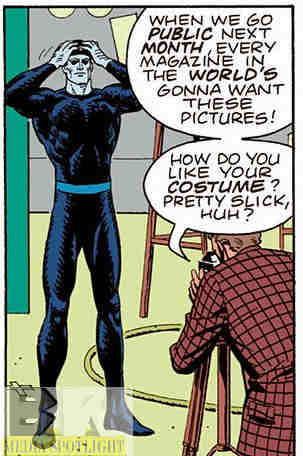
“Its bland, unheroic, and lame.” “It’s a government designed outfit.” “Exactly.”
Lost in that headline is Ozymandias announcing his retirement from the superhero world, so Doctor Manhattan and Silk Spectre II go to visit him. They’re introduced to Adrian’s genetically altered cat, Bubastis, who is a female cat creature thing. Harry lied to me again! He mentions something about Adrian’s sad eyes, but I’m assuming he’ll get his own focus issue down the line.
In the present, Doctor Manhattan finds a spot to begin building, and then another flashback. This is how he sees time, but it’s getting annoying. I’ve seen worse examples of going back and forth through time though. A protest of superhumans is going on in 1977, something at one time I would only say about a DC book if Glorious Godfrey was involved. That used to just be a Marvel thing, which is why I was a DC fan until that other bald guy showed up. Deciding Silk Specter’s attempts to break things up was taking too long he just teleports everyone to their homes, two people having heart attacks at the shock though Jon is sure there would have been more injuries or death given the rage of the protestors. Given some of what we’ve seen in the 2020s I’m not sure he’s wrong.
Later, vigilantes are now outlawed…in other words no more superheroes unless they work for the government. Rorschach continues on as usual, Nite Owl II and Silk Spectre retire (not that Laurie cares because she hated it), and the only heroes we’ve met that remain active through the government is Doctor Manhattan and the Comedian, who also breaks up the real world the Iran hostage crisis in their world. I’m betting in the new version Reagan didn’t get to become President as this was a key moment. Also, I think Moore hated him. I know Frank Miller did. Rorschach also killed a serial rapist and left it at the cops’ doorstep; again Moore not giving me the superheroes I want to see in favor of his cynical view of what a “real world” superhero would be like.
I can explain the events rather easily at this point. The problem from my side is describing how Jon’s memories and future knowledge jump all over as he builds a large structure on present day Mars. It’s not that he lacks emotion, if you ask me, it’s that there has been so much emotion from people who only see events as they happen and remember the past while he sees past, present, and future at the whim of some force that isn’t him.
Dr. Manhattan: Super-Powers And The Superpowers
Three pages that appear to be the opening of a book by Professor Milton Glass, just as we saw a glass structure made out of the sand of Mars. To be honest I tried to read it but it was a bunch of nonsense. The usual “we have poverty and war at home but we’re wasting money on the space program”, ignoring benefits that came from designing things for space travel that made their way here and the fact that throwing money at a problem doesn’t solve it. If we waited until we solved all the problems in the world before moving forward we’d never move forward. I just stopped caring what he had to say, so those of you with more patience than me can put up with this. I don’t think it’s going to matter to our main story and Op-Center has kind of ruined unnecessary flavor text for me.
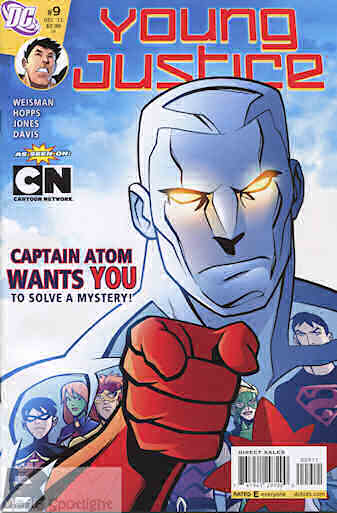
If this was the Charlton character…
I’m assuming there will be more of these focal issues in the future. (Doctor Manhattan knows for sure.) When we do I want to compare them to what DC ended up doing with the original character. We don’t know for sure that Moore would have kept Nathaniel Adam at the same power level of Jon Osterman, and you could make the case that Doctor Manhattan is even more powerful than Firestorm when it comes to restructuring things (though I have seen what they did with the concept recently where he’s split from Ronnie and turning people into sand for experimentation so I promise you I hate and want nothing to do with it–DiDio’s Darker DC continues without Dan DiDio). I’m pretty sure if this was a DC reader’s first introduction to the character it would reflect poorly on Captain Atom.
Not that he’s made a big splash. His appearance on Justice League Unlimited had him siding with Amanda Waller over the League even considering Waller was torturing the Question for information on the League. A soldier can disobey orders he feels are against America’s best needs. You wouldn’t agree to nuke Detroit (not that anyone would notice) just because your CO agreed to it. He’s a lot more military in more recent stories than he was in Charlton, and certainly more than Jon’s depicted here.
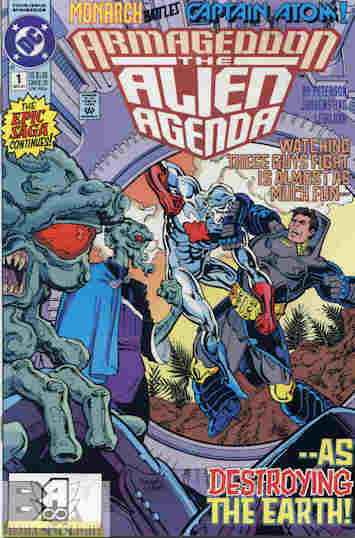
There’s also the problem of Monarch. The original ending to the 1990s event Armageddon 2001 was supposed to see him turn into Monarch and kill off every other superhero, believing they’d stop him from creating his utopia, which turned out to be so fascist that any mention of heroes was outlawed. That didn’t stop Matthew Ryder, who became the time being Waverider to undo what he did because as a kid a hero saved his life before Monarch’s attack. (That hero turned out to be Waverider himself because time travel stories are a mess.) However, this twist of the final issue (consisting of an open and close while Waverider’s mission was told through that year’s annuals, ended up leaking. DC editorial, or possibly the marketing department, decided the twist was more important than a proper sequence of events, and switched Monarch to Hank “Hawk” Hall, despite the Hawk & Dove annual showing he wouldn’t.
This led to Captain Atom actually fighting Monarch in the next series, The Alien Agenda while Waverider showed up for one final Armageddon: Inferno after. It also ruined Hank’s character, led to the second Dove’s death at future Monarch’s hands for the inciting incident (no, it didn’t make sense), and killed that series just for the sake of a twist nobody asked for, a hero turning evil. You could have had present day Captain Atom fighting his alternate timeline counterpart, a similar moment to Batman dealing with his “Justice Lord” counterpart in the Justice League cartoon. Instead we got this, and from what I’ve heard they still tried to make Captain Atom into Monarch decades later for some dumb reason. So it wasn’t Alan Moore that ruined Captain Atom, it was DC themselves. Good going, morons!
final thoughts
I’d say I’m glad this wasn’t Captain Atom, but it’s not like he faired any better. While it’s not clear if Moore would leave him this OP, and it would have been way off the mark if he did, this isn’t how I’d want to see the hero. This alone proves that making original characters was the better option. As for the story on its own, I wouldn’t want to read this story if not for the review and historical significance. Even I think he’s overpowered, they drained all the fun out of a character like this (I refer you to Firestorm in better times, or even Captain Atom) in order to make becoming a god tragic. His powers couldn’t exist in actual science so saying he’d be “unrealistic” otherwise is already lame. Moore decided to mess with his time perception, which is what’s ultimately causing him to leave humanity, even his own, behind.
That said, and I wouldn’t be much of a critic if I didn’t at least try to separate my biases from a critical view of the work on its own merits, the non-linear parts of the flashbacks are halted by the end of the story before it can become annoying if not for my previous experiences. As a backstory for this character, it’s not necessarily terrible. Most of this story’s problem comes from what it inspired, not the story itself–the whole superhero deconstruction through a grimdark cynical perspective. It’s sins are actually the sins of others: lazy writers more interested in using a gimmick than understanding it, thinking “if I did this people would love me”. That’s not how that works. We get a good sense of how things went wrong for a man trapped in the decisions of others who even after achieving near godhood was still doing what others wanted until it cost him the people he loved and his ability to love.
Or did it? We’ll see as time goes on. The next chapter seems more interested in the investigation of Eddie Blake’s murder and finally dropping all those “Tales Of The Black Freighter” parallels I hear was so important to the story. When I finally read chapter five we’ll find out.





[…] last time we looked at the origin of Doctor Manhattan and compared him to his inspiration, Captain Atom. A quick skim tells me this is more about the […]
LikeLike