

I have some time to do some buffer articles so it’s time to return to the Watchmen. Last time was a series of flashbacks of characters remembering their experiences with The Comedian. This is a guy who almost raped a woman, killed his Vietnamese baby momma (yes, she tried to cut his face–not a flare apparently, though that’s what it looked like to me at the time–but he was going to leave her when the Vietnam War ended), enjoyed the violence, had a strange idea to what the “joke” was about life, and it doesn’t seem like anybody liked him except Rorschach, who only saw his fighting bad guys and ignored what a bad guy he was.
Remember, Alan Moore considers Rorschach the baddie in this series even though he’s not the killer and believes in fighting the criminals. Others take the view that he’s not the one who killed the population of New York with a giant squid monster (or getting Doctor Manhattan to do it in the movie somehow) while Rorschach wants to fight villains. We have already seen that the world is not in the best of shape with the heroes in retirement. Unintentionally the world seemed brighter in the early days of the Minutemen. The colors were brighter, the sun seemed to be shining, and while the world got darker and colors more muted as we get closer to the story’s present day, it almost looks worse AFTER the heroes are legally banned.
Also, the story is already suffering the same mistake as The Incredibles in that the heroes gone should be making things easier for the supervillains and yet somehow they all seem to agree to the same law. They’ll kill, steal, and plot to take over the world, but THIS is the law they follow? Admittedly, we don’t see a lot of supervillains, but we have seen one retired villain in the previous issue so we can assume there were more. It doesn’t make sense and thinking about how Brad Bird used a similar law in his movie made me realize this mistake is happening here as well. We’ll have to see if that’s addressed as the next installment begins.
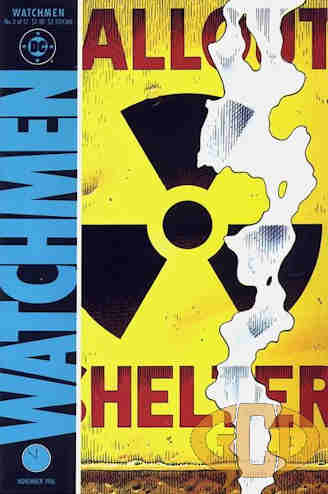
I just came for the free Pip Boy.
Watchmen #3
DC Comics (November, 1986)
“The Judge Of All The Earth”
WRITER: Alan Moore
ARTIST/LETTERER: Dave Gibbons
COLORIST: John Higgins
EDITOR: Len Wein
Okay, those of you who actually read this story (the movie doesn’t count, and maybe not the motion comic either–I’m talking to actual readers). Does Tales From The Black Freighter really matter? One early research source seemed to indicate that it wasn’t in the story despite years of hearing it was. Well, we start this story off with some kid trying to ignore a rambling newsstand owner while reading a comic clearly not for his age group (I can’t speak to the actual DC comic it’s based on). Apparently it’s also not a real comic, just one that exists in the Watchmen universe before Moore believed that in a superhero world nobody wanted to read about superheroes. Explain war comics and police comics then. Not that it matters because context is lost on me. Apparently this is being used to speak on the story but all we have is some dude on an island talking about his ships woman-like masthead. We don’t even see all of the panels in this sequence, as we keep looking back at the newsstand owner. And the pages keep coming up during the story as the kid keeps coming back to read the same comic over and over. He doesn’t even look like a kid that would be into this kind of pirate comic, superheroes or not.
The man only stops his rambling when a guy with a “the end is nigh” sign, something else that pops up in the story and was the subtitle for a tie-in game to the movie adaptation. He’s convinced the world will end today, but asks the newsstand owner to save his paper for tomorrow. Okay. Symbolism is not always my strong suit. I can tell it exists at times but not always what it’s pointing to. The Black Freighter story of all his dead men around him washed up him on the island, the guy who wants his paper saved for tomorrow after the world ends, the fact that “Institute For Extraspacial Studies” is on the wall inside the stand (that could be foreshadowing–remember that I review as I read for these deeper dives unlike the daily comic reviews, only tossing stuff in earlier paragraphs as I feel it fits better), and the building in the background being labeled a fallout shelter by a man in a hazmat suit. I know they’re there but not what they mean. Perhaps that will be revealed as it goes on but all I have is a comic with no context, an idiot, a newspaper seller yelling that they should nuke the Ruskies and call it a day, and a paranoid with bad science knowledge. Bet he’d try to duck and cover when the bombs dropped, but by the 1980s we knew in our world that wouldn’t work.
Sure, I could look it up. There’s a section of the fan wiki pages on these issues going over it. However, I shouldn’t have to. If I don’t get the symbolism while reading it, it feels pointless to me. I’m against highbrow stuff but be prepared to see it not work for everyone. Maybe in a second read I could pick up on more of it without a wiki. Each book so far has done that annoying thing of adding a quote from something that makes it sound so sophisticated, but seeing how many bad writers use it in place of actually making a point because they didn’t understand why it worked, I’m kind of numb to the whole thing, even under a good writer like Moore (whatever I may think about his content personally). I shouldn’t have to do research to enjoy a story and I’m not going to remember everything I learned in school as a kid, and that’s considering I had the teacher who covered that stuff. Every teacher, even good ones, have their own perspectives about the minutia of history.
I can at least guess that the unnamed captain’s comment about the wooden woman being someone he can’t love connects to Laurie waking up in bed with her husband…and her husband? Yes, somehow Doc M thought he could please her with a threesome involving two of himself, while a third was busy doing research. Alan Moore, ladies and gentlemen. Not surprising there’s no “Comics Code Authority” symbol on the Grand Comics Database version of these covers. I don’t see them supporting this one. She gets mad and leaves, the leaving going back and forth with his previous lover, Janey. It seems she has cancer now, for which she blamed Doctor Manhattan, but as she’s being interviews by a writer from the Nova Express newspaper we learn that he dumped her for a younger model because he doesn’t age. She might be a bit bitter. So she’s dying and wants to expose his alleged part of it.
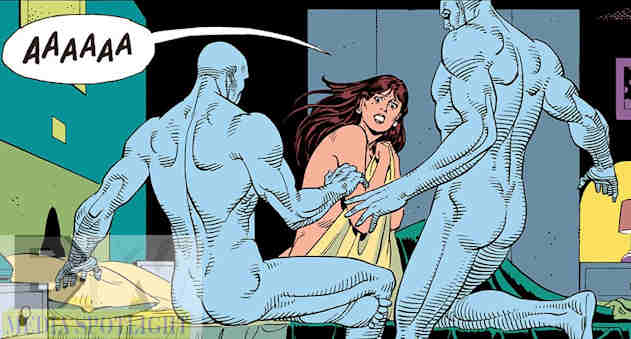
The porn parody doesn’t have to write itself. We have Alan Moore for that.
Laurie ends up at Dan’s place, nearly falling apart after the break-up, and she makes it clear she’s fully left him. This isn’t going out for a walk. This is also intercut with Doctor Manhattan getting ready for his interview, and this could be a “just me” moment. All this back and forth is annoying. I know it sets up “real time” but we had the first section going between the comic and the newsstand, the previous part between Laurie’s leaving and Janey’s declaration, and now between Laurie going to Dan and Doctor Manhattan getting ready for the interview at home and at the studio. I like to follow one event at a time unless the two events are supposed to match up, and they don’t Do the part of Dan and Laurie talking, the locksmith installing his new lock (not that it helps; Rorschach still breaks in easy later) suggesting his brother’s cab company as they prepare to go to Hollis’ place, then backtrack to the doc teleporting into the studio, upsetting the host, and darkening his skin (bluer, not what the HBO series did) to show off to the reader what he can do. The point is to show how out of touch with emotions and humanity he’s become or at least becoming, but it’s just not my style.
This routine continues as the pair are attacked by muggers while the blue hero is having his interview. Naturally two former superheroes have no problem cleaning their clocks (pun semi-intended) so we’ll focus on the press conference, where we first get his other name, Jon Osterman. Before then we have a first but I might have missed a last name. It starts with being asked about some situation in Afghanistan and if he’ll get involved. His handler told him to avoid that question. Then the other reporter jumps up, not only mentioning Janey’s cancer, which Jon knew nothing about, but other people he had been around, including Morloch (the supervillain from the previous issue that the Comedian visited). Jon knew about the first person he mentioned, I’m guessing Jon’s “Golden/Silver Age” sidekick, but not any of the other names. The reporter then insists that it was Doctor Manhattan who gave them all cancer by being around him, since we’ll learn his backstory does involve radiation, like his inspiration Captain Atom.
Now all the reporters try to get in on barraging him with questions. Doctor Manhattan…right, I have a shorter name now…Jon lets the stress him him and just screams for everyone to leave him alone, teleporting everyone outside the studio. Could be worse, folks. Could be a cornfield. Jon returns home to see a nuclear warning sticker being put on his door. Laurie of course knows none of this as she heads to find a hotel for the night to rethink her relationship, but Hollis shows Dan on the news that this all went down.
“…because I’m not convinced the writer is.”
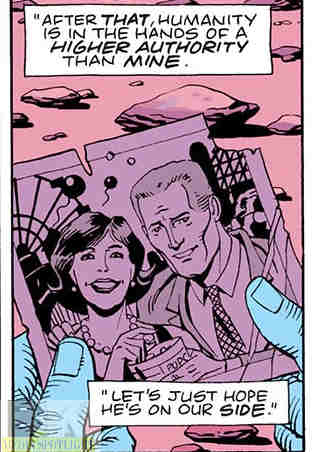
Doctor Manhattan visits, and vaporizes what I think is his old lab and then goes to Mars. All he brings with him is a picture of him and Janey. So maybe he hasn’t lost all his humanity or stopped caring about her? Back on Earth, Laurie returns home to get blame for his leaving and his handler demanding she get screened for cancer. The newsstand owner just gives the kid the comic, which ends on a cliffhanger and ticking him off, because the Russians are in Afghanistan. (Any historians want to take this one? I’m still burned out from Op-Center and that was two novels ago as I write this.) We get another back and forth with Manhattan on Mars looking at Janey’s picture and the war room of the President seeing what might happen if both sides start tossing nukes, and it’s not the best picture for the US East Coast and Mexico. This one kind of works. The world could use him and it looks like him leaving is what convinces the Soviets now is the time to start World War III. This story is also ending on a cliffhanger.
Under The Hood
I had to stop reading this fifth chapter, the last one presented in the comic as far as I’m aware, partway through. For one thing I needed to stand up and move around a bit, but what annoyed me was exactly why I never read this book until fate forced it on me. Hollis talks about how it stopped being fun after the McCarthy hearings came for superheroes forcing them to reveal their identities and a trend away from costumed villains after the heroes were forced out of costume. I’m not sure how much research the British man did about the House Un-American Activities Committee, which did target celebrities; this is why I believe is one of the reasons the Hollywood system to this day hates Republicans. The press stopped covering their activities as much, and Hollis got bored with the whole thing. Not that he was getting old. Not that something happened to him. It wasn’t “fun” anymore. @#%#$$ THAT!
This isn’t why people became costumed crimefighters even without superpowers, or rather why we readers loved them. It was that the criminal element had found so many ways to either bypass or intimidate the authorities that there was only so much they could do without enacting the kinds of restrictions reserved for wartime security or a certain pandemic. So the general public had to step in to help, but how could they? Superheroes were a catharsis, seeing them tackle the mobsters, foreign spies, and other threats we normal people couldn’t. Within a superhero universe, it’s because they wanted to help the police but because the system by necessity could be too restrictive they could go outside it and stop their criminal schemes. It wasn’t for fun but because it was the only way to stand up. Even when supervillains arrived and superpowers started coming into play, the heroes now stood up against villains too evil for the police and other law enforcement agencies couldn’t handle because there’s no way they’d be equipped to deal with them. They needed a Superman or an Iron Man to fight what they couldn’t without a bigger budget and a worried public. Look how many people complain about cops with “military equipment” right now, and that’s just an exaggeration. So unless a superhero is in the area during a bank robbery or a mugging they usually leave that to the police while they fight the villains the law can’t touch.
What really sent Hollis into retirement and auto restoration was the debut of Doctor Manhattan and a new crop of costumed heroes. I don’t see the big deal about feeling obsolete with superpowered heroes when there’s only one, singular instead of plural. I’m not bothered by the retirement, but the REASONS given, especially the part of how it wasn’t “fun” anymore and the press were ignoring them. I kind of like heroes who tried to stay out of the press, like Superman early in his career.
So I’m a bit more negative to this issue. I don’t like the back and forth scenes, I don’t like Moore’s view on superheroes, and as far as Doctor Manhattan, I know where that one ends up as far as the “causing cancer” stuff. I’ll save that for when we get there as this series continues.





haha! title a reference from Alexander and the blah blah blah very bad day.
LikeLiked by 1 person
For the confused the reference is in my promotional text for the article: “AKA “Doctor Manhattan And The Terrible, Horrible, No Good, Very Bad Day” Thanks.
LikeLike
[…] something and only Rorschach, one of the few remaining active superheroes, is curious what it is. In our last chapter the former Silk Spectre, tired of her boyfriend Doctor Manhattan seeming to lose his humanity, left […]
LikeLike