

I tried getting myself to re-read the previous issue. I wondered if reading it as intended rather than the way I read it to review it if I might get a better experience. I don’t think I would. Maybe the constant character switching would be less jarring but the story itself wouldn’t change. It’s still not the superhero experience I wanted. Still, it made me do this issue a bit different. I usually like to do the intro before the review, like I do with Chapter By Chapter, give my thoughts going into the comic. I probably could have still, but I opted to read the chapter first this time, since we’re focusing on one character: Rorschach.
Rorschach is an interesting figure in discussing Watchmen. For Alan Moore he’s the baddie in this story. Maybe not evil, but you can tell from the story how much he hates the character. Rorschach was originally going to be The Question, specifically the original Charlton version by Steve Ditko. If you only know Vic Sage from Justice League Unlimited, you don’t know Ditko’s creation. Having read the old Charlton adventures Vic was very outspoken in his own identity as a news commentator. Yes, they had those before the 24 hour news cycle needed something to fill in time. Ditko was inspired by the writings of Ayn Rand, and for a far-leaning liberal like Moore that had to be the worst kind of character…and back in the 1980s that wasn’t even as left-leaning as some of the more extreme views today. (This is the end of the political commentary outside of examining the character himself.) So Moore wants us to hate Rorschach.
This is not what has happened, at least not by the people I follow who discuss Watchmen. To them, Rorschach is the hero of the story. He’s the only one investigating the murder. He’s the only one fighting crime because he feels it’s the right thing to do. His hero-worship of the Comedian is off-putting as is his brutal nature, so that puts me off. However, he actually believe in good and evil, right and wrong, and wanting to clean up the criminal underworld. I disagree with his methods and the specifics of his worldview, but I kind of see why some comic commentators see him as the real hero. You may not agree with the assessment by the time we’re done, but you may understand it.
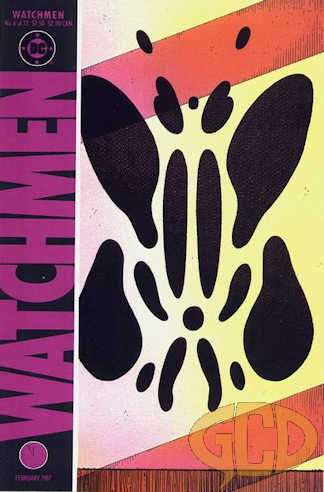
I see a man dreaming he’s a butterfly. A very violent butterfly.
Watchmen #6
DC Comics (February, 1987)
“The Abyss Gazes Also”
WRITER: Alan Moore
ARTIST/LETTERER: Dave Gibbons
COLORIST: John Higgins
EDITOR: Len Wein
I’m not going to do a linear review of this chapter. The story is told through the notes of psychologist Dr. Malcom Long, with the text coda this issue being the arrest record of Walter Kovacs, aka Rorschach. Through his notes and Walter’s examination, plus the arrest record and a psychiatric history report from the New York State Psychiatric Hospital filling in a few gaps, we get the backstory of Rorschach. It’s very well told through these vehicles. The record even has a stain like someone put their coffee mug on it, the occasional typo, and some extra material: two letters and a drawing from his time in the Charlton Home For Problem Children. I’m going to go over Rorschach’s backstory, and then discuss Dr. Long’s part of the story.
Rorschach did not have a good upbringing. His father disappeared before he was born. The mom said she kicked him out. Walter thinks his dad just left or maybe died in the war. There’s no definitive record on what happened to him, just that his name was Charlie. We only see two moments from his childhood. When he was five he walked in on his mother about to have sex with her client, because she was a prostitute. She doesn’t take it well, and the text material suggests this is the first time he interrupted a client, while everything else suggests this wasn’t the first time he was beaten.
The other comes from when a couple of older bullies target him in an alley. They chastise him for his “whore” mother and shove him down, his face being covered in mud. Then one of the boys prepares to sodomize him, but with the mud on the usual relaxed but emotionless Walter snaps, and shoves the kid’s lit cigarette in his enemy’s eye. This is when the police finally take notice of his life and pull him out of there. Walter doesn’t explain why he did it. I’m not sure why. I guess his strange form of justice hadn’t kicked in yet. It’s not really explored. At sixteen, he learns his mom was killed by her pimp and he only has one reply: “good”. You can see what formed Walter’s persona issues and his belief in justice. A sympathetic backstory alone doesn’t redeem a character, something too many writers today seem to forget in their attempts to humanize and even condone supervillainy. I think we can at least agree Rorschach is not a good man, just the only actual crimefighter in this story about costumed crimefighters.
As an adult, Walter takes on a job at a clothing manufacturer. This is how he gets his shifting mask. The cloth is made of a fabric created by Doctor Manhattan, which explains how the black moves. The client found it ugly and refused to take it, so he brought it home and cut it until it didn’t resemble a woman. He hasn’t shown any resentment towards the women in the story, but given his mom, would you be surprised if he had any? The only other women we’ve seen him interact with are the two Silk Spectres, and barely that in flashbacks. It’s as good an explanation as any. Outside of Doctor Manhattan and Nite Owl’s ship later there isn’t much in the way of the fantastical in this “grounded” superhero story.
When he reads the client was murdered two years later, and given everything else–his mom, the bully, the specifics of the client’s murder that I’m not comfortable going over while people either watched or ignored it–that’s when he finally decides to use the mask to become Rorschach…though in his mind it was just Walter as Rorschach. It didn’t become his identity, his face, until years later, after he and only the Comedian continues fighting crime. The Comedian did it for the government, and I’m assuming Rorschach wasn’t privy to Blake’s other activities (like impregnating a woman and then killing her when she got mad at him for leaving after the war and tried to scar him, or the attempted rape of the first Silk Spectre) and only saw him fighting for his country. That’s when he “truly” became Rorschach, the mask now being his “true” face. I don’t buy it with Batman but I see how it feels that way to Rorschach.
This is told to us primarily through Dr. Long, and it’s through him that we see Rorschach’s effect on him. When the story begins we learn Long just sees this case as his path to fame, which Rorschach himself figures out. If Long can cure a case as severe as Korvacs’ he’ll be famous. Instead, he becomes obsessed with the case, infuriating his wife. Walter/Rorschach also messes with him. One ink blot reminds him of a dead dog, but he says it’s a butterfly. Another reminds him of his mom with one of her johns, but he says it’s flowers. Long tries to get a real answer out of him with the first image, which is what we see on the cover, and he finally tells the story that made him fully transition from the traditional hero to the more violent version we know today. He takes a case rescuing a kidnapped child, falsely believed to be the daughter of a rich man. This one I have to sadly give more detail for. Be warned for the next paragraph.
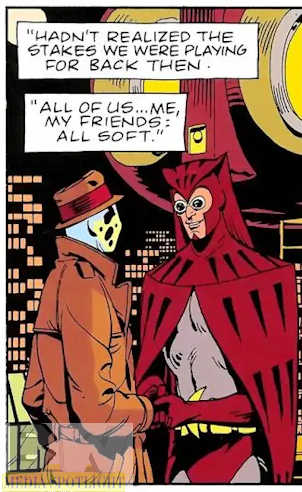
A rare instance of Rorschach in his less violent years. Note how clean his outfit and mask are.
When Rorschach arrives the kidnapper is out drinking and Rorschach sees the two german shepherd guard dogs fighting over a bone. When he sneaks inside all he finds is the little girl’s dress and a series of butcher tools. I think you can imagine the rest. He did, and uses the cleaver to kill the dogs, and when the kidnapper comes home, insisting he wasn’t involved, Rorschach handcuffs him to an expose pipe and sets the building on fire. He leave a hacksaw that won’t cut the pipe in time. You can also guess what it can cut off.
This was when “Walter” was replaced by “Rorschach”. He doesn’t like when Long calls him “Walter”, and over the course of a few sessions, possibly after that moment, Long is not the same. Throughout the story he has trouble believing that his history with his mother had any connection, nor the ugly murder of the client despite the obvious influences to those of us willing to accept Rorschach as he is. When he tells Long that story, however, something changes. He has to fight to call him Walter. His relationship with his wife, already a bit strained (sidebar: the use of their silhouettes, matching what was going on with Walter’s mom and one of her clients in the second ink blog was interesting, but not being good at symbolism I know I’m only guessing it showcases their relationship), gets worse. At the end Long is a pretty broken man, though not quite on Rorschach’s level of broken.
Even through the story we see Walter doesn’t want to talk at all. When the prisoners remind him of the bully incident he’s ready to talk a bit more. The word balloons are still normal, not Rorschach’s usual style, but he still starts speaking more like Rorschach. He’s not fully himself without his mask, his “face”. Gibbons always gets credit for his art, but let’s give him a hand for how he uses word balloons and lettering to spotlight the difference between the two personas. It’s a clever use of the text side of this medium that is both visual and written.
There’s also an incident in the prison where one of the other inmates tries to tease Rorschach with a shiv in the food line. I would be surprised if he was planning to kill him then, but I don’t know much about prison life, thank you Jesus. Rorschach tosses some baking fat at him, telling everyone “I’m not locked in here with you, you’re locked in here with me”. It’s a famous line from this book, and I remember it from an issue of Battle Of The Planets, the good one from Top Cow, where Mark delivers that line to the Spectra agents just before G-Force wipes the room with them. It’s a good line and it came from here. Too bad it’s delivered off-panel in one of Long’s reports rather than showing him saying it.
Overall the chapter gives us a great deep dive into Rorschach’s mind and origins. Does it make him a hero? I’m still not a fan of his methodology and this may well be Moore taking a shot at Ditko’s philosophy…so good thing this didn’t ruin the Question, though most people are probably more tied to his conspiracy theory nut angle in Justice League Unlimited. What makes him seem heroic compared to the others is that he still wants to fight crime, still believes in justice, and still wants to be a crimefighter. The others either give up or join the other side. It’s more that he’s more of a hero than the rest of the characters, including the Comedian. One of those commentators I mentioned, Gary from Nerdrotic, stated recently that Moore’s goal was to “put the final nail in the coffin of traditional superheroes”, and this book is most certainly ground zero for that. I also like how imagery is used in telling Rorschach’s story. Whatever I think of the character himself, this was a chapter I actually didn’t hate…which is the best praise I can give a book in such strong contrast to what I want to see out of superhero stories.
When next I convince myself to read this book we’ll pop in on the former Nite Owl II and Silk Spectre II. I’m betting that other famous moment is in this one.





[…] feels like one of those aforementioned soap operas where I am right now (having recently finished issue #6 in that review series), this has the time for minor character development. It’s setting up Kevin’s backstory […]
LikeLike